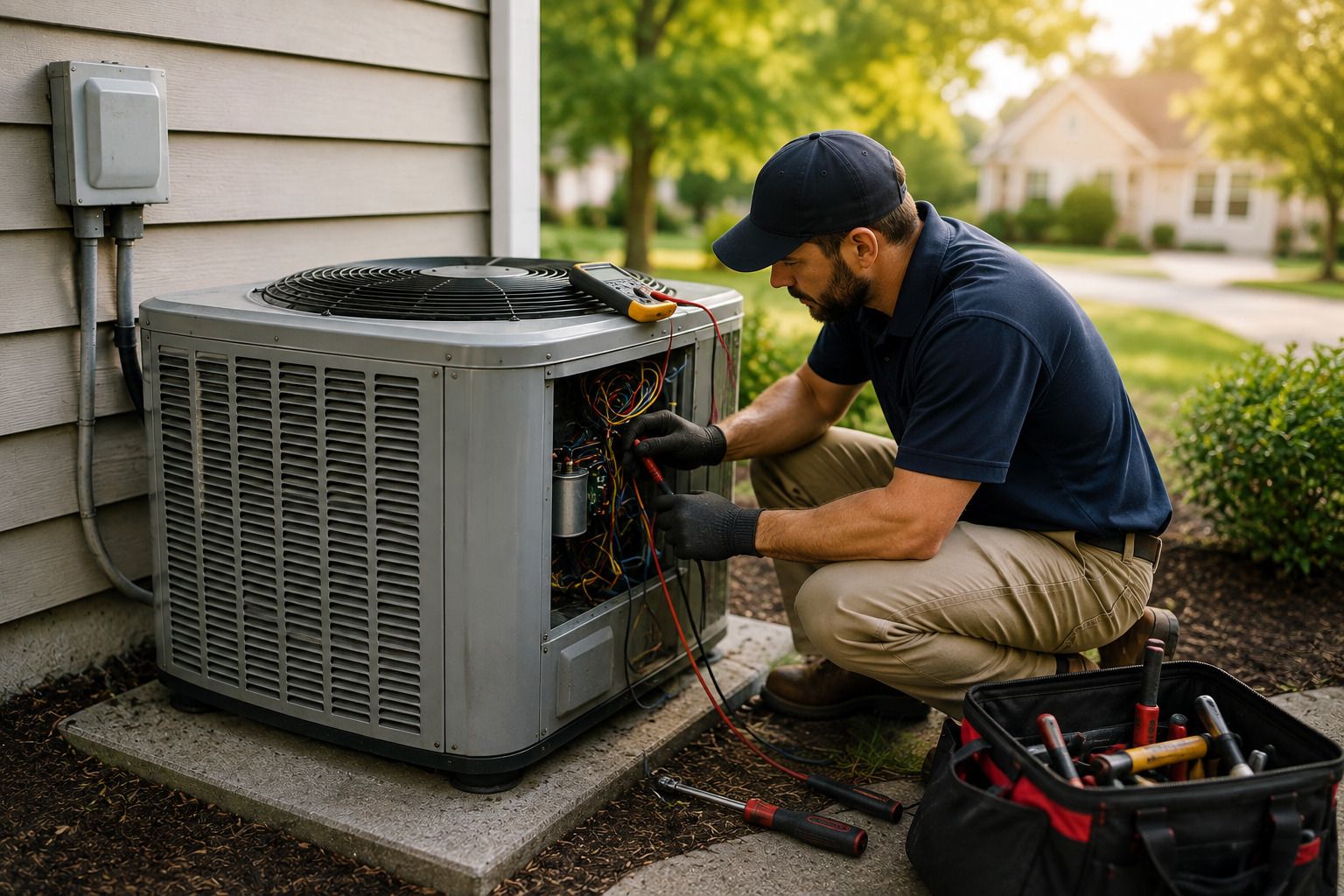
Why Your HVAC System Keeps Breaking Down in Glen Burnie: Common Problems Homeowners Shouldn’t Ignore
Living in Glen Burnie means your HVAC system doesn't exactly get an easy job. Maryland weather can go from a chilly winter morning to a warm afternoon and then throw a humid summer at you a few months later. Your heating and cooling system has to handle freezing temperatures, sticky humidity, pollen, storms, and plenty of long days when the AC seems to have one mission: keep the house from turning into a toaster.
That's why HVAC problems in Glen Burnie often become noticeable at the worst possible time.
Your furnace waits until the coldest night of the year to start acting strange. Your AC decides to stop cooling right when the temperature climbs above 90°F. And that mysterious noise you've been ignoring for three months suddenly becomes loud enough to sound like somebody dropped a toolbox inside the unit.
The good news is that many HVAC failures don't happen completely out of nowhere. Your system often gives you warning signs before a major component fails. Knowing what those signs mean—and knowing when to call a professional for HVAC repair in Glen Burnie can help prevent a minor problem from turning into an expensive emergency.
Glen Burnie's Weather Puts Your HVAC System Through the Ringer
An HVAC system has to work harder than most homeowners realize. During summer, your AC isn't simply lowering the temperature. It is continuously removing heat and moisture from the indoor environment. During winter, the heating system has to maintain comfortable indoor temperatures while cold outdoor air constantly tries to make its way back inside.
Glen Burnie homeowners also have to deal with changing humidity, pollen, storms, and outdoor debris. All of these conditions can affect HVAC equipment over time.
The result is fairly predictable: components wear out, filters become clogged, coils collect dirt, electrical connections deteriorate, and airflow gradually becomes less efficient.
Your HVAC system doesn't necessarily go from "perfectly healthy" to "completely dead" overnight. More often, it starts working a little harder, running a little longer, and making slightly stranger noises until somebody finally notices.
Your AC Is Running Constantly but the House Is Still Hot
One of the clearest signs that your cooling system needs attention is when it runs for long periods without bringing the house down to the temperature you've selected.
During a particularly hot Maryland afternoon, longer AC cycles aren't necessarily unusual. The problem is when your system seems to run continuously and still can't maintain a comfortable indoor temperature.
There are several possible explanations. A dirty air filter can restrict airflow, while a dirty evaporator coil can interfere with heat transfer. Low refrigerant, a failing blower motor, ductwork problems, or a struggling outdoor condenser can also reduce cooling performance.
Sometimes homeowners respond by lowering the thermostat another five degrees, hoping the AC will "try harder." Unfortunately, the thermostat isn't a turbo button.
If your Glen Burnie home remains warm while the AC runs constantly, a local HVAC technician can inspect the system and determine what is actually preventing it from cooling properly.
Strange Noises Are Your HVAC System's Way of Complaining
Every HVAC system makes some noise. You should expect to hear a blower running, a condenser fan operating, or the normal startup and shutdown sounds of the equipment.
What you shouldn't ignore is a sudden change in those sounds.
A new buzzing noise may indicate an electrical problem. Grinding can point toward a failing motor or bearing. Rattling may mean something has become loose. Screeching can indicate a problem with a motor, belt, or another moving component.
Then there's the dreaded banging sound.
If your HVAC unit suddenly sounds like someone is throwing bowling balls into a metal box, don't assume it will fix itself.
Ignoring unusual noises can allow a relatively small mechanical problem to become a much more expensive failure. A professional HVAC technician can identify where the sound is coming from and determine whether the system needs a simple repair or more extensive service.
A Dirty Filter Can Cause More Trouble Than You Think
The humble HVAC filter doesn't look like an exciting piece of equipment.
It is, however, one of the most important maintenance components in your system.
The filter catches airborne particles before they travel deeper into the HVAC equipment. As it collects dust, pollen, pet hair, and other debris, airflow can gradually become restricted.
That means your blower may have to work harder to move air through the system.
During Glen Burnie's pollen-heavy seasons, filters can become dirty faster than homeowners expect. A filter that looked perfectly fine a few weeks ago can be noticeably clogged later, particularly in homes with pets or high indoor activity.
Replacing the filter according to the manufacturer's recommendations is one of the simplest things homeowners can do to help maintain proper airflow.
But if replacing the filter doesn't solve the problem, don't keep changing filters and hoping for a miracle. The restriction could be somewhere else in the system.
When Your AC Blows Warm Air
There are few things more annoying than turning on your AC during a hot Glen Burnie afternoon and discovering that the vents are blowing air that feels suspiciously close to room temperature.
Warm air can result from several different problems.
The thermostat could be malfunctioning. The outdoor condenser might not be operating. The evaporator coil could be frozen. Refrigerant could be low because of a leak. The compressor could have a problem, or an electrical component could have failed.
This is one situation where guessing can become expensive.
Replacing a thermostat when the actual problem is a failed condenser component doesn't solve anything. Adding refrigerant when the system has an unresolved leak doesn't solve the underlying issue either.
A professional HVAC technician can test the system and narrow down the actual cause before recommending a repair.
The HVAC Contactor Can Cause an Outdoor Unit to Stop Working
One small electrical component that can create surprisingly large problems is the HVAC contactor.
The contactor acts as an electrically controlled switch that allows high-voltage power to reach components such as the compressor and condenser fan motor.
When a contactor starts failing, the symptoms can be confusing. The outdoor unit might fail to start, make repeated clicking or buzzing sounds, or operate intermittently. In some cases, homeowners may hear the system attempting to start without the condenser operating normally.
Because the component is part of the high-voltage electrical system, this isn't something to experiment with using household tools.
If the outdoor unit isn't starting properly or is producing unusual electrical sounds, contact a qualified HVAC contractor. A professional technician can test the electrical components and determine whether the contactor is actually responsible.
Why Your Furnace Might Struggle During a Glen Burnie Winter
HVAC problems aren't limited to summer.
When winter arrives, your heating system becomes the most important appliance in the house. If the furnace begins cycling on and off repeatedly, takes too long to heat the home, produces unusual smells, or struggles to maintain the thermostat setting, something may be wrong.
A furnace that constantly turns on and off can be experiencing airflow restrictions, thermostat problems, overheating, ignition issues, or other mechanical and electrical problems.
Some homeowners wait until the system completely stops before calling for HVAC repair in Glen Burnie.
That's understandable, but not necessarily the best strategy.
If the system is already behaving strangely, having it inspected before the coldest part of winter can potentially prevent an inconvenient breakdown when you need heat the most.
Uneven Temperatures Could Point to an Airflow Problem
Does your downstairs feel perfect while the upstairs bedroom feels like a different state?
Uneven temperatures are extremely common in homes and can have several causes. Ductwork design, leaks, insulation, blocked registers, restricted airflow, blower performance, and equipment sizing can all influence how evenly conditioned air reaches different areas.
Closing vents in rooms you don't use isn't always the solution. Your HVAC system was designed to move a specific amount of air, and randomly closing registers can affect system pressure and airflow.
If one area of your house is consistently too hot or too cold, a local HVAC technician can evaluate the system rather than simply telling you to move the thermostat.
Sometimes the problem isn't the temperature setting.
It's how the conditioned air is getting there.
High Indoor Humidity Is More Than an Annoyance
Glen Burnie's summer humidity can make a 78°F room feel significantly warmer than the number suggests.
Your air conditioner normally removes some moisture from indoor air while it cools the house. If the system isn't operating efficiently, indoor humidity can remain high even when the AC appears to be running.
You may notice that the house feels sticky, certain rooms feel damp, or the thermostat says the temperature is acceptable while everyone inside still feels uncomfortable.
High humidity can have multiple causes, including cooling problems, inadequate airflow, equipment sizing, ductwork issues, or drainage problems.
A professional HVAC contractor can evaluate the system and determine whether the AC is actually removing moisture as it should.
Don't Ignore a Repeatedly Tripping Breaker
A circuit breaker that trips once deserves attention.
A breaker that repeatedly trips whenever your AC or furnace operates deserves immediate attention.
The breaker is designed to interrupt electrical power when it detects an unsafe condition. Repeatedly resetting it without finding the underlying cause isn't a repair.
The problem could involve a capacitor, contactor, compressor, damaged wiring, motor, or another electrical component.
If your HVAC system repeatedly trips the breaker, turn the equipment off and have a qualified technician investigate it.
Your electrical panel is already doing its job.
You don't need to argue with it.
When Is It Time to Call an HVAC Professional?
There are plenty of HVAC tasks homeowners can handle themselves. Replacing an air filter, keeping the outdoor condenser free from leaves and vegetation, and making sure vents aren't blocked are all reasonable maintenance tasks.
The line changes when you're dealing with refrigerant, electrical components, gas-fired equipment, compressors, motors, or repeated system failures.
Call a professional HVAC technician when your system is making unusual noises, repeatedly freezing, blowing warm air, cycling excessively, tripping breakers, producing unusual smells, or failing to maintain the desired temperature.
The objective isn't simply to get the equipment running again.
A proper HVAC repair should identify why the problem happened in the first place.
Otherwise, you may find yourself paying for the same problem twice.
Repair or Replace? That's the Question
Not every broken HVAC system needs to be replaced.
A failed capacitor, contactor, thermostat, motor, electrical connection, or other individual component may be repairable without replacing the entire system.
On the other hand, an older system with repeated breakdowns, serious corrosion, major refrigerant problems, poor efficiency, or a failing compressor may make replacement a more sensible long-term decision.
This is where an experienced HVAC contractor can provide useful perspective.
A good technician should be able to explain what failed, what it will take to repair it, how the rest of the system is performing, and whether the repair makes financial sense given the equipment's age and condition.
The goal isn't to automatically sell you a new system.
The goal is to find the solution that makes sense for your home.
Keep Your Glen Burnie HVAC Ready for Whatever Maryland Throws at It
Glen Burnie homeowners don't get to choose the weather. One day you're wearing a hoodie, and a few months later you're wondering why your driveway feels hot enough to cook breakfast on.
Your HVAC system has to be ready for both.
Regular maintenance, timely repairs, clean filters, good airflow, and professional inspections can all help keep the system operating reliably throughout the year.
And when your AC starts making a noise that sounds like a lawn mower trapped inside a washing machine, don't wait for it to become a full-blown emergency.
Call a local HVAC technician such as QualityHvac and have the problem diagnosed.
Whether you need AC repair, heating service, electrical troubleshooting, or a complete HVAC evaluation, getting professional help early can prevent a small issue from becoming a much larger headache.
Because when Maryland decides it's time for a heatwave, the last thing you want is your HVAC system deciding it's time for retirement.
Keep the filters clean, pay attention to the warning signs, and let professional technicians handle the complicated stuff. Your Glen Burnie home will be much better for it.
Appreciate the creator