
Why Self-Discipline Is More Important Than Motivation
Most people wait to "feel like it" before they start working on a goal. They wait for motivation. But motivation is a feeling, and feelings come and go. Self-discipline is different. It is a habit you build, and it works even on the days you feel low, tired, or bored.
This is why self-discipline is more important than motivation. It is the quiet skill that keeps you going after the excitement of a new goal wears off. In this guide, we break down what motivation really is, what research says about self-discipline, and a simple original framework — built around the idea of a motivational canvas — that you can use to build daily discipline in real life.
What Motivation Really Is (and Why It Fades Fast)
Motivation is an emotional spark. It shows up when you watch an inspiring video, read a quote, or start a new year with a fresh goal. It feels strong in the moment, but it is not built to last. Motivation depends on your mood, your energy, and your surroundings. When those change, motivation often disappears with them.
The Problem With Waiting to "Feel Motivated"
If you only work on your goals when you feel motivated, you will work on them very rarely. Life is full of days when you feel tired, distracted, or simply not in the mood. Waiting for the right feeling before you take action puts your goals in the hands of your mood, not your plan. This is the main reason many people start strong in January and quit by February.
What Self-Discipline Really Means
Self-discipline is the ability to do what needs to be done, even when you do not feel like doing it. It is not about being hard on yourself. It is about building small, repeatable habits that do not depend on your mood. Self-discipline turns a goal into a routine, and a routine does not ask you how you feel today — it just happens.
Self-Discipline Is a Skill, Not a Personality Trait
Many people believe some individuals are simply "born disciplined" while others are not. This is not true. Self-discipline works like a muscle. The American Psychological Association explains that people can strengthen self-control through small, repeated acts of self-control practiced daily, and that willpower is something people can learn rather than something they are simply born with. This means anyone can build more self-discipline, starting today, with the right daily structure.
The Research: Why Self-Discipline Beats Motivation
This is not just an opinion. Psychology research backs it up clearly.
The Self-Discipline vs IQ Study
Psychologist Angela Duckworth studied eighth-grade students and found that their self-discipline scores predicted their grades, attendance, and test scores better than their IQ scores did. In other words, students who could manage their impulses and stick to a routine outperformed students who were simply "smarter" but less consistent. Her later research also found that self-control predicts long-term outcomes such as health, savings, and employment at least as well as intelligence or family income.
What the American Psychological Association Says About Willpower
The APA describes willpower as the ability to resist short-term temptation in favor of long-term goals, and notes that this ability is closely tied to self-discipline. Their research also shows that focusing on one clear goal at a time, tracking your progress, and building small daily habits are proven ways to strengthen this skill over time — not talent, not luck, just practice.
Motivation vs Self-Discipline: A Simple Comparison
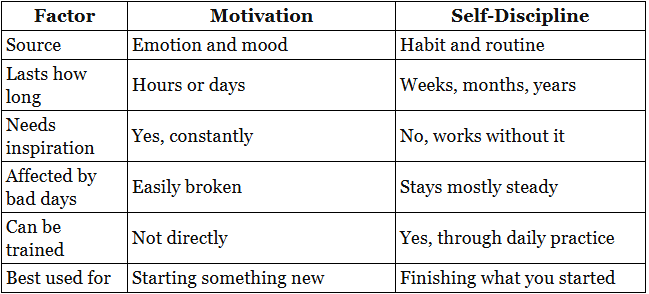
This table shows why motivation is useful to start a goal, but self-discipline is what carries you across the finish line.
The Motivational Canvas Framework: A Simple Original System
To make self-discipline practical, we built a simple original framework called the Motivational Canvas Framework. Think of your daily routine as a blank canvas — every day you either paint it with small disciplined actions, or you leave it empty and hope motivation shows up. The framework has four parts.
Cue. Pick one clear signal that tells your brain it is time to act — for example, opening your daily planner first thing in the morning.
Action. Choose one small task you can complete in under fifteen minutes. Small actions are easier to repeat than big ones.
Visible Reminder. Place a physical reminder where your eyes will land every day. A motivational canvas, motivational wall art quotes on your wall, or a diary with motivational diary quotes on your desk all work well here. What matters is that it is visible, not hidden in an app.
Streak. Track your consistency, not your intensity. A short streak of small daily wins builds more discipline than one big effort followed by weeks of nothing.
This framework turns self-discipline from an abstract idea into a system you can actually follow, day after day.
Simple Daily Tools That Build Self-Discipline
You do not need big willpower to be disciplined. You need small tools that make the right action the easy action.
Use a Daily Planner to Remove Decisions
A daily planner removes the need to decide what to do next. When your day is already written down, you do not have to rely on motivation to figure out your priorities — you just follow the plan.
Keep a Diary With Motivational Diary Quotes for Reflection
Writing a few lines each night, next to motivational diary quotes, helps you notice patterns in your discipline. You start to see which days you followed through and which days you skipped, without judging yourself too harshly.
Put a Motivational Canvas or Wall Art Quotes Where You Will See Them
A motivational canvas or motivational wall art quotes placed near your desk acts as a silent reminder of your goal. You do not need to feel inspired every time you look at it — it simply nudges you back to your routine.
Read Motivational eBooks for Structured Learning, Not Just Inspiration
Good motivational eBooks do more than lift your mood for an hour. The better ones give you a structure or a plan you can apply, which supports discipline instead of only supporting a temporary feeling.
Use a Ceramic Motivational Mug as a Morning Anchor
A ceramic motivational mug or one of the many motivational coffee mugs can become part of your morning cue. Pairing a small, fixed ritual like your morning coffee with your daily planning session helps your brain link the two together over time.
Try Journaling Prompts to Build Self-Awareness
Journaling prompts give you a starting question instead of a blank page. This lowers the effort needed to reflect, which makes the habit easier to repeat, even on days when you do not feel like writing.
How to Grow as a Person Using Discipline Instead of Willpower Alone
People who grow as a person over the long run are rarely the most talented or the most excited people in the room. They are the ones who show up consistently, in small ways, even on ordinary days. Self-discipline is what makes that consistency possible, because it does not depend on how inspired you feel that morning.
Self Improvement Products That Support Structure, Not Just Emotion
Good self improvement products work best when they support structure — a planner that organizes your day, a mug that anchors your routine, or wall art that keeps your goal visible — rather than only products that try to spike your emotions for a short time. Structure lasts. A mood boost does not.
Common Mistakes People Make When They Rely Only on Motivation
Many people chase motivation instead of building discipline, and this leads to three common problems. First, they only work on goals in short bursts, right after watching something inspiring, then stop once the feeling fades. Second, they judge themselves harshly on low-energy days, which makes them want to quit rather than adjust the plan. Third, they buy new tools, apps, and products hoping the next one will finally "motivate" them, instead of using simple tools consistently, such as a daily planner or a visible motivational canvas, to support a steady routine.
Frequently Asked Questions
Is self-discipline more important than motivation?
Yes. Motivation helps you start a goal, but self-discipline is what keeps you going once the initial excitement fades. Research from the American Psychological Association and psychologist Angela Duckworth both show that self-control and self-discipline predict long-term success better than short-lived motivation.
Can motivation be replaced completely by discipline?
Not entirely, and it does not need to be. Motivation is still useful for starting new goals or getting through a hard week. The key is not to depend on it daily. Self-discipline, built through small daily habits and visible reminders like a motivational canvas, should carry most of the weight.
How long does it take to build self-discipline?
Self-discipline builds gradually through repeated small actions, not overnight. Research on self-control suggests that practicing an act of self-control daily for about two weeks can lead to measurable improvement, and consistency over months builds it further.
What is the Motivational Canvas Framework?
It is a simple, original four-part system — Cue, Action, Visible Reminder, and Streak — that turns self-discipline into a daily habit. It uses a visible object, such as a motivational canvas or wall art quote, as an anchor that reminds you of your goal without relying on your mood.
Conclusion
Motivation will always come and go. It is a feeling, and feelings are not reliable enough to build a life on. Self-discipline, on the other hand, is a skill you can grow through small daily actions, simple tools, and visible reminders that keep you on track. Start small: pick one cue, one action, one visible reminder, and track your streak. That is how real, lasting growth happens.
This article is brought to you by Motivation N You, a platform built to bridge the gap between inspiration and execution. Motivation N You offers daily planners, motivational eBooks, ceramic motivational mugs, motivational wall art, and journaling prompts designed to help people move from a passive mindset to a life of steady, purposeful action.
Sources and Further Reading
American Psychological Association. What You Need to Know About Willpower: The Psychological Science of Self-Control. apa.org
Duckworth, A. L., & Seligman, M. E. P. (2005). Self-Discipline Outdoes IQ in Predicting Academic Performance of Adolescents. Psychological Science. Summary via Angela Duckworth Research
Moffitt, T., Poulton, R., & Caspi, A. (2013). Lifelong Impact of Early Self-Control. Summarized in Duckworth & Gross (2014), Self-Control and Grit
Psychology Today. Willpower. psychologytoday.com
Appreciate the creator