Why Is Surgical Accuracy Important in ENT Treatment Today?
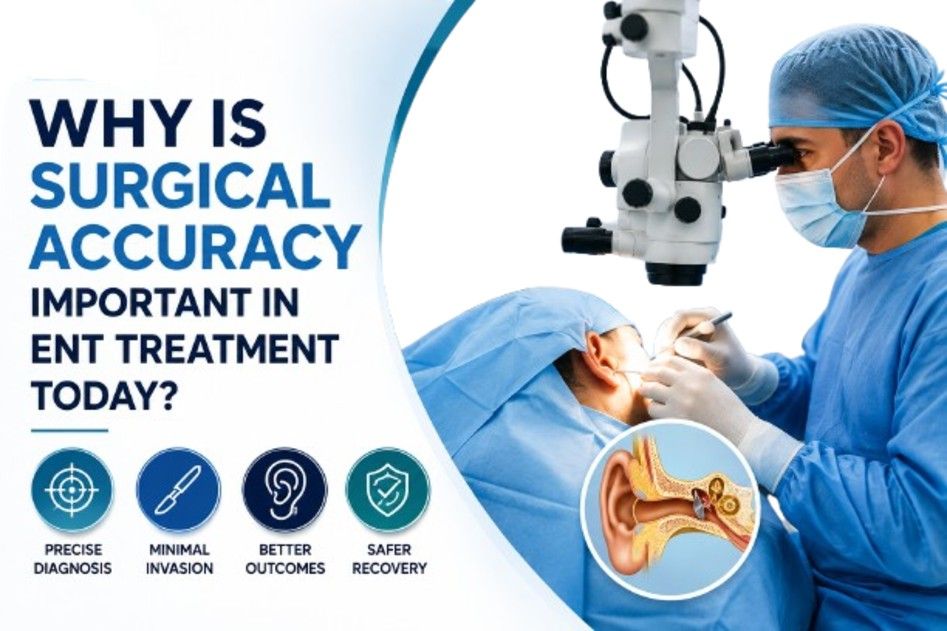
A patient once described her upcoming sinus surgery as "just a procedure," the phrase she'd use for a dental filling. Her surgeon gently corrected the assumption — not to alarm her, but because the space being operated on sits closer to her eye and brain than most people realise. That gap between how patients imagine ENT surgery and what actually happens in the operating room changes how a patient should think about the recommendation in front of them.
What "Accuracy" Actually Means in This Context
The direct answer: surgical accuracy in ENT treatment refers to how precisely a surgeon can operate relative to the patient's own anatomy, particularly where target tissue sits close to the eyes, brain lining, major nerves, or blood vessels. It matters more here than in many other fields because the head and neck pack these structures into a small space, leaving little room for a minor miscalculation that would be inconsequential elsewhere in the body.
How Much Used to Rest on Skill and Memory Alone
For decades, ENT surgery relied heavily on a surgeon's training, a CT scan studied beforehand, and an endoscopic camera view during the procedure. This built entire careers and remains genuinely effective for most straightforward cases. The limitation was never a lack of skill — it was the difficulty of converting a flat, two-dimensional scan into a real-time three-dimensional decision, in a narrow field, often under time pressure. In routine anatomy, this gap rarely mattered. In distorted or complex anatomy, it was where risk quietly accumulated.
Why the Margin for Error Hasn't Gotten Bigger
It would be reasonable to assume that as surgical technique improves, procedures simply become safer across the board. What's actually happened is narrower: the margin for error in high-risk zones hasn't grown more forgiving, since the anatomy hasn't changed. What has changed is the tools available to manage that margin — today's conversation isn't about whether surgeons have become more skilled, but about measuring and verifying accuracy in real time, rather than relying on judgment alone.
The Shift Toward Measurable Precision
This is where Navigation Surgery Treatment in Gurgaon (https://www.entgurgaon.com/navigation-surgery.php) becomes relevant to the broader question. Image-guided systems track a surgeon's instruments against the patient's own CT scan throughout the procedure, showing their exact position on screen as surgery progresses. It doesn't replace the surgeon's judgment or perform the surgery independently — it functions as a continuous check confirming the procedure is unfolding exactly where intended. Dr. Manish Prakash notes this matters most where anatomical landmarks are unreliable, such as revision surgeries or atypical anatomy, where visual judgment alone has less to work with.
Not Every Procedure Needs This Level of Precision
It would be misleading to suggest every ENT surgery requires this layer. A first-time, uncomplicated procedure with typical anatomy is often managed safely through conventional endoscopic technique alone, and adding Navigation Surgery in Gurgaon (https://www.entgurgaon.com/navigation-surgery.php) wouldn't meaningfully improve that outcome. The cases where accuracy tools genuinely change the risk profile are specific: growths near the eye socket or skull base, revision procedures, and situations near major nerves where minor deviation could have lasting consequences.
How This Changes the Conversation With Your Surgeon
For patients, this shift means the right question isn't "does my surgeon use this technology," but "does my case benefit from it." A thorough evaluation, including detailed imaging, should identify whether the anatomy carries elevated risk before any technology decision is made. For sinus-specific procedures, this might lead toward Navigation Sinus Surgery in Gurgaon (https://www.entgurgaon.com/endoscopic-sinus.php), while other procedures may call for a different form of guidance, or none at all, depending on individual anatomy.
Surgical accuracy matters in ENT treatment today not because surgery has become more dangerous, but because patients and surgeons now have better tools to manage risk that has always existed in this anatomy. If you're facing a recommendation for a complex or revision procedure, it's reasonable to ask how your surgeon plans to manage that specific risk. Dr. Manish Prakash and the team at ENT Gurgaon assess this individually, matching the approach to what your scan and history actually show.
Frequently Asked Questions
Does surgical accuracy technology reduce the risk of complications? It can meaningfully reduce risk in complex or high-risk cases by confirming instrument position in real time, though outcomes still depend on the surgeon's judgment. It functions as an added safety layer, not a guarantee.
Is this level of precision needed for common procedures like tonsillectomy? Generally, no. Most routine procedures don't involve the anatomical proximity to sensitive structures that makes this technology valuable. It's typically reserved for sinus, skull base, or nerve-adjacent surgeries with elevated risk.
How do I know if my surgery needs this extra precision? This depends on your CT scan findings, surgical history, and how close the treatment area lies to structures like the eye or skull base. Your ENT specialist can advise after reviewing your imaging and examination.
Does this technology make surgery take longer? Slightly, in some cases, due to setup and calibration time. This is generally a modest difference, weighed against the added safety benefit where anatomical risk justifies its use.
Will using this technology affect my recovery time? Recovery is typically similar to conventional surgery for the same procedure, since the technology changes how precisely surgery is guided, not what is physically done to the tissue.
Appreciate the creator