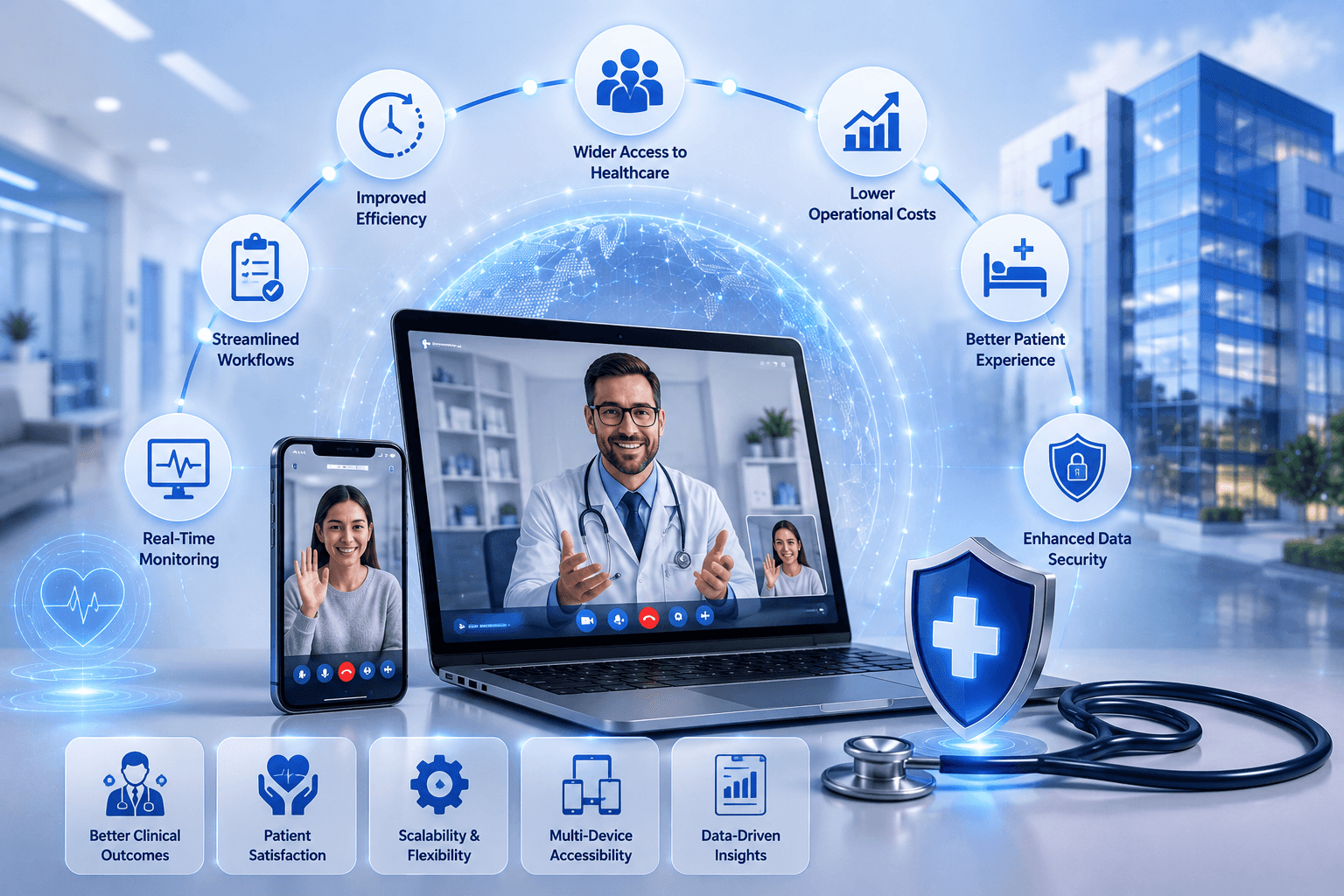
Why Healthcare Businesses Need Telemedicine Software Development
Healthcare businesses are operating in an environment where patients increasingly expect convenient access, faster communication, and connected digital experiences. Hospitals, clinics, diagnostic centers, specialty practices, and digital health companies are exploring virtual care models to complement appropriate in-person services. Telemedicine platforms can support video consultations, appointment scheduling, secure messaging, patient portals, and remote monitoring within a structured digital environment.
For organizations planning scalable virtual care services, Telemedicine Software Development can help create technology around specific clinical, administrative, and patient workflows. Unlike a basic communication tool, a purpose-built telemedicine platform may connect virtual consultations with Electronic Health Records (EHRs), Electronic Medical Records (EMRs), billing workflows, identity management, and Remote Patient Monitoring (RPM). This connected approach can help healthcare businesses build more coordinated digital services while addressing usability, security, and interoperability requirements.
Meeting the Growing Demand for Accessible Virtual Care
Patients may face practical barriers when accessing healthcare, including long travel distances, limited specialist availability, mobility challenges, and scheduling constraints. Telemedicine can reduce some of these barriers by enabling eligible healthcare interactions through smartphones, tablets, and computers. This is particularly relevant for organizations serving rural communities, distributed populations, or patients requiring regular follow-up.
Healthcare businesses can use virtual care as an additional service channel rather than a complete replacement for physical facilities. The appropriate balance depends on clinical needs, patient conditions, professional judgment, and local regulations. A well-designed platform helps organizations define which services can be delivered remotely and when an in-person examination is necessary.
Extending Services Beyond Physical Locations
Traditional healthcare delivery is often tied to a specific clinic, hospital, or medical office. Telemedicine technology can allow healthcare businesses to extend selected services beyond these physical boundaries, giving eligible patients additional ways to communicate with professionals. This can be useful for follow-up visits, behavioral health services, specialist discussions, and certain chronic care programs.
For multi-location healthcare groups, a shared digital platform may also improve coordination across facilities. Patients can access approved services through a consistent interface, while authorized staff can work within defined organizational workflows. The result is a more flexible service model that can support geographic expansion without treating every interaction as a facility-based visit.
Improving Operational Efficiency Across Healthcare Workflows
Healthcare organizations manage numerous administrative activities, from patient registration and appointment booking to reminders, documentation, and follow-up communication. When these processes rely on disconnected tools, staff may spend additional time switching systems or manually transferring information. Healthcare businesses are operating in an environment where patients increasingly expect convenient access, faster communication, and connected digital experiences. Hospitals, clinics, diagnostic centers, specialty practices, and digital health companies are exploring virtual care models to complement appropriate in-person services. Telemedicine platforms can support video consultations, appointment scheduling, secure messaging, patient portals, and remote monitoring within a structured digital environment.
For organizations planning scalable virtual care services, Telemedicine Software Development can help create technology around specific clinical, administrative, and patient workflows. Unlike a basic communication tool, a purpose-built telemedicine platform may connect virtual consultations with Electronic Health Records (EHRs), Electronic Medical Records (EMRs), billing workflows, identity management, and Remote Patient Monitoring (RPM). This connected approach can help healthcare businesses build more coordinated digital services while addressing usability, security, and interoperability requirements.
Meeting the Growing Demand for Accessible Virtual Care
Patients may face practical barriers when accessing healthcare, including long travel distances, limited specialist availability, mobility challenges, and scheduling constraints. Telemedicine can reduce some of these barriers by enabling eligible healthcare interactions through smartphones, tablets, and computers. This is particularly relevant for organizations serving rural communities, distributed populations, or patients requiring regular follow-up.
Healthcare businesses can use virtual care as an additional service channel rather than a complete replacement for physical facilities. The appropriate balance depends on clinical needs, patient conditions, professional judgment, and local regulations. A well-designed platform helps organizations define which services can be delivered remotely and when an in-person examination is necessary.
Extending Services Beyond Physical Locations
Traditional healthcare delivery is often tied to a specific clinic, hospital, or medical office. Telemedicine technology can allow healthcare businesses to extend selected services beyond these physical boundaries, giving eligible patients additional ways to communicate with professionals. This can be useful for follow-up visits, behavioral health services, specialist discussions, and certain chronic care programs.
For multi-location healthcare groups, a shared digital platform may also improve coordination across facilities. Patients can access approved services through a consistent interface, while authorized staff can work within defined organizational workflows. The result is a more flexible service model that can support geographic expansion without treating every interaction as a facility-based visit.
Improving Operational Efficiency Across Healthcare Workflows
Healthcare organizations manage numerous administrative activities, from patient registration and appointment booking to reminders, documentation, and follow-up communication. When these processes rely on disconnected tools, staff may spend additional time switching systems or manually transferring information. Telemedicine software can bring selected workflows into a more coordinated environment.
Automation may support appointment confirmations, digital intake forms, notifications, and routine communication. However, effective automation should be based on real operational needs rather than technology for its own sake. Healthcare businesses gain more value when software reduces repetitive tasks while preserving clear responsibility for clinical and administrative decisions.
Simplifying Appointment Scheduling and Patient Onboarding
Digital scheduling can allow patients to view available appointment options, request suitable time slots, and receive consultation instructions. Healthcare teams may benefit from improved visibility into provider availability and virtual appointment demand. Automated reminders can also support clearer communication before a scheduled consultation.
Patient onboarding can include registration, consent workflows, identity checks, and collection of relevant information according to organizational requirements. A carefully designed process should avoid unnecessary steps that discourage users. For healthcare businesses, the objective is to create an efficient pathway from appointment request to completed virtual interaction.
Connecting Telemedicine With EHR and EMR Systems
Standalone virtual consultation tools can create information silos if they are not aligned with existing healthcare systems. Integration with EHR and EMR platforms may allow authorized professionals to access relevant information and document virtual encounters within established processes. This can support better continuity between digital and facility-based care channels.
Healthcare interoperability standards such as HL7 and FHIR play an important role in structured health data exchange. The right technical approach depends on existing software, vendor capabilities, application programming interfaces, data governance policies, and regulatory requirements. Healthcare businesses should evaluate integration needs early because legacy systems can add significant complexity.
Creating More Connected Clinical Experiences
Connected digital workflows can reduce the need for healthcare professionals to move repeatedly between unrelated applications. Where appropriate integrations exist, patient information, consultation records, and follow-up activities can be coordinated more effectively. This can improve workflow consistency while giving authorized teams better access to relevant data.
Telemedicine platforms may also connect with laboratory systems, pharmacy workflows, payment solutions, and patient portals when legally and technically appropriate. Each integration requires careful planning around permissions, data accuracy, and security. Reliable connectivity is important because healthcare decisions should not depend on incomplete or incorrectly synchronized information.
Supporting Remote Patient Monitoring and Chronic Care
Healthcare businesses increasingly use Remote Patient Monitoring programs to support selected patients outside traditional facilities. Depending on the clinical use case, connected devices may collect measurements such as blood pressure, blood glucose, heart rate, or oxygen saturation. Authorized care teams can review transmitted information according to defined protocols and escalation procedures.
A telemedicine platform can help organize monitoring information alongside virtual communication and follow-up workflows. This may be particularly relevant for chronic disease management programs. However, RPM implementation requires attention to device reliability, data quality, patient consent, alert design, and clear clinical responsibility.
Enabling More Structured Long-Term Patient Engagement
Patients managing ongoing conditions may require repeated interactions rather than isolated appointments. Digital platforms can support scheduled follow-ups, reminders, educational resources, and secure communication where appropriate. This creates opportunities for healthcare businesses to build more structured engagement models around continuing care.
Effective engagement should remain simple and purposeful. Excessive notifications, confusing dashboards, or unnecessary data collection can reduce patient trust and increase staff workload. Healthcare organizations should focus on features that support measurable patient and operational needs rather than adding complexity without a defined benefit.
Strengthening Security and Privacy in Virtual Healthcare
Telemedicine systems process sensitive personal and medical information, making cybersecurity a core business requirement. Healthcare applications should consider encryption, secure authentication, role-based access control, audit logging, API protection, session management, and vulnerability monitoring. Security controls should be incorporated throughout architecture and development rather than added only before launch.
Depending on the market and data-processing activities, healthcare businesses may need to consider requirements associated with HIPAA in the United States or the GDPR in the European Union. Obligations vary by jurisdiction and use case, so organizations should obtain appropriate legal and regulatory guidance. Technical security measures are important, but they are only one part of broader compliance governance.
Protecting Sensitive Health Information
Access to health information should be limited according to clearly defined roles and legitimate operational needs. Physicians, nurses, administrators, patients, and technical teams may require different permissions within the same platform. Role-based access models can help organizations manage these distinctions more systematically.
Healthcare businesses should also plan for ongoing security maintenance after deployment. Software dependencies require updates, vulnerabilities may emerge, and infrastructure needs continuous monitoring. Regular assessments, secure development practices, and incident response planning can help reduce avoidable risks over the platform lifecycle.
Building Scalable Digital Healthcare Services
A healthcare business may initially launch telemedicine for one department or a limited patient group and later expand to additional specialties, locations, or regions. Scalable software architecture can support this growth without requiring the organization to rebuild its core platform repeatedly. Cloud infrastructure, modular services, and well-designed APIs may contribute to long-term flexibility.
Scalability is not limited to handling more users. It also involves database performance, availability, integration capacity, monitoring, and the ability to introduce new workflows. Healthcare businesses should consider expected growth during technical planning so that digital services can evolve alongside organizational needs.
Preparing for AI and Emerging Health Technologies
The future of virtual healthcare is increasingly connected with Artificial Intelligence, wearable devices, cloud computing, and the Internet of Medical Things (IoMT). AI-enabled tools may assist with administrative automation, documentation, patient routing, or data analysis when implemented responsibly and with appropriate professional oversight.
Healthcare businesses should evaluate emerging technologies based on evidence, clinical relevance, privacy, cybersecurity, and regulatory requirements. Future-ready architecture can make responsible integration easier, but innovation should solve defined healthcare problems. Technology creates stronger value when it supports patients and professionals rather than adding unnecessary features.
Why Custom Development Matters for Healthcare Businesses
Every healthcare organization has different specialties, workflows, patient populations, existing systems, and compliance responsibilities. A small specialty clinic may need a focused virtual consultation solution, while a hospital network may require complex integrations, multi-role dashboards, and enterprise-level infrastructure. Generic software may not always align with these differences.
Custom development gives healthcare businesses greater control over workflows, integrations, user experience, and future expansion. It can support multilingual interfaces, accessibility requirements, specialty-specific processes, and connections with existing systems. The development strategy should still be based on realistic business objectives and validated user needs.
Aligning Technology With Real Healthcare Requirements
Successful telemedicine projects begin with a clear understanding of the people who will use the platform. Patients need accessible and understandable interfaces, while clinicians need workflows that do not create unnecessary administrative burden. Operational teams require visibility and control without excessive complexity.
Healthcare businesses should therefore involve relevant stakeholders during discovery, design, development, and testing. Technical decisions should reflect actual care processes, integration constraints, security requirements, and measurable outcomes. This alignment can reduce the risk of building software that looks modern but fails to support day-to-day healthcare operations.
Conclusion
Healthcare businesses need telemedicine software to support accessible virtual care, connected workflows, patient engagement, remote monitoring, and scalable digital services. Hospitals, clinics, specialty practices, and digital health organizations can use these platforms to complement appropriate in-person care while creating additional ways for patients and professionals to interact.
A successful telemedicine platform requires more than video communication. It depends on thoughtful architecture, EHR and EMR integration, interoperability, cybersecurity, usability, and regulatory awareness. By aligning software with genuine clinical and operational requirements, healthcare businesses can build digital care capabilities that remain useful as patient expectations and healthcare technologies continue to evolve. can bring selected workflows into a more coordinated environment.
Automation may support appointment confirmations, digital intake forms, notifications, and routine communication. However, effective automation should be based on real operational needs rather than technology for its own sake. Healthcare businesses gain more value when software reduces repetitive tasks while preserving clear responsibility for clinical and administrative decisions.
Simplifying Appointment Scheduling and Patient Onboarding
Digital scheduling can allow patients to view available appointment options, request suitable time slots, and receive consultation instructions. Healthcare teams may benefit from improved visibility into provider availability and virtual appointment demand. Automated reminders can also support clearer communication before a scheduled consultation.
Patient onboarding can include registration, consent workflows, identity checks, and collection of relevant information according to organizational requirements. A carefully designed process should avoid unnecessary steps that discourage users. For healthcare businesses, the objective is to create an efficient pathway from appointment request to completed virtual interaction.
Connecting Telemedicine With EHR and EMR Systems
Standalone virtual consultation tools can create information silos if they are not aligned with existing healthcare systems. Integration with EHR and EMR platforms may allow authorized professionals to access relevant information and document virtual encounters within established processes. This can support better continuity between digital and facility-based care channels.
Healthcare interoperability standards such as HL7 and FHIR play an important role in structured health data exchange. The right technical approach depends on existing software, vendor capabilities, application programming interfaces, data governance policies, and regulatory requirements. Healthcare businesses should evaluate integration needs early because legacy systems can add significant complexity.
Creating More Connected Clinical Experiences
Connected digital workflows can reduce the need for healthcare professionals to move repeatedly between unrelated applications. Where appropriate integrations exist, patient information, consultation records, and follow-up activities can be coordinated more effectively. This can improve workflow consistency while giving authorized teams better access to relevant data.
Telemedicine platforms may also connect with laboratory systems, pharmacy workflows, payment solutions, and patient portals when legally and technically appropriate. Each integration requires careful planning around permissions, data accuracy, and security. Reliable connectivity is important because healthcare decisions should not depend on incomplete or incorrectly synchronized information.
Supporting Remote Patient Monitoring and Chronic Care
Healthcare businesses increasingly use Remote Patient Monitoring programs to support selected patients outside traditional facilities. Depending on the clinical use case, connected devices may collect measurements such as blood pressure, blood glucose, heart rate, or oxygen saturation. Authorized care teams can review transmitted information according to defined protocols and escalation procedures.
A telemedicine platform can help organize monitoring information alongside virtual communication and follow-up workflows. This may be particularly relevant for chronic disease management programs. However, RPM implementation requires attention to device reliability, data quality, patient consent, alert design, and clear clinical responsibility.
Enabling More Structured Long-Term Patient Engagement
Patients managing ongoing conditions may require repeated interactions rather than isolated appointments. Digital platforms can support scheduled follow-ups, reminders, educational resources, and secure communication where appropriate. This creates opportunities for healthcare businesses to build more structured engagement models around continuing care.
Effective engagement should remain simple and purposeful. Excessive notifications, confusing dashboards, or unnecessary data collection can reduce patient trust and increase staff workload. Healthcare organizations should focus on features that support measurable patient and operational needs rather than adding complexity without a defined benefit.
Strengthening Security and Privacy in Virtual Healthcare
Telemedicine systems process sensitive personal and medical information, making cybersecurity a core business requirement. Healthcare applications should consider encryption, secure authentication, role-based access control, audit logging, API protection, session management, and vulnerability monitoring. Security controls should be incorporated throughout architecture and development rather than added only before launch.
Depending on the market and data-processing activities, healthcare businesses may need to consider requirements associated with HIPAA in the United States or the GDPR in the European Union. Obligations vary by jurisdiction and use case, so organizations should obtain appropriate legal and regulatory guidance. Technical security measures are important, but they are only one part of broader compliance governance.
Protecting Sensitive Health Information
Access to health information should be limited according to clearly defined roles and legitimate operational needs. Physicians, nurses, administrators, patients, and technical teams may require different permissions within the same platform. Role-based access models can help organizations manage these distinctions more systematically.
Healthcare businesses should also plan for ongoing security maintenance after deployment. Software dependencies require updates, vulnerabilities may emerge, and infrastructure needs continuous monitoring. Regular assessments, secure development practices, and incident response planning can help reduce avoidable risks over the platform lifecycle.
Building Scalable Digital Healthcare Services
A healthcare business may initially launch telemedicine for one department or a limited patient group and later expand to additional specialties, locations, or regions. Scalable software architecture can support this growth without requiring the organization to rebuild its core platform repeatedly. Cloud infrastructure, modular services, and well-designed APIs may contribute to long-term flexibility.
Scalability is not limited to handling more users. It also involves database performance, availability, integration capacity, monitoring, and the ability to introduce new workflows. Healthcare businesses should consider expected growth during technical planning so that digital services can evolve alongside organizational needs.
Preparing for AI and Emerging Health Technologies
The future of virtual healthcare is increasingly connected with Artificial Intelligence, wearable devices, cloud computing, and the Internet of Medical Things (IoMT). AI-enabled tools may assist with administrative automation, documentation, patient routing, or data analysis when implemented responsibly and with appropriate professional oversight.
Healthcare businesses should evaluate emerging technologies based on evidence, clinical relevance, privacy, cybersecurity, and regulatory requirements. Future-ready architecture can make responsible integration easier, but innovation should solve defined healthcare problems. Technology creates stronger value when it supports patients and professionals rather than adding unnecessary features.
Why Custom Development Matters for Healthcare Businesses
Every healthcare organization has different specialties, workflows, patient populations, existing systems, and compliance responsibilities. A small specialty clinic may need a focused virtual consultation solution, while a hospital network may require complex integrations, multi-role dashboards, and enterprise-level infrastructure. Generic software may not always align with these differences.
Custom development gives healthcare businesses greater control over workflows, integrations, user experience, and future expansion. It can support multilingual interfaces, accessibility requirements, specialty-specific processes, and connections with existing systems. The development strategy should still be based on realistic business objectives and validated user needs.
Aligning Technology With Real Healthcare Requirements
Successful telemedicine projects begin with a clear understanding of the people who will use the platform. Patients need accessible and understandable interfaces, while clinicians need workflows that do not create unnecessary administrative burden. Operational teams require visibility and control without excessive complexity.
Healthcare businesses should therefore involve relevant stakeholders during discovery, design, development, and testing. Technical decisions should reflect actual care processes, integration constraints, security requirements, and measurable outcomes. This alignment can reduce the risk of building software that looks modern but fails to support day-to-day healthcare operations.
Conclusion
Healthcare businesses need telemedicine software to support accessible virtual care, connected workflows, patient engagement, remote monitoring, and scalable digital services. Hospitals, clinics, specialty practices, and digital health organizations can use these platforms to complement appropriate in-person care while creating additional ways for patients and professionals to interact.
A successful telemedicine platform requires more than video communication. It depends on thoughtful architecture, EHR and EMR integration, interoperability, cybersecurity, usability, and regulatory awareness. By aligning software with genuine clinical and operational requirements, healthcare businesses can build digital care capabilities that remain useful as patient expectations and healthcare technologies continue to evolve.
Appreciate the creator