Why Do Some Ear Piercings Heal Faster Than Others?
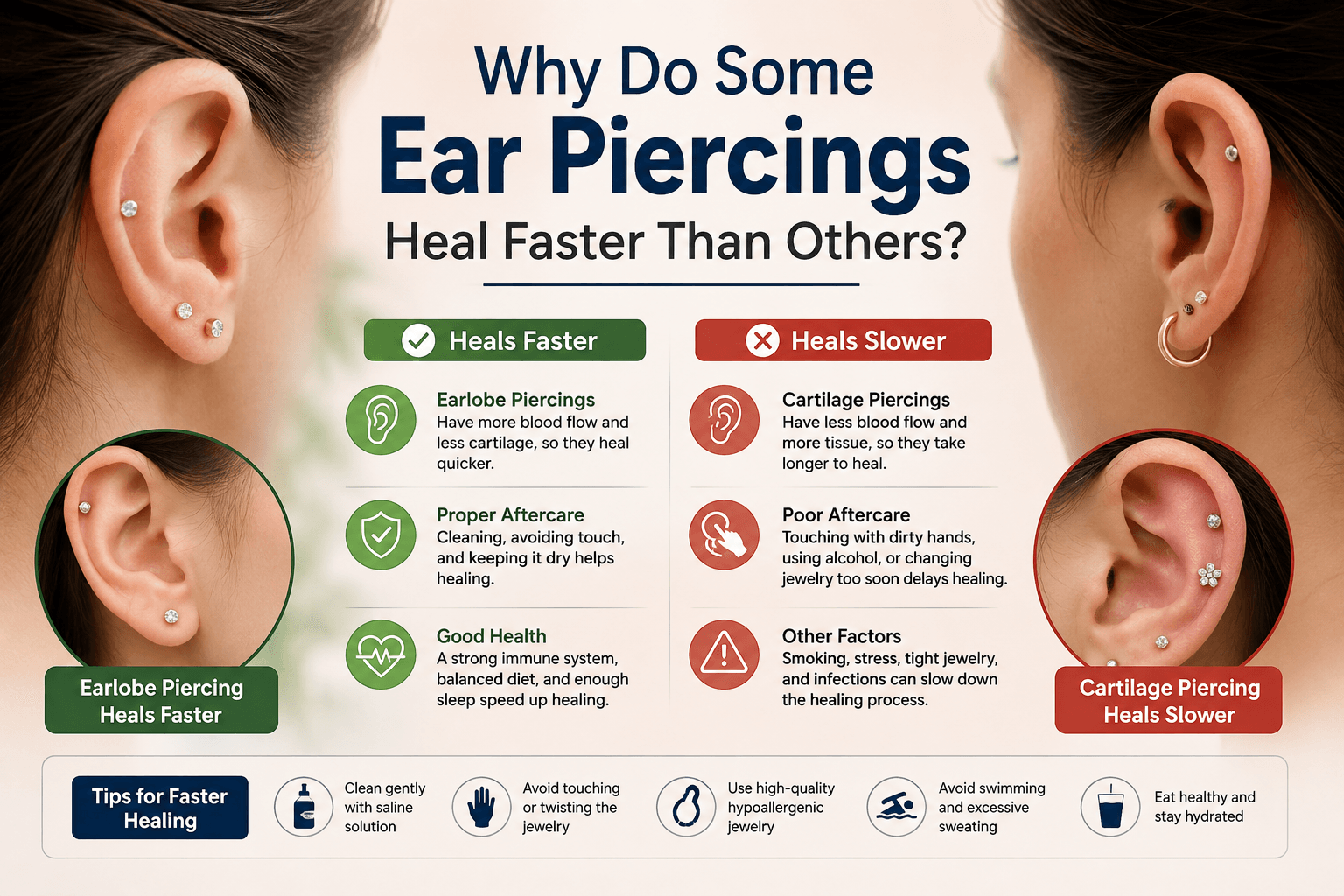
Two colleagues get their ears pierced on the same afternoon, at the same studio, with the same jewellery. Six weeks later, one has forgotten the piercing even exists. The other is still dabbing at a red, tender spot before every video call. Same procedure, same day, completely different outcomes. If you have ever wondered why that happens, you are not imagining things — and the answer has less to do with luck than most people assume.
The Short Answer First
Ear piercings heal at different speeds mainly because of three factors working together: where on the ear the piercing sits, how the piercing was made, and how the individual's skin and immune response behave afterward. Cartilage piercings almost always take longer than earlobe piercings, and even two lobe piercings can heal at different rates depending on aftercare and technique. None of this means something has gone wrong — it simply means healing is not one-size-fits-all.
It Starts With Where the Needle Goes
The earlobe is soft tissue with a strong blood supply, which is exactly why lobe piercings often close up within six to eight weeks. Cartilage, on the other hand, has very little blood flow. Less blood flow means fewer healing cells reach the area quickly, which is why a helix or tragus piercing can take anywhere from three months to a year to feel fully settled. This is not a flaw in technique — it is basic tissue biology. Anyone comparing a lobe piercing to a cartilage piercing is really comparing two different healing environments, not two versions of the same process.
The Piercing Method Makes a Bigger Difference Than You Think
A common assumption is that all piercings are essentially identical procedures. In practice, the tool used matters. A piercing gun forces blunt pressure through tissue, which can cause micro-trauma around the entry point, especially in cartilage. A hollow needle, by contrast, removes a small core of tissue cleanly, leaving a more predictable wound margin for the body to close. This is one reason a professionally performed Cosmetic Ear Piercing Treatment in Gurgaon (https://www.entgurgaon.com/cosmetic-ear-piercing.php), done under sterile, clinical conditions, tends to heal more evenly than a piercing done with a handheld gun at a jewellery counter. The jewellery itself matters too — surgical-grade metal reduces the irritation that nickel-based studs commonly cause.
Your Body's Own Healing Clock
Even with identical technique, biology varies from person to person. Age, skin type, general immunity, and even nutrition influence how quickly new tissue forms around a piercing. Someone who smokes, has poorly controlled diabetes, or is managing a skin condition like eczema may notice slower healing simply because their body's repair mechanisms are already working harder elsewhere. This is not something to feel anxious about — it is worth being aware of, especially before choosing a piercing site, because it changes what "normal" healing should look like for that individual.
Everyday Habits That Quietly Slow Things Down
Healing is rarely undone by one dramatic mistake. It is usually slowed by small, repeated habits — sleeping on the pierced side, letting hair products or perfume touch the area, twisting jewellery "to keep it clean," or switching earrings before the site has properly closed. Phone calls pressed against a fresh cartilage piercing, gym headbands, and even helmets during travel can reintroduce friction at exactly the wrong time. None of these habits cause infection by themselves, but together they can turn a four-week lobe healing timeline into a two-month one.
When a Slow Healing Piercing Signals Something More
Most delayed healing is simply that — delayed, not dangerous. But there is a point where slow healing becomes a genuine concern rather than a normal variation. Persistent swelling beyond the first two weeks, spreading redness, warmth, thick discharge, or a bump that keeps growing rather than shrinking are signs the tissue may be reacting to infection or to the metal itself. Cartilage piercings deserve particular attention here, since infections in this area can occasionally involve the underlying structure and are best evaluated early rather than treated at home with guesswork.
How an ENT Specialist Looks at Ear Piercings Differently
A general piercing studio can perform the procedure, but it cannot examine the ear's underlying anatomy or judge whether a particular cartilage site is prone to complications for a specific patient. Dr. Manish Prakash notes that ear cartilage has less room for error than most people assume — an infection here can progress differently compared with a soft tissue infection elsewhere on the body, which is why clinical evaluation matters when swelling or pain does not settle within the expected window. This is also the reasoning behind choosing a proper Cosmetic Ear Piercing Hospital in Gurgaon (https://www.entgurgaon.com/cosmetic-ear-piercing.php) for cartilage piercings in particular, where sterilisation, needle technique, and jewellery selection are handled under medical supervision rather than general retail conditions.
What Faster Healing Actually Looks Like
Faster healing is not really about willpower or luck — it is about aligning technique, hygiene, and realistic expectations. Cleaning gently with saline rather than alcohol, avoiding unnecessary touching, choosing hypoallergenic jewellery, and giving cartilage piercings the extra months they genuinely need all shift the odds meaningfully. For patients who want the procedure done with medical precision from the start, opting for Ear Piercing by ENT Specialist in Gurgaon (https://www.entgurgaon.com/cosmetic-ear-piercing.php) removes much of the guesswork, since the piercing site, angle, and jewellery type are chosen with the ear's anatomy in mind rather than convenience alone.
If your piercing feels like it is taking longer than it should, or if something about the healing process feels off, it is worth getting it looked at rather than waiting it out indefinitely. Dr. Manish Prakash and the team at ENT Gurgaon regularly guide patients through exactly this kind of decision — distinguishing normal, slow-but-steady healing from something that needs active treatment. A short evaluation early on is almost always simpler than managing a complication later.
Frequently Asked Questions
How long should a normal earlobe piercing take to heal? Most earlobe piercings heal within six to eight weeks, though some people take slightly longer. As long as swelling and tenderness are gradually reducing rather than increasing, this timeline is considered normal and does not usually need medical intervention.
Why do cartilage piercings take so much longer than lobe piercings? Cartilage has a much lower blood supply than the earlobe, so fewer healing cells reach the area quickly. This naturally slows tissue repair, meaning cartilage piercings can take anywhere from three months to over a year to fully settle.
Is it normal for a piercing to still hurt after a month? Mild tenderness after a month, especially in cartilage, can be within normal range. However, increasing pain, spreading redness, or discharge after four weeks is not typical healing and should be evaluated by a specialist.
Can changing earrings too early affect healing speed? Yes. Removing or switching jewellery before the piercing has properly closed can reintroduce bacteria and disturb the healing tissue, often restarting part of the healing process and prolonging discomfort.
When should I see an ENT specialist instead of waiting it out? If swelling worsens, a firm bump develops, discharge appears, or pain increases rather than settling within the expected timeframe, it is advisable to have the piercing examined rather than continuing home care alone.
Appreciate the creator