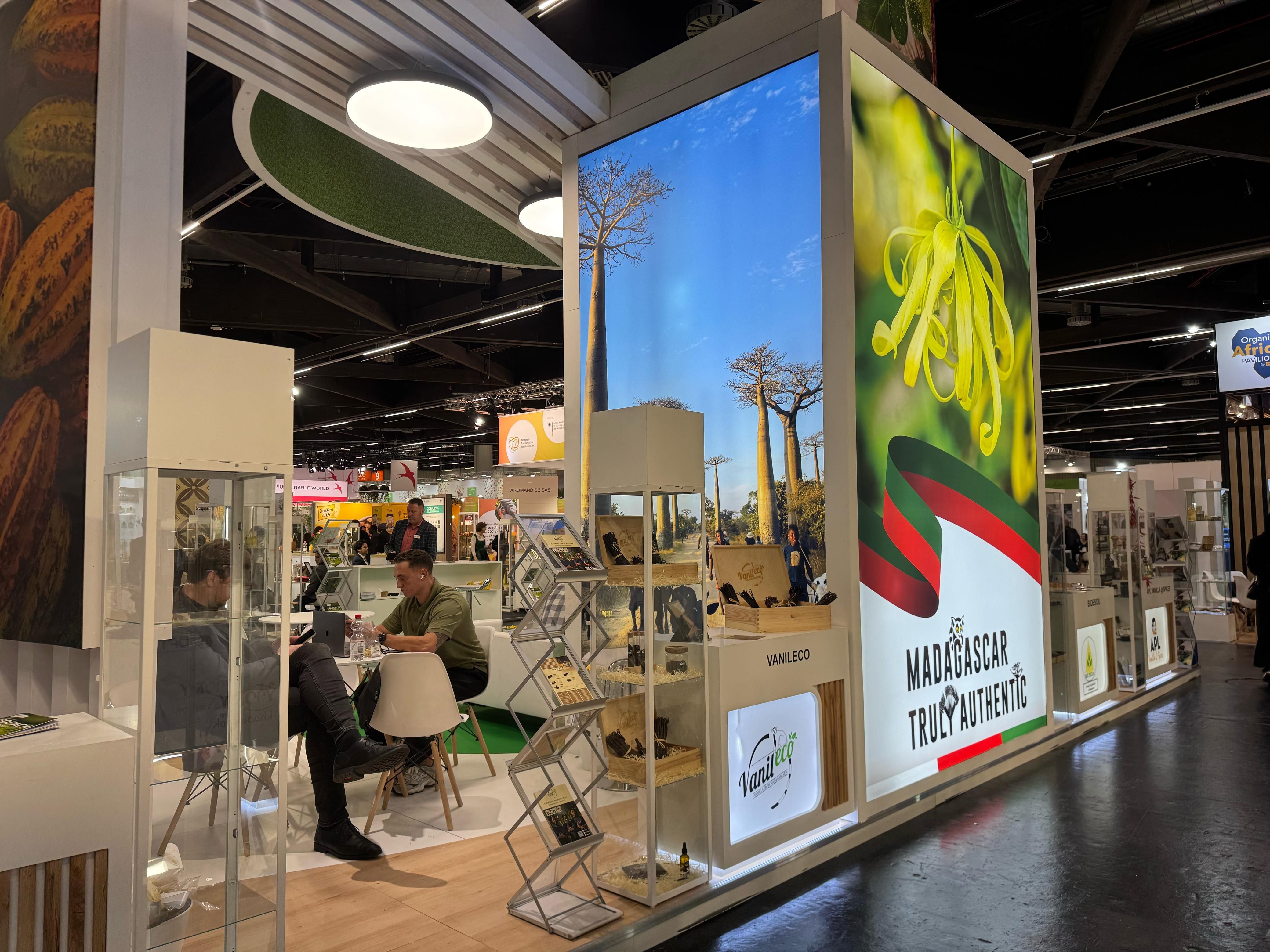
Why a 3D Logo Creates a Stronger First Impression at Exhibitions
You have about three seconds to get someone to stop and walk past your booth. That’s not an exaggeration, that’s about how long research into trade show attention spans tells you that you actually have before someone has made up their mind, consciously or otherwise, whether your stand is worth a second glance. In that window, most exhibitors are counting on a flat, printed brand to do the heavy lifting. Not that often.
That changes immediately with a 3D logo. The explanation is simple: flat graphics become lost on a show floor covered in flat images. A raised dimensional logo does not.
Why Flat Logos Don’t Work on a Crowded Show Floor
Walk the floor of any large trade fair and you’ll see the same visual pattern repeated from booth to booth: printed vinyl graphics, illuminated panels, banner stands, all sitting on the same flat plane. The best-designed flat branding starts to visibly merge together after a visitor has passed the twentieth identical-format booth.
That's the crux of the difficulty with depending solely on exhibition graphics for brand recognition. But a flat logo, no matter how wonderfully made, is competing for attention in the exact same visual language as everything around it. You'd have to be looking very closely already to notice it at all. With a 3D logo, there is no such problem. 3D logos alter the physical geometry of the space itself, rather than merely the graphics printed on it.
The Psychology Of 3-Dimensional Branding
Human vision is naturally drawn to depth, shadow and contrast before it processes flat color or text. The raised logo reflects ambient light differently depending on the angle at which a visitor approaches, creating natural variations of shadow and highlight that a printed graphic just cannot match. One of the most powerful – and least discussed – elements in the exhibition stand branding toolbox is this: You aren’t just designing what people see, you’re planning the way light interacts with your brand all day long as the venue illumination changes.
That’s why 3D lettering with LED signage works so effectively, too. Backlighting or edge-lighting a dimensional logo creates an additional layer of visual difference; brightness against a relatively dim show floor and depth against flat competition logos, stacking two attention-grabbing cues instead of just one.
Where a 3D Logo Belongs in a Custom Exhibition Stand
Not every stand needs a big dimensional build but there are few locations that have consistently given the best return on the investment:
Over the entry, facing the main aisle: This is the highest-visibility location on most stands, and it’s precisely where sightline height matters the most. Here a dimensional logo is hung, often seen from many aisles away, well before a visitor gets close enough to view tiny lettering.
Behind the reception/meeting space: For those guests that do stop, a 3D logo behind a reception desk photographs well, reinforces brand recall during the actual discussion and gives staff a natural professional backdrop for any images taken throughout the presentation.
Built into a feature wall: Many powerful custom exhibition stand designs do not treat the logo as a separate entity but rather incorporate the dimensional logo into a larger feature wall with texture, material changes or lighting zones to make the whole stand read as one single, cohesive piece of exhibition stand design rather than a logo bolted onto a generic background.
It's Also a Practical Signal, Not Just an Aesthetic One
And, a second consequence is worth noting here. Dimensional branding costs more and is more harder to make than a printed banner and visitors, whether consciously registering this or not, tend to perceive that investment as a signal of firm scale and seriousness. This is one example of a more general notion in show stand branding, that the physical quality of your presence silently announces the quality of your business, before a word is spoken to your team.
This is extremely important in businesses where trust and credibility are formed rapidly, such as enterprise technology, industrial equipment, pharmaceuticals and financial services. A flat logo does not hurt that credibility. It does not help build it the way a well-done dimensional element does.
Right execution
A 3D logo will only work if it is built and placed correctly. A few things to get right before committing to a build:
Size to the sightline, not the pocket book: If a dimensional logo is too small to be seen from the main aisle, it fails its function. Reverse engineer from the distance you want it to be viewed from.
Match materials to your brand. Not just your stand: Acrylic, metal, and lit channel letters all have a very different feel. The material should support your brand positioning, premium, technical, approachable and not only be chosen for cost.
Plan the lighting with the logo, not after the logo: That lighting choice totally transforms the whole visual impact of a dimensional construction. This has to be integrated into the initial display stand design and not added in the final walkthrough.
Make it readable from a distance, not only from up close: A lot of 3D detailing tends to vanish visibly beyond a few meters. Bold, basic forms will always read better across a show floor than delicate detail will.
Conclusion
In a hall full of flat graphics competing for the same three seconds of attention, a skillfully crafted 3D logo is one of the most reliable methods to physically separate your stand from the throng before a visitor has even started reading. It's not just a branding concept for an exhibition that's worth thinking about, it's one of the few items on a stand that operates on a purely visual, pre-conscious level, doing its job before a visitor has even decided to engage at all.
To get it right requires cooperation between display graphics design, lighting and the very structure of the stand itself, yet for exhibitors competing on a congested show floor it’s often the single most impactful design decision available.
Know more: https://exhibitelevate.com/blogs (https://exhibitelevate.com)
Appreciate the creator