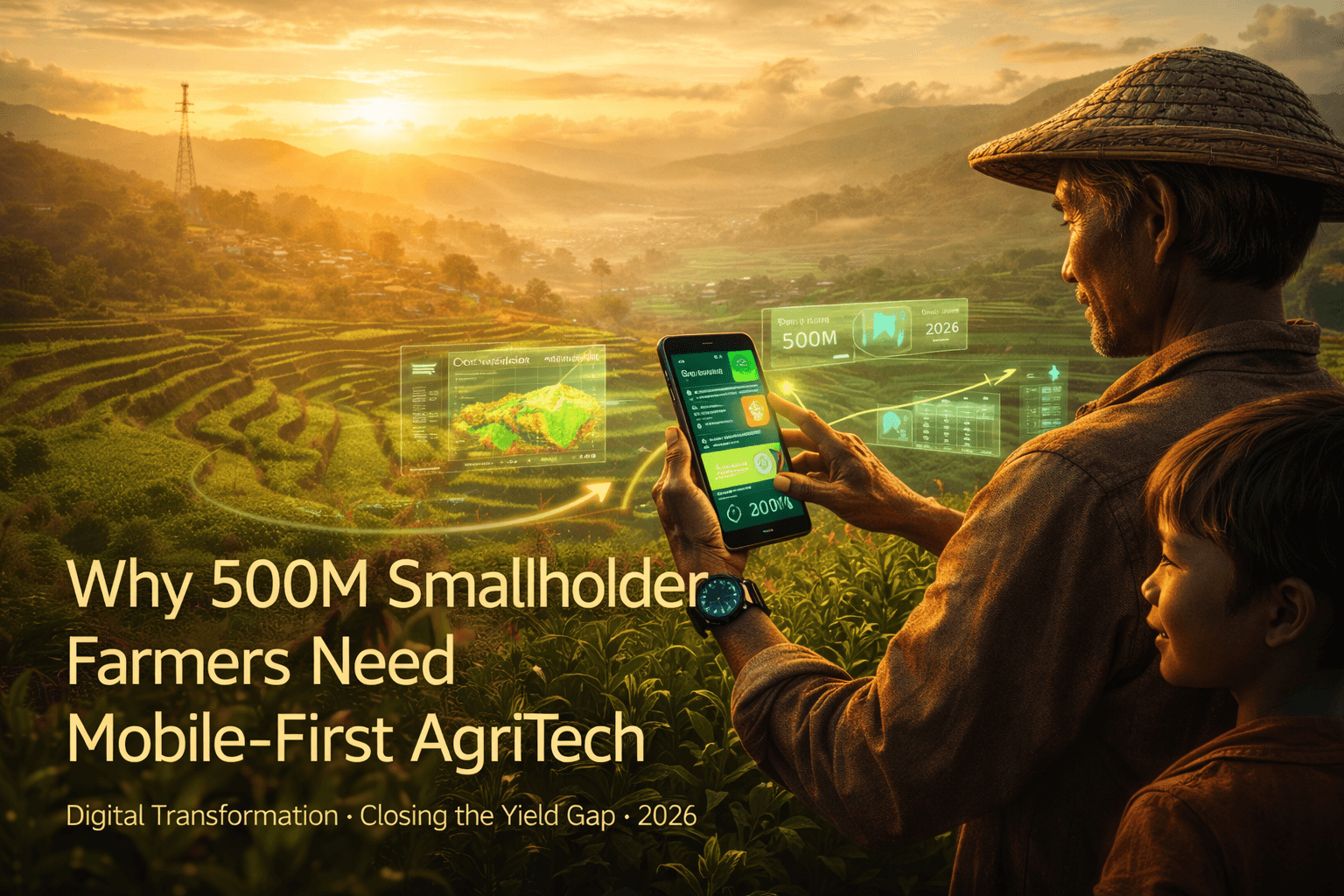
Why 500M Smallholder Farmers Need Mobile-First AgriTech
The global food system rests on the shoulders of approximately 500 million smallholder farmers. These individuals produce nearly 80% of the food consumed in the developing world, yet they remain a vulnerable segment of the agricultural value chain. As we navigate 2026, the "yield gap"—the difference between potential and actual crop productivity—continues to widen due to climate volatility and fragmented supply chains.
The solution is no longer found in traditional heavy machinery or centralized industrial upgrades. Instead, it lies in the pockets of the farmers themselves. Mobile-first AgriTech refers to the intentional design of agricultural software that prioritizes smartphone accessibility, offline functionality, and localized data processing. For developers and stakeholders, understanding this shift is critical to stabilizing the global food supply. For those looking to see how these technologies are applied across various sectors, exploring AI mobile apps by industry provides a broader perspective on the 2026 digital landscape.
The 2026 Landscape: Connectivity vs. Capability
As of early 2026, smartphone penetration in rural agricultural hubs has reached a tipping point. According to data from the GSMA (2025), over 65% of rural populations in Sub-Saharan Africa and Southeast Asia now have access to 4G-enabled devices. However, a "capability gap" persists. While the hardware exists, the software often fails to account for the unique constraints of the field: high data costs, intermittent signal, and low literacy levels.
Smallholder farmers are currently facing a "triple threat":
Soil Degradation: Over 33% of global soils are moderately to highly degraded (FAO, 2025).
Market Opacity: Middlemen often take up to 60% of the final market price due to a lack of direct-to-consumer digital infrastructure.
Climate Unpredictability: 2025 recorded the highest frequency of "micro-climate" shifts, rendering traditional planting calendars obsolete.
Core Pillars of Mobile-First AgriTech
To serve 500 million users effectively, AgriTech must move beyond simple "weather apps." In 2026, the industry has coalesced around several primary functional pillars:
1. Computer Vision for Pest and Disease Diagnosis
Modern mobile apps now utilize edge-based AI to identify crop diseases instantly. A farmer can snap a photo of a spotted leaf, and the app processes the image locally to identify the pathogen. This eliminates the need for a physical visit from an extension officer, which in many regions is a 1-to-2,000 ratio.
2. Hyper-Local Weather Intelligence
Standardized national forecasts are useless for a farmer on a mountainside. 2026 AgriTech leverages mesh networks and satellite "nowcasting" to provide 1-kilometer-resolution weather updates. This allows for precision irrigation and prevents the loss of expensive fertilizers during unexpected heavy rains.
3. Fintech Integration and Credit Scoring
Smallholders are often "unbanked." By analyzing farm data (acreage, crop types, historical yields), mobile platforms create digital identities. These identities allow farmers to access micro-loans for seeds and equipment that were previously unavailable due to a lack of traditional collateral.
Designing for the Field: Technical Considerations
Building for a smallholder farmer is fundamentally different from building for a corporate user in a high-rise. The technical architecture must be "rural-resilient." This involves building offline-first AI apps for rural farming markets to ensure that critical features like soil analysis or pest identification function without an active internet connection.
Key considerations for 2026 AgriTech development include:
Low-Power UI: Using dark modes and simplified graphics to preserve battery life in areas with limited electricity.
Voice-First Interfaces: Utilizing Natural Language Processing (NLP) in local dialects to assist farmers with limited formal literacy.
Edge Computing: Processing data on the device to minimize latency and data costs.
For organizations looking to build these robust systems, leveraging specialized expertise is essential. Teams focusing on Mobile App Development in Dallas have increasingly turned their attention to global AgriTech, utilizing high-performance cloud backends to support these localized mobile frontends.
Real-World Impact: 2025-2026 Case Evidence
In Kenya and India, the "Digital Green" initiatives of 2025 demonstrated that smallholders using mobile-first advisory services saw a 22% increase in average yields.
Case Study: The Rice Value Chain (Vietnam, 2025)
Context: Farmers were over-applying nitrogen fertilizer, leading to soil acidity and wasted capital.
Solution: A mobile-first app provided leaf color analysis via the phone's camera.
Outcome: Farmers reduced fertilizer costs by 18% while maintaining the same yield, directly increasing their take-home profit.
AI Tools and Resources
Plantix — AI-driven crop doctor for pest and disease detection
Best for: Instant field diagnosis of over 500 different crop types
Why it matters: Provides organic and chemical treatment recommendations based on a photo
Who should skip it: Industrial farms with automated sensor-to-spray drone systems
2026 status: Active, now includes enhanced soil-nutrient deficiency detection via camera
Stripe Issuing — Programmable card and credit infrastructure
Best for: AgriTech platforms building micro-loan systems for rural farmers
Why it matters: Allows platforms to issue "restricted spend" virtual cards for specific agricultural inputs
Who should skip it: Regions with heavy regulatory restrictions on digital-only banking
2026 status: Widely used for agricultural micro-disbursements
Terra0 — Decentralized autonomous forest/farm management
Best for: Validating carbon credits for smallholder farmers
Why it matters: Uses satellite data to pay farmers for carbon sequestration and conservation
Who should skip it: Short-term seasonal harvesters with no permanent land rights
2026 status: Transitioning from beta to public protocols for global climate finance
Risks, Trade-offs, and Limitations
While the promise of AgriTech is immense, the road to 2026 has revealed significant hurdles that can lead to total project failure if ignored.
When AgriTech Fails: The Data Literacy Gap
A common failure occurs when developers release a feature-rich app without considering the "on-boarding" reality of the user.
Warning signs: High app download numbers but zero repeat usage (retention).
Why it happens: The interface relies on complex icons or western-centric navigation patterns that don't translate to a farmer's mental model.
Alternative approach: Implement "Human-in-the-Loop" systems where local village leaders act as the primary interface for the technology during the first year of adoption.
Key Takeaways
Mobile is the Bridge: For 500 million farmers, the smartphone is the only accessible entry point to the modern global economy.
Offline is Mandatory: Any AgriTech solution that requires 100% uptime will fail in the field. Localized AI processing is the standard for 2026.
Trust over Tech: Technology must be paired with local agricultural extension services to gain the trust of traditional farming communities.
Economic Empowerment: The ultimate goal of AgriTech is not just "better farming" but "better living" through transparent markets and fair credit access.
Appreciate the creator