What’s Driving the Generative AI Boom? The Companies Turning AI Into Real Products
The generative AI (https://www.junkiescoder.com/services/generative-ai-development-services) boom is no longer being driven by chatbots alone. Massive infrastructure investment, enterprise productivity demands, multimodal capabilities, and the rise of AI agents are pushing generative AI from experimentation into real products and business workflows.
In 2026, Alphabet, Amazon, Microsoft, and Meta are collectively planning roughly $725 billion in capital expenditures, much of it directed toward data centers, AI infrastructure, and computing capacity. At the same time, enterprises are moving beyond basic text generation toward AI systems that can reason over business data, use tools, automate workflows, and process multiple forms of information.
The investment story, however, is not the same as the ROI story. Boston Consulting Group reports that generative AI investment is projected to increase by 60% over the next three years, while only about one in four executives say their organizations are seeing significant returns from AI and GenAI investments. BCG also argues that the biggest barrier to GenAI value is not the technology itself, but the people, processes, and organizational changes required to deploy it effectively.
That tension defines the market in 2026: companies are spending more than ever on AI, but the winners will be the ones that turn that spending into useful products, measurable productivity, and sustainable business value.
What’s Driving the Generative AI Boom?
Several forces are pushing generative AI from an emerging technology into a broader business platform.
1. Massive AI Infrastructure Investment
Training and serving advanced AI models requires enormous amounts of compute, networking, storage, and energy.
Alphabet, Amazon, Microsoft, and Meta have each announced exceptionally large 2026 capital-spending plans, with the combined figure reaching roughly $725 billion according to current reporting.
This infrastructure race matters because generative AI companies are competing not only on model quality, but also on access to affordable, scalable compute.
The result is an expanding AI infrastructure stack that includes:
GPUs and specialized AI accelerators
High-speed networking
Large-scale data centers
Cloud AI platforms
Model-serving infrastructure
Data storage and retrieval systems
Energy and cooling infrastructure
The economics are changing quickly, but one thing is clear: AI capability increasingly depends on infrastructure at massive scale.
2. Enterprise Productivity Pressure
Enterprises are moving from AI experimentation toward measurable business outcomes.
Instead of asking whether a chatbot can generate text, organizations are asking whether AI can:
Reduce customer-service workload
Accelerate software development
Automate document processing
Improve enterprise search
Assist financial analysis
Speed up marketing production
Reduce repetitive administrative work
BCG's research reinforces this shift. Its analysis suggests that organizations capture more value when GenAI initiatives are connected to core business processes rather than isolated experiments.
3. The Rise of AI Agents
One of the biggest changes in generative AI is the transition from responding to instructions to executing workflows.
Traditional GenAI applications generally generate text, images, code, or other content when prompted.
AI agents go further. They can use generative models to:
Interpret a goal
Plan a sequence of actions
Call external tools
Retrieve information
Execute tasks
Evaluate results
Escalate or retry when necessary
This makes agents particularly relevant to enterprise workflows where AI needs to interact with databases, APIs, business applications, and internal knowledge systems.
4. Multimodal AI
Generative AI is no longer limited to text.
Modern systems increasingly combine:
Text
Images
Audio
Video
Documents
Structured data
Sensor or operational data
This allows a single AI workflow to understand multiple data types instead of forcing businesses to maintain separate AI systems for each modality.
For example, a customer-support system could combine a written complaint, product images, call transcripts, and account information before recommending the next action.
5. Proprietary Data and Workflow Advantages
Model access is becoming easier, which means the model itself is not always the strongest source of competitive differentiation.
Enterprise products can differentiate through:
Proprietary data
Retrieval systems
Domain-specific knowledge
Internal workflows
Specialized evaluations
Secure integrations
Custom tools and APIs
Human review processes
Importantly, proprietary data does not necessarily mean training a foundation model from scratch. Companies can use retrieval-augmented generation, private knowledge bases, fine-tuning, context engineering, or tool integrations without retraining the underlying model.
The competitive advantage increasingly comes from how AI is connected to a company's data and workflows.
Who Is Turning Generative AI Into Real Products?
The market is becoming easier to understand when divided into three layers:
Foundation model companies building core AI systems
Infrastructure and cloud companies providing the compute and platforms
Enterprise and consumer software companies embedding AI into products and workflows
Foundation Models and Core AI Infrastructure
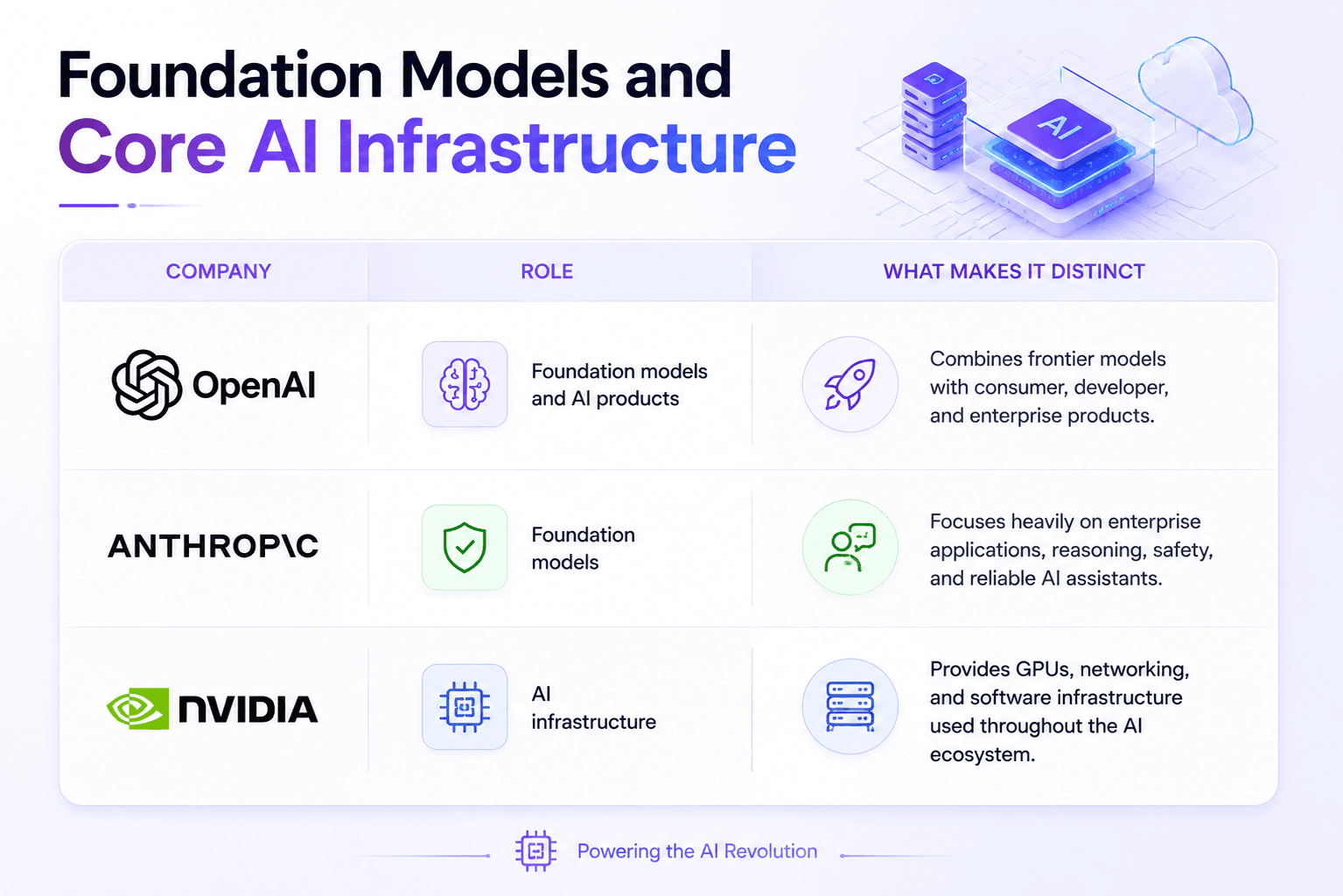
These companies occupy different positions in the stack, but all benefit from the rapid expansion of generative AI workloads.
The important distinction is that not every AI leader is a model company. Infrastructure providers can capture enormous value even when the final AI product is built by someone else.
Tech Giants Turning AI Into Enterprise Products
Microsoft: AI Inside the Enterprise Stack
Microsoft is embedding AI across its cloud, productivity, developer, and business software ecosystem.
Its strategy spans areas such as:
Azure AI infrastructure
Microsoft 365 AI capabilities
GitHub Copilot
Enterprise AI services
AI agents and workflow automation
This gives Microsoft an important advantage: AI can be sold through software and cloud products that enterprises already use.
Google: AI Across Search, Cloud, and Consumer Products
Google's AI strategy spans foundation models, cloud infrastructure, search, productivity software, and consumer applications.
Google Cloud also provides enterprise AI development capabilities through its AI platform ecosystem, allowing organizations to build applications around foundation models and their own business data.
The broader strategy is to connect AI capabilities across Google's existing distribution channels rather than treat GenAI as a standalone product.
Amazon: AI as Cloud Infrastructure
Amazon's major advantage comes through AWS.
Amazon Bedrock enables businesses to build generative AI applications using foundation models and integrate them with enterprise data, applications, and cloud infrastructure.
This positions AWS less as a single AI-product company and more as an infrastructure layer for organizations building their own AI products.
Meta: Open Models and Consumer AI
Meta has taken a different route by investing heavily in open-weight Llama models while integrating AI features into its consumer platforms.
Its strategy demonstrates another path for GenAI companies: use models and AI assistants to increase engagement across existing social, messaging, and consumer ecosystems while also expanding the developer ecosystem around open models.
Where Is Generative AI Creating Real Business Value?
The most interesting GenAI deployments are not necessarily the ones with the most impressive demos. They are the ones connected to measurable business workflows.
Banking and Financial Services
Financial institutions are exploring generative and predictive AI for:
Credit assessment
Customer support
Fraud analysis
Document processing
Compliance
Financial research
The value comes from reducing manual processing and helping employees work through large volumes of structured and unstructured financial information.
Healthcare and Life Sciences
Healthcare (https://www.junkiescoder.com/industry/healthcare-app-development)and pharmaceutical organizations are applying AI to areas such as:
Medical-document processing
Research assistance
Drug discovery
Clinical workflows
Patient communication
Knowledge retrieval
These applications require significantly stronger governance than consumer AI because reliability, privacy, and regulatory requirements can be critical.
Marketing and Advertising
Generative AI is increasingly being used for:
Campaign ideation
Content production
Audience analysis
Synthetic research
Personalization
Creative variations
The major shift is from generating isolated marketing assets to using AI throughout the campaign workflow.
Insurance
Insurance companies can apply GenAI to:
Claims processing
Policy analysis
Customer support
Document extraction
Underwriting assistance
Internal knowledge systems
The strongest applications typically combine GenAI with existing business rules and human review rather than giving the model unrestricted decision-making authority.
Enterprise Software
Enterprise software (https://www.junkiescoder.com/services/enterprise-software-development) may ultimately become one of the largest GenAI distribution channels.
Instead of opening a separate AI application, employees increasingly encounter AI directly inside:
CRM systems
Developer tools
Productivity suites
IT service platforms
Knowledge-management systems
Security products
Analytics platforms
This makes AI part of the workflow rather than another standalone application.
Why Are Companies Spending So Much on AI but Still Struggling With ROI?
This is where the GenAI story becomes more complicated.
BCG reports that only about one in four executives say their organizations are seeing significant returns from AI and GenAI investments.
The problem is not necessarily model quality.
BCG's widely cited 10-20-70 principle argues that successful GenAI transformation requires approximately:
10% algorithms
20% data and technology
70% people, processes, and organizational change
The exact allocation should not be treated as a universal accounting formula. The larger point is that implementing GenAI requires much more than selecting a powerful model.
Companies may have excellent models but still fail to capture value because:
Employees do not adopt the tools
Existing workflows are not redesigned
AI outputs are not integrated into business systems
Success metrics are unclear
Data quality is poor
Human-review processes are missing
AI pilots never reach production
The next phase of the GenAI market will therefore be less about who has the best demo and more about who can successfully operationalize AI.
The Five Risks That Could Slow the Generative AI Boom
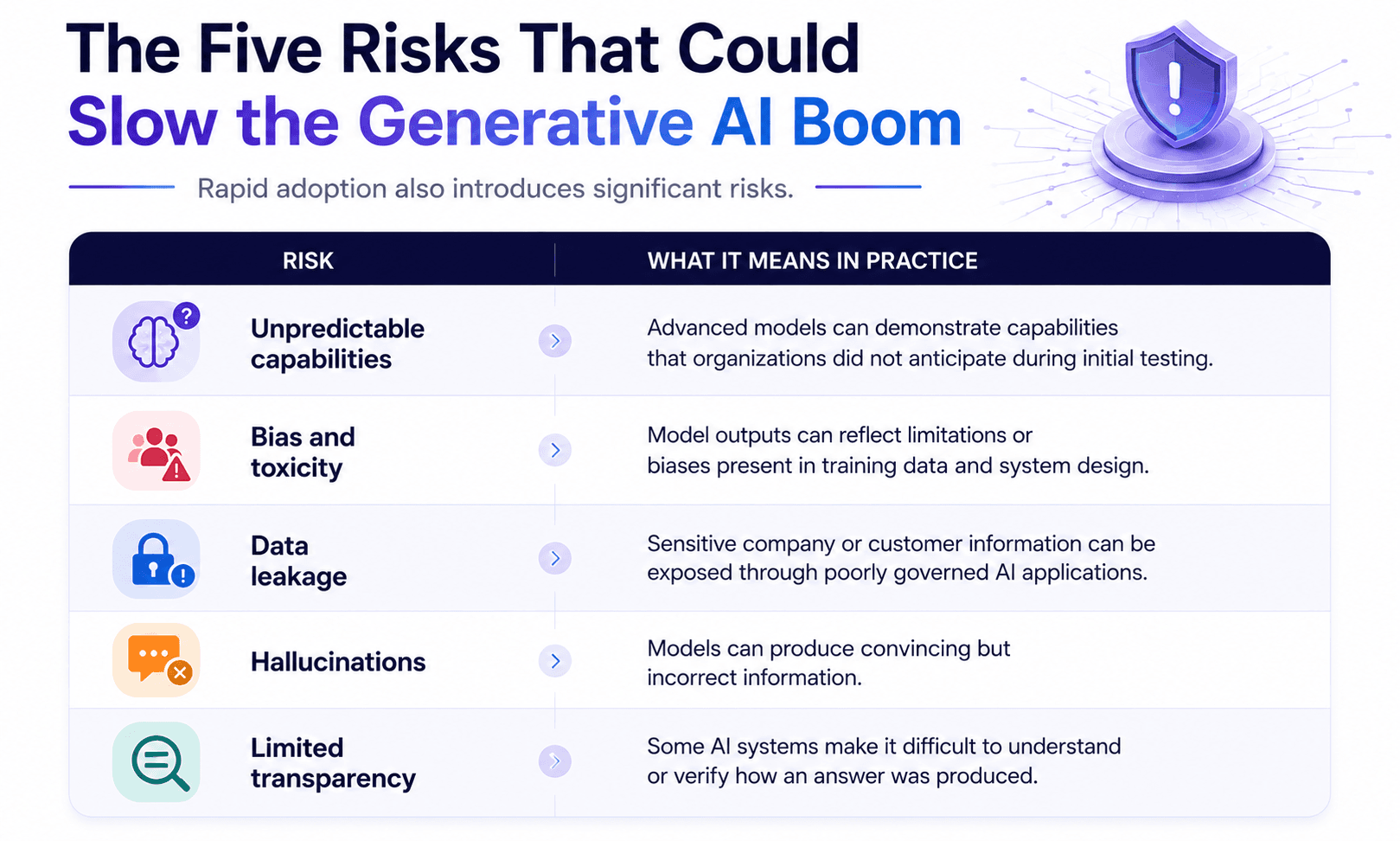
These risks become more serious as AI moves from content generation into business-critical workflows.
A marketing assistant producing an imperfect headline is one problem.
An AI system influencing a financial decision, medical workflow, or security operation is another. Enterprise AI product deployment (https://www.junkiescoder.com/services/enterprise-ai-product-deployment) requires much more than getting a model to generate accurate outputs; it also demands secure integrations, governance, monitoring, human oversight, and reliable performance in real-world production environments.
That is why enterprise GenAI increasingly requires:
Evaluation
Access controls
Monitoring
Human oversight
Audit trails
Data governance
Security testing
Clear escalation procedures
The Infrastructure Problem: More Compute Does Not Automatically Mean More ROI
AI infrastructure spending is growing at an extraordinary pace, but infrastructure investment creates its own economic risks.
The faster hardware improves, the faster older infrastructure can become less competitive.
Companies investing billions in AI data centers therefore need to consider:
GPU utilization
Hardware depreciation
Energy costs
Cooling requirements
Data-center capacity
Model efficiency
Inference economics
Hardware refresh cycles
Current reporting puts the 2026 capital spending plans of Alphabet, Amazon, Microsoft, and Meta at roughly $725 billion combined, illustrating the scale of the infrastructure race.
The key question is no longer simply:
“How much AI infrastructure can companies build?”
It is:
“How much business value can that infrastructure generate?”
What Comes Next for Generative AI?
The next stage of the market is likely to be defined by the transition from AI capability to AI utility.
The most important developments to watch include:
AI Agents (https://www.junkiescoder.com/services/ai-agent-development) Become More Operational
Agents will increasingly move from demonstrations to controlled production workflows where they can execute tasks across multiple systems.
AI Becomes Multimodal by Default
Text-only systems will increasingly be supplemented by models that understand images, audio, video, documents, and structured business data.
Enterprise AI Moves Closer to Core Systems
Instead of separate AI assistants, organizations will embed AI into CRM, ERP, developer tools, customer service, analytics, security, and productivity platforms. In many enterprises, this shift will also go hand in hand withlegacy application modernization (https://www.junkiescoder.com/services/legacy-application-modernization), as older systems need modern APIs, cloud-ready architectures, and better data integration before AI can be embedded effectively into existing workflows.
Model Choice Becomes Less Important Than System Design
Businesses will increasingly select models based on:
Cost
Latency
Reliability
Context requirements
Tool use
Privacy
Evaluation results
rather than simply choosing whichever model has the highest benchmark score.
ROI Becomes the Main Competitive Metric
As AI spending increases, boards and executives will increasingly ask:
What did this AI investment actually improve?
That will push companies toward measurable outcomes such as revenue growth, cost reduction, faster cycle times, higher employee productivity, and improved customer experience.
Frequently Asked Questions
What's actually driving the generative AI boom in 2026?
The biggest drivers are massive infrastructure investment, enterprise productivity demands, AI agents, multimodal capabilities, and the growing ability to integrate AI into real business workflows. BCG projects GenAI investment to increase by 60% over the next three years.
Which companies are leading generative AI in 2026?
The market includes foundation-model companies such as OpenAI and Anthropic, infrastructure providers such as NVIDIA, cloud and enterprise platforms such as Microsoft, Google, and AWS, and consumer AI companies such as Meta. Their strategies differ significantly, so “leading” depends on whether the focus is models, infrastructure, enterprise software, or consumer products.
Why are many companies still not seeing strong AI returns?
The main challenge is often implementation rather than model capability. BCG's research emphasizes people, processes, workflow redesign, and organizational change as major determinants of GenAI ROI.
How is agentic AI different from generative AI?
Generative AI primarily creates or transforms content in response to instructions. Agentic AI uses generative models as part of a broader system that can plan, use tools, retrieve information, execute actions, and work toward a defined goal.
Is proprietary data becoming more important?
Yes, but proprietary data does not necessarily need to be used to train a foundation model. Companies can create differentiation through private retrieval systems, domain-specific context, workflows, evaluations, fine-tuning, and integrations with internal systems.
What is the biggest financial risk in the AI infrastructure race?
One major risk is that enormous infrastructure investments may not generate sufficient returns if compute demand, model economics, or AI-product revenue fail to grow quickly enough. Rapid hardware improvements can also increase depreciation and refresh-cycle pressure.
What industries are adopting generative AI fastest?
Adoption is expanding across financial services, healthcare, life sciences, marketing, insurance, software development, customer service, and enterprise operations. The strongest opportunities tend to occur where organizations have large volumes of repetitive knowledge work and measurable workflow bottlenecks.
Conclusion
The generative AI boom is real, but the story is becoming more complicated than simply building bigger models.
Hundreds of billions of dollars are flowing into AI infrastructure, foundation models are becoming more capable, and enterprises are moving from experimentation toward agents, multimodal systems, and workflow automation. Current 2026 spending plans from four major technology companies alone illustrate the extraordinary scale of the infrastructure race.
Yet the biggest opportunity may not belong to the company with the most powerful model.
It may belong to the companies that can turn AI capability into reliable products, measurable productivity, and repeatable business value.
That means the next phase of generative AI will be defined by more than model performance. It will be shaped by infrastructure economics, proprietary data, workflow integration, governance, adoption, and ROI.
The companies pulling ahead are increasingly treating AI not as a standalone experiment, but as part of the operating infrastructure of their products and businesses.
The real GenAI race has moved from “Who can build the smartest model?” to “Who can turn AI into something people and businesses actually use?”
Appreciate the creator