What the Met's Latest Retail Crime Crackdown Means for Your London Business
The Metropolitan Police are taking retail crime more seriously than ever before. And the numbers prove it.
In the 2025/26 financial year, the Met made almost 50 per cent more arrests for shoplifting offences, a rise of 1,800 arrests. The positive outcome rate for retail crime, meaning a charge or caution, rose by 123 per cent, jumping from 2,682 to 5,996 in just one year.
For London business owners, this is significant news. But it also raises an important question: what does this mean for you and your premises?
The Scale of the Problem
Recorded shoplifting offences in London have more than doubled in the last four years, soaring from 3,202 in April 2022 to 7,865 in March 2026. More than 90,000 offences were reported in the year ending March 2026 alone.
But here's the reality behind those numbers. Just 104 prolific shoplifters were linked to more than 5,300 offences over the last two financial years, accounting for nearly a third of all cases where a suspect was identified. Each of those 104 offenders broke the law at least 31 times before they were jailed.
The problem isn't just the volume of crime. It's the concentration. A small number of repeat offenders are causing a disproportionate amount of harm to London's retail businesses.
How the Met Is Fighting Back
The Met has introduced several new measures that are already delivering results.
New Technology: Officers are trialling retail crime reporting technology that allows retailers to submit reports and CCTV footage instantly. Since its rollout in areas like Lewisham and central London, the positive outcome rate, defined as an arrest, charge or conviction, is 21.4 per cent. That's well above the Met average of 14 per cent.
Retrospective Facial Recognition (RFR): This fast-tracked process has achieved an 80.5 per cent identification rate for unknown retail offenders. In one case, RFR identified a suspect linked to 52 previously unsolved offences.
Information-Sharing Agreements: The Met has signed agreements with 16 Business Crime Reduction Partnerships and Business Improvement Districts across London. In the first month alone, 92 wanted offenders were identified.
Largest-Ever Crackdown: In October 2025, officers carried out the UK's largest ever targeted crackdown on organised shoplifting gangs. They arrested 32 people, raided more than 120 shops suspected of reselling stolen goods, and seized hundreds of thousands of pounds worth of items.
Deputy Commissioner Matt Jukes said: "Cracking down on shoplifting is a clear priority for the Met. By strengthening neighbourhood teams, using better intelligence and focusing on hotspot locations, we are arresting repeat offenders who cause the most harm to retail staff and local businesses."
What This Means for Your Business
These police operations are making a real difference. Shoplifting across London fell by 3.7 per cent, around 3,500 fewer offences, between April 2025 and March 2026.
But here's the hard truth: police resources are finite. While the Met is making progress, it cannot be everywhere at once.
Consider this: only 20 per cent of shoplifting cases are submitted with CCTV evidence. Where clear CCTV is provided, officers can identify around 80 per cent of suspects through facial recognition and crime databases. The gap between what's reported and what's solved is still significant.
Assistant Commissioner Matt Twist put it plainly: "We are still seeing the same individuals come back again and again, which shows the system needs to change."
The Gap That Still Exists
The Met has solved 92 per cent more shoplifting cases so far this year. That's impressive progress. But the total number of solved cases still represents a fraction of all incidents.
In the year to May 2025, just 6.8 per cent of shoplifting cases had a positive outcome. That improved to 14.3 per cent in the year to May 2026. Progress is being made, but the gap remains wide.
For your business, this means one thing: you cannot rely solely on police response to protect your premises.
What You Can Do
The Met is clear about what they need from businesses. Deputy Commissioner Matt Jukes said: "What we really want to do is see great information flow from the stores, really high quality CCTV, really high quality statements."
But beyond reporting and evidence-sharing, there's another layer of protection that every London business should consider.
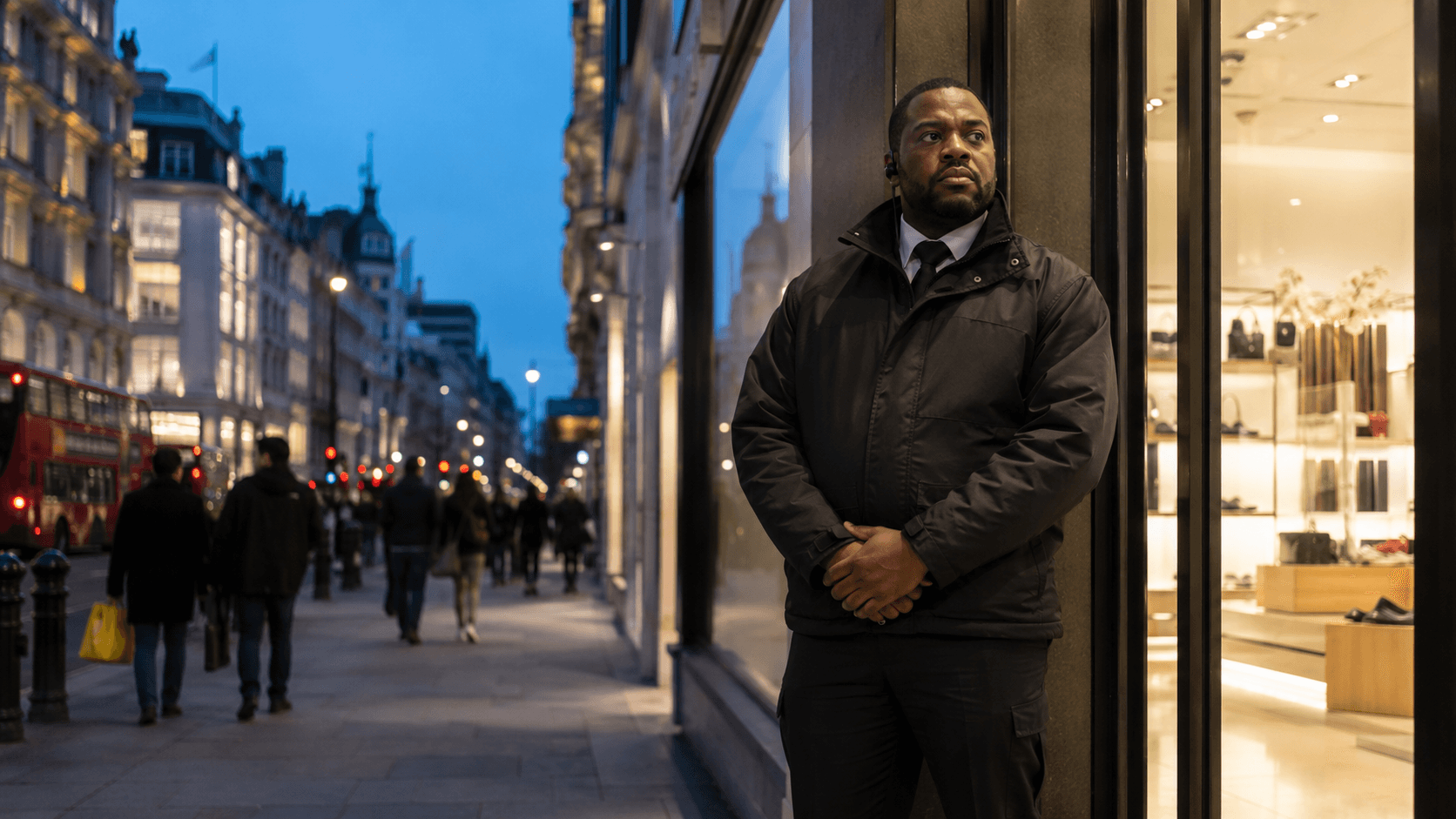
Proactive security fills the gap that police resources cannot cover. A visible, professional security presence on your premises:
Deters crime: Thieves look for easy targets. A uniformed guard tells them to move on.
Provides immediate response: Guards can challenge suspicious individuals and call police the moment something happens.
Delivers verifiable evidence: Digital patrol reports with GPS timestamps provide proof for insurance claims.
A professional security company in London can provide the active protection that cameras and alarms alone cannot match.
For many retail businesses, the most effective solution is a dedicated manned guarding service. Trained guards on your premises change behaviour instantly, and they're there when police can't be.
The Bottom Line
The Met is making significant progress. Arrests are up. Positive outcomes are up. Shoplifting is down.
But the criminals are still out there. And they're still targeting London businesses.
Don't wait for a break-in to show you what you should have done. Take a proactive step today. Walk your premises at night. Review your security setup. And consider whether your current protection is truly enough for the risks of 2026.
Your business deserves to be safe. Your staff deserve to feel secure. And with the right security partner, you can achieve both.
Appreciate the creator