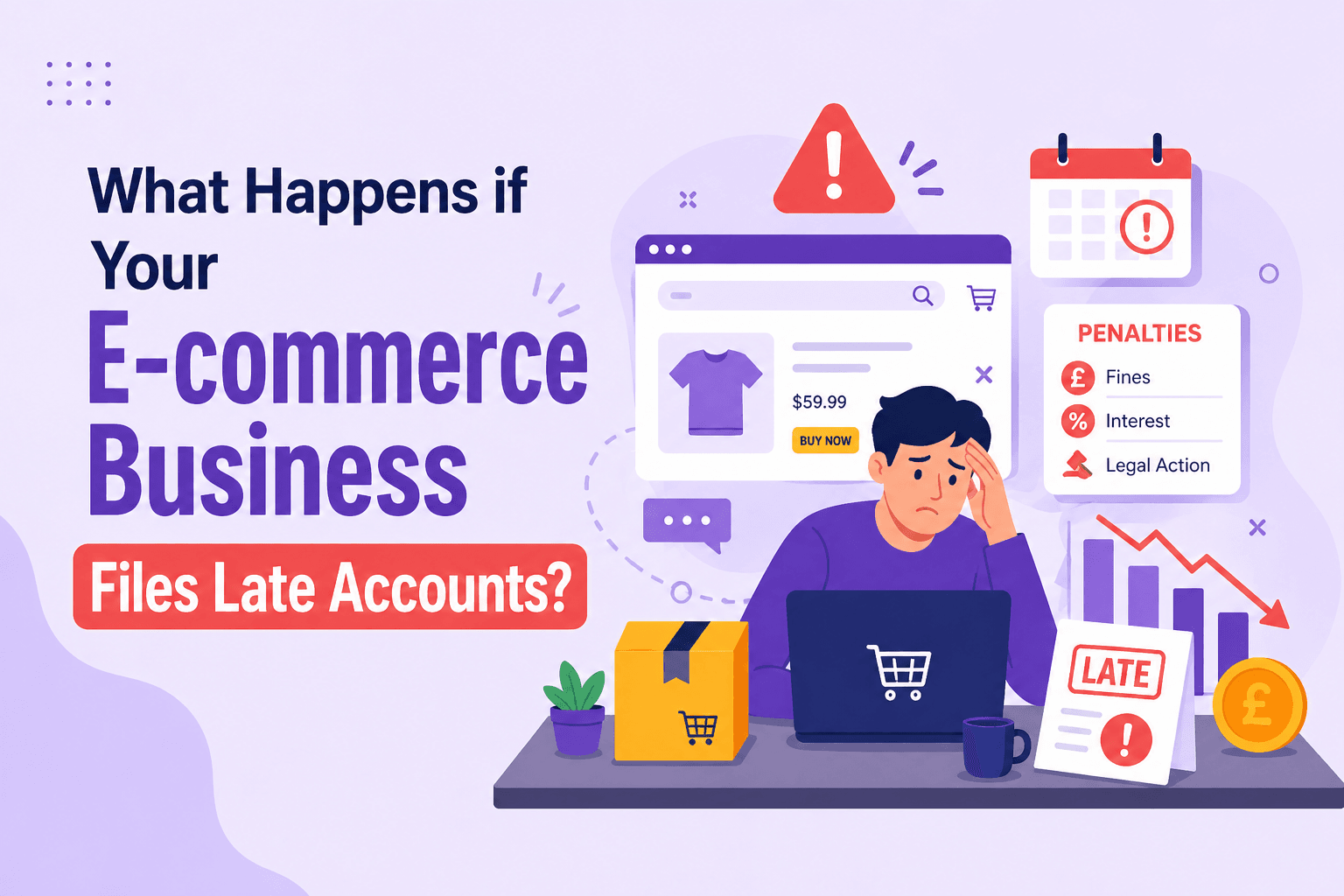
What Happens if Your E-commerce Business Files Late Accounts?
Most ecommerce business owners dread the idea of a fine from Companies House. It feels like the obvious consequence when deadlines slip. But if you have ever spoken to an accountant who works exclusively with online sellers, you will hear a different concern altogether. The fine is almost the least of your worries.
The real damage from late statutory accounts runs deeper, and it tends to show up in places that are far harder to fix than a penalty notice.
What Are Statutory Accounts and Why Do They Matter for Online Sellers?
Statutory accounts are the formal financial statements every limited company in the UK must prepare and file each year. They include a balance sheet, a profit and loss account, and notes to the accounts. They go to Companies House and HMRC, and they are publicly visible.
For ecommerce businesses, this is where things get interesting. Your accounts are not like those of a local service business or a high-street shop. You are likely pulling revenue from multiple platforms - Amazon, Shopify, Etsy, eBay - each with its own payout structure, fee deductions, and timing differences. A set of statutory accounts that does not reflect this properly is not just inaccurate. It is misleading to anyone who reads it.
That includes future investors, lenders, and HMRC.
The Fine Is the Starting Point, Not the Endpoint
Companies House operates a sliding penalty scale for late accounts. A private limited company filing up to one month late gets a £150 fine. Between one and three months, it rises to £375. Beyond six months, you are looking at £1,500. If it becomes a recurring pattern, those figures double.
For a growing ecommerce brand doing decent volume, these amounts are manageable. Annoying, but manageable. What is not manageable is the chain of consequences that follows from a track record of late filing.
What actually gets damaged
Your credit profile. Late accounts show up on credit reference searches. If you ever need a business loan, invoice financing, or a supplier credit line, late filing history is a red flag.
Your ability to sell the business. Any serious buyer or acquirer will run due diligence. Gaps or delays in your filing history cast doubt on how well the business is run.
Your relationship with HMRC. A business that files late with Companies House draws attention. It signals disorganisation, and HMRC tends to scrutinise disorganised businesses more closely.
Director reputation. As a director, your name is publicly attached to every filing. A pattern of lateness follows you, not just the company.
Why Ecommerce Accounts Are Harder to Get Right on Time
The complexity of ecommerce bookkeeping is what causes most deadline problems. It is rarely laziness. It is that the numbers are genuinely difficult to pull together correctly.
When you sell on Amazon, the amount that lands in your bank account is not your revenue. It is a net figure after Amazon fees, refunds, FBA charges, and advertising costs. Your statutory accounts need to reflect gross revenue, with each deduction shown correctly. If your accountant simply banks the deposit figure, your accounts are wrong from the first line.
The same issue applies across Shopify, Etsy, and eBay, each in slightly different ways. A proper set of accounts for an ecommerce business takes time and specialist knowledge to build. That is why professional statutory accounts services exist specifically for this sector - not because the rules are different, but because applying them correctly to ecommerce data requires a different level of focus.
The Hidden Cost: Decisions Made on Bad Numbers
Here is the part that most business owners do not consider. When your statutory accounts are late or poorly prepared, you lose access to accurate historical data at the exact moment you need it most.
Ecommerce moves fast. Pricing decisions, stock purchases, ad spend - all of these benefit from clean financial visibility. If your accounts are always three months behind because they keep getting filed late, you are constantly making present-day decisions based on stale or incomplete figures.
Working with a personal tax accountant who also handles your company accounts adds another layer of benefit here. Your personal drawings, dividends, and salary structure all feed into your self-assessment. When the company accounts are late, your personal tax position gets delayed too, and any planning opportunities narrow or disappear entirely.
How to Get Ahead of the Problem
The fix is not complicated, but it does require consistency. Here is what keeps ecommerce businesses out of trouble with their statutory accounts:
Use cloud accounting software connected to your selling platforms. Tools like Xero paired with A2X or Link My Books automate the data flow so your books stay current rather than being rebuilt from scratch each year.
Do not wait until year-end to reconcile. Monthly bookkeeping reviews mean there are no surprises when accounts preparation begins.
Work with an accountant who knows ecommerce. The back-and-forth delays that push accounts past deadlines almost always come from an accountant who does not know what they are looking at.
Set internal deadlines three months ahead of the Companies House deadline. This gives buffer time if anything needs correcting.
FAQ
What is the deadline for filing statutory accounts?
For a private limited company, statutory accounts must be filed with Companies House within nine months of your financial year-end. For a new company in its first year, the deadline is 21 months from incorporation. Missing these dates triggers automatic penalties.
Can I file statutory accounts myself without an accountant?
Technically yes, but for ecommerce businesses it carries real risk. The complexity of multi-platform revenue, COGS, and VAT treatment makes errors likely without specialist knowledge. Errors in statutory accounts can trigger HMRC enquiries or require costly corrections later.
Will Companies House strike my company off for late accounts?
Yes, in serious cases. If accounts are significantly overdue and there is no communication with Companies House, the registrar has the power to begin strike-off proceedings. This can also affect your personal credit record as a director. It is an extreme outcome but a real one.
Appreciate the creator