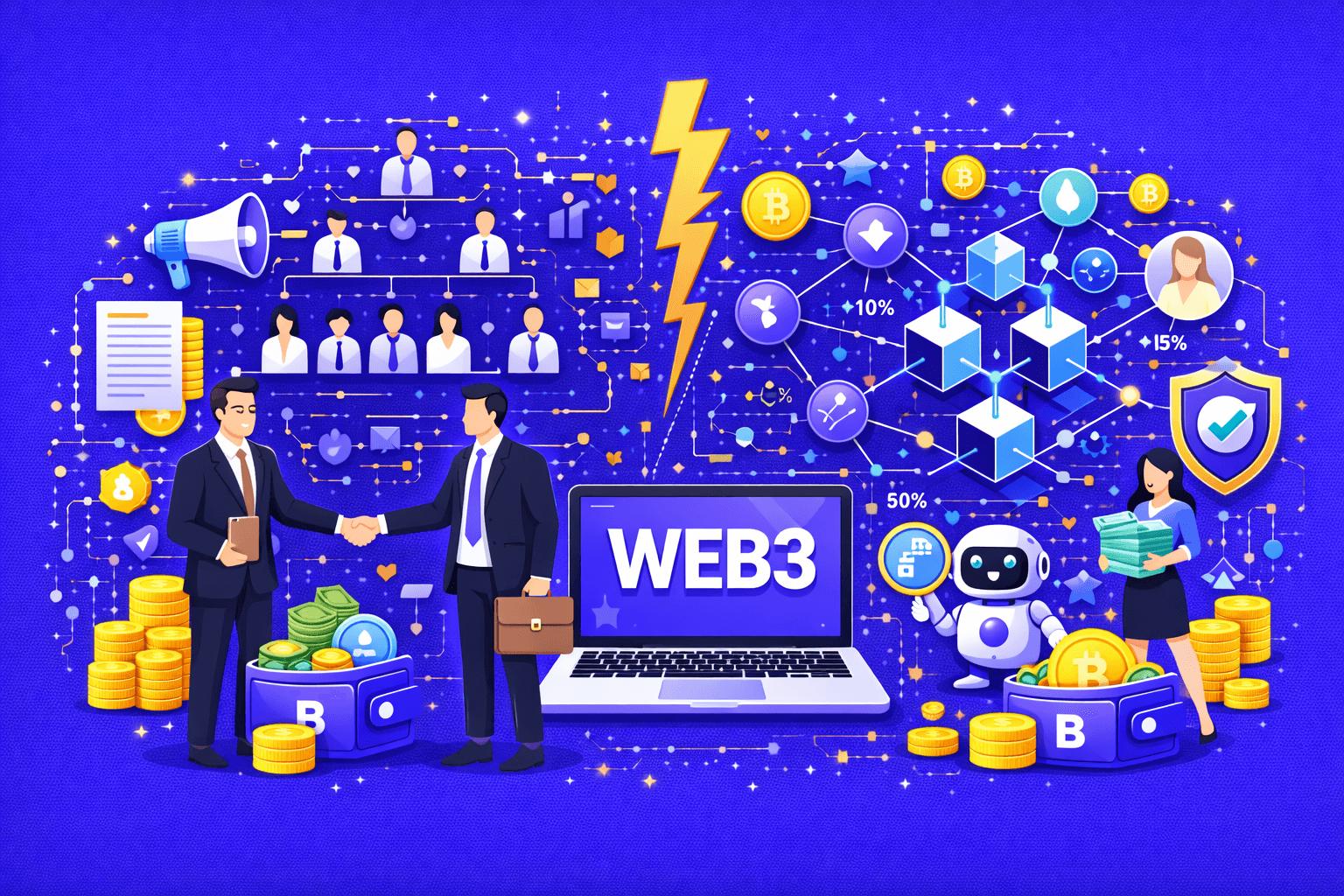
Web3 Applications of Multi-Level Marketing Systems
Multi-level marketing has been around for decades. The business model itself is not new. What is new is the infrastructure underneath it. Web3 is changing how MLM networks are built, how participants interact with them, and how trust is established without relying on a company to be the final authority on who earned what.
This article looks at where Web3 technology is being applied inside MLM systems today, what specific problems it solves, and what businesses in the U.S. need to understand before they build in this space.
The Problem Web3 Is Solving in MLM
Traditional MLM networks have a structural trust problem. The company controls the database. The company calculates the commissions. The company decides when payouts happen. Participants have no independent way to verify that the numbers they see on their dashboard match what the backend actually recorded. When disputes arise, the company's records are treated as final.
This setup has created real problems over the years. Commission errors go undetected for months. Rank qualifications get changed without clear notice. Payout timing shifts during high-volume periods. Participants who recruit aggressively and build large downlines find that the rules governing their earnings can be rewritten without their input.
Web3 does not ask participants to trust the company. It asks them to trust the code. When the commission logic runs on a public blockchain as a smart contract, any participant can read the rules. Payouts execute automatically when conditions are met. Referral links are recorded on-chain and cannot be edited by anyone. According to Wikipedia, decentralized applications run on a peer-to-peer network of computers rather than a single server, which means no single party controls the outcome.
That shift from company-controlled to code-controlled is the core of what Web3 brings to MLM.
On-Chain Referral Tracking
One of the most straightforward Web3 applications in MLM is moving referral tracking onto the blockchain. In a traditional system, when someone joins under a referrer, that relationship is stored in a private database. The referrer has no way to independently confirm it. If a data migration goes wrong or a record is altered, they may lose credit for their recruitment activity without ever knowing it happened.
In a Web3 MLM system, referral relationships are written to the blockchain at the moment of enrollment. The sponsor wallet address and the new participant wallet address are linked in a transaction that is permanent and publicly readable. Neither the platform operator nor anyone else can modify that link after the fact.
This has a practical effect on participant behavior. Recruiters who build their networks knowing that their downline is cryptographically recorded are more confident investing time in network building. That confidence translates into more committed participation, which benefits the entire network.
For a detailed look at how these referral structures are encoded into blockchain-based MLM networks, this resource on blockchain-based MLM network design explains the technical mechanics behind on-chain genealogy trees.
Automated Commission Distribution via Smart Contracts
Commission distribution is where most traditional MLM platforms create friction. Calculations happen in batches. Payouts go through approval queues. Finance teams process withdrawals on weekly or monthly cycles. Participants wait days or weeks to access money they technically earned the moment a qualifying sale happened.
Smart contracts remove the queue entirely. The commission logic is written into the contract before deployment. When a qualifying event occurs, the contract executes automatically, calculates the upline commissions across every applicable level, and sends the funds to the correct wallet addresses. The entire process completes in the time it takes for a blockchain transaction to confirm, often a matter of seconds.
This speed is not just a convenience feature. It fundamentally changes how participants experience the platform. Seeing a commission land in your wallet within seconds of a sale closing is a much stronger motivational signal than knowing a payment will arrive sometime next week after the finance team processes it. Companies offering crypto mlm software development solutions build this automated distribution as the core payout mechanism rather than an optional feature.
Decentralized Governance: Giving Participants a Real Voice
One of the more ambitious Web3 applications in MLM is decentralized governance. The idea is that the people who participate most actively in the network also get a say in how the network evolves. This is implemented through governance tokens that accumulate based on activity metrics like sales volume, recruitment, or platform usage.
When governance proposals come up, such as adjusting commission percentages, adding a new plan structure, or expanding into a new market, token holders vote. The outcome is determined by the collective decision of the network rather than a single executive team behind closed doors.
This model is called a DAO (Decentralized Autonomous Organization). According to Wikipedia, a DAO is an organization represented by rules encoded as a transparent computer program, controlled by the organization members, and not influenced by a central government. Wyoming was among the first U.S. states to legally recognize DAOs as business entities, and other states have since followed.
For MLM businesses, DAO governance is a powerful trust-building tool. It addresses one of the most common participant complaints, which is that the company changes the rules without consulting the people most affected by them. A crypto mlm software development company that has experience building DAO governance layers can integrate this into the platform architecture from the start rather than trying to retrofit it later.
Token-Based Incentive Layers
Beyond commission payouts, Web3 MLM platforms use tokens to create additional incentive layers that keep participants engaged beyond the immediate financial return. These token economies are designed to reward behaviors that benefit the network: consistent sales activity, mentoring downline members, contributing to community content, or simply staying active over a sustained period.
Utility tokens earned through these activities can unlock premium features inside the platform, give access to exclusive product tiers, or be staked to earn additional rewards. This creates a financial ecosystem where participants have multiple reasons to stay engaged rather than collecting commissions and doing nothing else.
Designing a token economy that works long-term is genuinely difficult. The tokens need real utility to maintain value. If the only use for a token is converting it to cash, participants will do exactly that, creating sell pressure that drives the price down and erodes the incentive structure. A capable crypto mlm software development company in the USA will push clients to think through token utility before writing any code, because getting this wrong at the design stage is very expensive to fix after launch.
NFT Memberships and Rank Credentials
NFTs (non-fungible tokens) have found a practical use case inside Web3 MLM systems that goes well beyond digital art. In this context, NFTs serve as membership passes, rank credentials, and product access keys that are verifiable on-chain and transferable between participants.
A participant at a senior rank in the network might hold an NFT that grants access to premium commission rates, exclusive training content, or early product releases. Because the NFT is recorded on the blockchain, its authenticity and ownership are verifiable without any company database lookup. If that participant chooses to sell their position, the NFT and its associated benefits can transfer to the buyer according to rules defined in the smart contract.
This creates a secondary market for network positions that does not exist in traditional MLM. High-performing downlines have real asset value, and the NFT structure makes that value liquid and transferable. For businesses exploring this model, working with a team offering cryptocurrency mlm software development services that understands both NFT mechanics and MLM compensation structures is essential, because the two need to be tightly integrated to work correctly.
One of the practical limits of early Web3 MLM systems was chain exclusivity. A platform built on Ethereum was only accessible to participants holding Ethereum-compatible wallets and willing to pay Ethereum gas fees. Participants who held assets on BNB Chain, Solana, or Polygon were effectively locked out unless they bridged funds, adding friction and cost that drove away people who would otherwise have joined.
Cross-chain infrastructure is now mature enough to address this. Bridge protocols and multi-chain smart contract deployments allow participants to join a network from whichever chain they prefer and still participate in the same referral hierarchy and commission structure. Payouts can be denominated in stablecoins like USDT or USDC and delivered to whichever chain the participant specifies.
For U.S. businesses, this matters because the domestic crypto user base is fragmented. Different demographics use different chains for different reasons. Limiting a platform to a single chain is a self-imposed ceiling on the addressable participant pool. The infrastructure to remove that ceiling exists, and companies building crypto mlm software development solutions that include cross-chain support from day one are building for a larger market.
Privacy in a Transparent System
Blockchain's default transparency is one of its strengths and one of its complications. In a public blockchain, all transaction history is readable by anyone with an explorer. For MLM participants, this means their commission earnings, downline growth, and withdrawal patterns are technically visible to any network member who looks up their wallet address.
Most participants are not comfortable with that level of exposure. They want the benefits of blockchain transparency, specifically that the rules are public and the records cannot be tampered with, without broadcasting their personal financial activity to the entire network.
Zero-knowledge proofs (ZKPs) address this directly. A ZKP allows a participant to prove that they meet a qualification threshold without revealing the actual number. A participant can prove they hit a sales volume requirement without displaying their exact earnings to their downline. This privacy layer can be built into Web3 MLM platforms without sacrificing the underlying transparency that makes blockchain valuable in the first place.
This is an emerging area, and not every development team has experience implementing ZKPs in production. It is a feature worth asking about specifically when evaluating platforms, especially for businesses with participants who are sensitive about financial privacy.
The Infrastructure That Makes It All Work
Describing Web3 MLM features is straightforward. Building them reliably at scale is harder. The distributed ledger infrastructure underneath these systems needs to handle high transaction volumes without significant delay or cost. For MLM networks with active participants, the volume of commission calculation events, withdrawal requests, and governance votes adds up quickly.
Layer 2 networks like Arbitrum and Optimism, built on top of Ethereum, reduce transaction costs by orders of magnitude while inheriting Ethereum's security model. Alternative Layer 1 chains like Solana offer very high throughput at low cost. The choice of infrastructure affects every downstream technical decision, from wallet integrations to data indexing strategies.
For businesses that want to understand how the ledger layer specifically connects to MLM operations, this detailed breakdown of how distributed ledger technology powers MLM systems covers the infrastructure mechanics that determine real-world platform performance.
Regulatory Considerations Specific to Web3 MLM in the USA
Adding Web3 components to an MLM does not remove it from the FTC's oversight. The core test for whether an MLM is legal in the U.S. is still the same: does the majority of participant income come from actual product or service sales, or does it come primarily from recruitment? A blockchain-based commission structure that rewards recruitment over sales is still a pyramid scheme, regardless of how sophisticated the technology is.
Governance tokens and reward tokens distributed through the platform may also attract SEC attention if they meet the criteria for investment contracts under the Howey Test. Businesses need legal review of their token design before launch, not after. Working with a crypto mlm software development company that has navigated these questions before means the software architecture can be built to support compliance rather than working against it.
For a broader structural overview of how compliant blockchain MLM networks are typically designed, this guide on blockchain MLM network architecture covers the design decisions that have regulatory implications and how to approach them.
Choosing the Right Platform for Web3 MLM
Not every blockchain developer understands MLM. Not every MLM software company understands blockchain. The intersection of the two domains is specific, and building a production-grade Web3 MLM platform requires competence in both. Commission plan mechanics, genealogy tree performance at depth, token economic design, smart contract security, and U.S. regulatory compliance all need to be handled correctly for the platform to work as intended.
Businesses exploring this space should evaluate their development partner carefully. Ask to see past deployments. Ask for smart contract audit reports. Ask specifically how they have handled compliance requirements in previous projects. Reviewing what a complete cryptocurrency MLM software platform includes in terms of Web3 features and compliance architecture is a useful reference point before starting any vendor conversations.
Key Takeaways
Web3 replaces company-controlled databases with on-chain records that no single party can alter, solving MLM's fundamental trust problem.
On-chain referral tracking gives participants permanent, independently verifiable proof of their network relationships.
Smart contract-based commission distribution eliminates payout delays, executing automatically when qualifying conditions are met.
DAO governance allows active participants to vote on network rule changes instead of having changes imposed on them.
NFT-based rank credentials make network positions verifiable, transferable, and potentially tradeable as real assets.
Token incentive layers add motivation beyond cash commissions, but require careful utility design to hold long-term value.
Cross-chain support removes participant access barriers and expands the addressable network significantly.
Zero-knowledge proofs allow privacy-preserving verification, letting participants prove qualifications without exposing earnings.
FTC and SEC compliance requirements apply equally to Web3 MLM systems. Technology does not exempt a business from regulatory scrutiny.
Appreciate the creator