Vermicompost for Agriculture
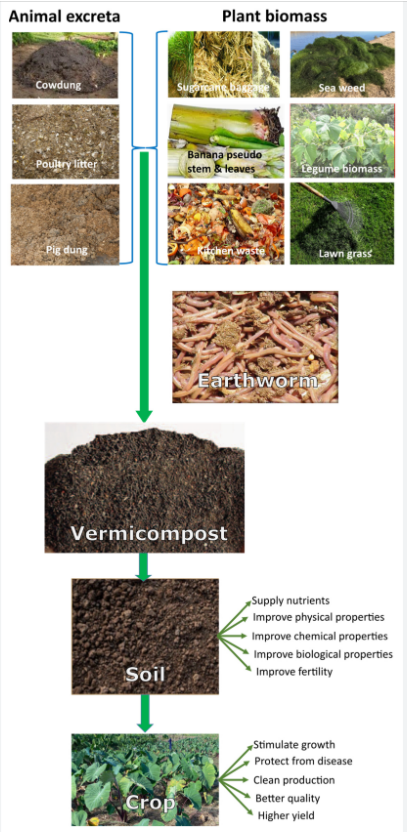
SRIJEETA MAJUMDER Composting is a process in which the biodegradation of organic matter takes place in an aerobic environment. There is various composting process and is one of the traditional practice for organic waste management. Over time composting techniques have evolved with various advanced engineering. Vermicomposting is an extension of composting technology in which earthworms are involved in the degradation process. Earthworms consume organic matter and accelerate the degradation process. In the end, nutrient-rich vermicompost considered one of the finest organic fertilizers is obtained. Vermicompost is termed black gold. The application of vermicompost has various benefits including promoting soil health and plant growth. Being organic is always superior to other synthetic chemicals. The demand for vermicompost production is rising in the global market. The outcome of vermicompost never harms human health and is always safe for consumption. Environmental issues are always resolved by the application of vermicompost. The technology itself for vermicompost production is environment-friendly and economical. The zero pollution and low cost of vermicomposting technology make it advantageous over other fertilizer production technologies. At present for sustainable future adoption of eco-friendly and economical technology is very much important. Vermicomposting has the potential to mitigate all the problems related to health, the environment, and society. Organic waste generation is becoming a major problem all over the world and its ultimate fate is the waste stream. The burning also releases harmful elements into the atmosphere as well as destroys the overall physical properties of the soil. Proper waste management through the utilization of these biowastes as organic fertilizer for organic farming is possible. This may set a benchmark as the most significant approach for sustainable development.

The importance of earthworms for the biodegradation of organic waste was first observed by Charles Darwin which became the base for the evolution of modern sustainable technology called vermicomposting for organic waste management. Vermicomposting has evolved more scientifically by different researchers. There are various benefits associated with vermicompost. Vermicomposting is considered more advantageous than the traditional composting process. The particle obtained after a breakdown during vermicomposting is more homogenous and uniform with earthy manifestation than the heterogeneous mixture obtained during the composting process. The release of nutrients is slow during the application of vermicompost to the soil. This benefits the easy uptake of nutrients by plants and also increases the water-holding capacity of the soil. Vermicomposting highly influences the soil's physical properties. The soil porosity, aeration, and temperature are well maintained during the application of vermicompost. Soil microbial activity is also enhanced and replenishes nutrient content in the soil in a significant way which gradually promotes healthy plant growth. The bulk density of soil is also observed to be reduced due to enhanced microbial activity resulting in increased porosity. The oxidation potential is also enhanced during vermicompost application to the soil. Vermicomposting of different organic wastes with different earthworm species results in nutrient-rich eco-friendly vermicompost. The nutrient content is significantly high in vermicompost produced from various feedstocks and acts as a soil amendment for organic farming. The nutrients are released into a more exchangeable format during the stabilization process of organic waste making these elements readily available to plants in the final vermicompost. If we consider the economic benefits of vermicompost, at the current time the global fertilizer market is increasing. Farmers are more concentrated on efficient production. Organic fertilizers are always derived from natural sources. Vermicompost is a result of the bio-conversion of various organic wastes. The improvement in soil quality and healthy crops associated with vermicompost application highly influence the rural economy. The economic profit for any agricultural produce is evaluated based on yield, return and cost–benefit analysis. The nutrient losses from the field are marginalized during any organic application including vermicomposting. The lower emission of pollutants, soil biota conservation, and enhanced nutrients are all characterized by economic profit for any marginal farmers using organic manure like vermicompost. On the other hand site production of vermicompost also requires very low input for installation and the raw material can be easily available without any transportation costs. Rural development is possible through employment generation by the small entrepreneur with vermicompost production with readily available resources in and around. The farmers benefited substantially from organic farming as compared to equivalent economic input in synthetic fertilizers.
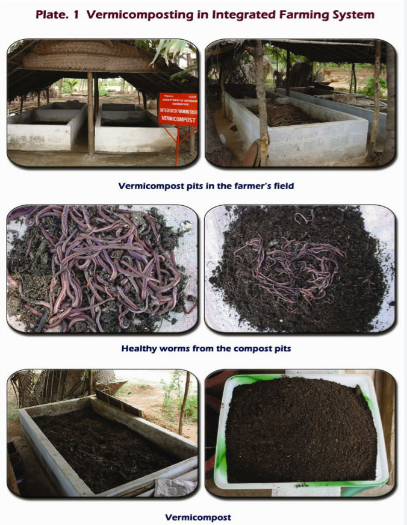
Abstract Vermicomposting is a process in which earthworms are used to convert organic materials into humus-like material known as vermicompost. Several researchers throughout the world have found that the nutrient profile in vermicompost is generally higher than in traditional compost. Vermicompost can enhance soil fertility physically, chemically, and biologically. Physically, vermicompost-treated soil has better aeration, porosity, bulk density, and water retention. Chemical properties such as pH, electrical conductivity, and organic matter content are also improved for better crop yield. Types of Vermicomposting Systems:- No matter how large or small, vermicomposting piles are contained in three basic types of systems: bins, beds, and windrows. Significance of Vermicompost
Vermicompost improves the recycling of soil.
Vermicompost enriches the soil with microbes.
In rural areas, the production of vermicompost can provide livelihood support to the unemployed.
Vermicompost helps in improving soil texture, and aeration and increases water retention capacity.
Vermicompost acts as a soil conditioner and improves the biological, physical, and chemical properties of the soil. Applications of Vermicompost Vermicomposting is environmentally friendly and is widely used in agriculture. These organic wastes contain organic carbon and plant nutrients in appreciable amounts.
Vermicomposting can also be used as a technique for domestic wastewater management.
Vermicompost can be used in organic farming and small-scale sustainable farming.
Vermicompost has several excellent properties and has many advantages when applied to the soil.
Vermicompost is an excellent nutrient-rich organic fertilizer, which helps plants to grow well and give better yields.
Adding vermicompost, which is rich in organic compounds, to the soil, plays a fundamental role in improving productivity.
Vermicompost can also be used as a growth regulator as it contains all essential plant nutrients in appropriate proportions. Thus, it is complete and balanced plant food.
Vermicompost is high in proteins and other essential nutrients. Therefore, it is also used as an alternative in aquaculture feed.
Regular use of vermicompost extract promotes plant growth, keeps plants healthier, and fights plant diseases.
CONCLUSIONS Vermicomposting is regarded as a clean, sustainable, and zero-waste approach to managing organic wastes but there are still some constraints in the popularization of vermicomposting. Instead of increasing research in the field of vermicomposting, the practical application of vermicomposting needs more attention. Vermicomposting on a large scale is required to solve the problem of waste disposal effectively and on a global level. One of the major constraints is the lack of awareness and proper knowledge regarding vermicomposting and the use of vermicomposting. It is necessary to guide farmers about vermicomposting and the appropriate use of vermicompost by organizing various training and extension activities. Innovative and effective agricultural activities must be developed to educate and assist farmers in organic farming. They should be educated about the process of vermicomposting and the quantities of vermicompost that should be applied to achieve the best results in agricultural fields. The higher cost of organic fertilizer than synthetic fertilizer is also an obstacle for farmers to adopt organic farming on a large scale. Mass application of vermicompost is not achieved due to the failure of policy implementation related to vermicompost technology.
Appreciate the creator