Upskilling vs Reskilling: How Distance Learning Solutions Support Both
According to the World Economic Forum's Future of Jobs report, nearly 63% of employers identify skill gaps as the biggest barrier to business transformation.
Organisations need an effective training format that can help teams with upskilling, reskilling, or both in accordance with requirements, and distance learning solutions seem to fit the bill.
Distance learning solutions (https://www.acadecraft.com/learning-solutions/distance-elearning-solutions/) can support both aspects of skills: upskilling or reskilling. But how would you know what your team needs? Further in this article, we will discuss that.
What is the use of distance learning solutions?
Distance learning solutions deliver the training content organisations need by using digital tools such as learning management systems, video assessments, recorded modules, and online assessments for connecting learners to instructors via technology. Organisations use this format for its qualities that facilitate learning regardless of the locations or distance between learners and trainers.
The role of distance learning in upskilling vs reskilling
Each of them solves different problems
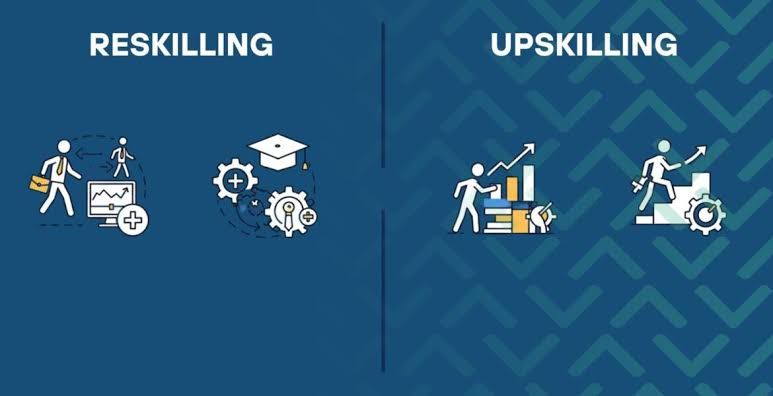
Upskilling means deepening the knowledge of what the learner already knows, like a sales executive learning about consultative selling techniques. On the other hand, reskilling means training for a completely different role, such as a manual worker transferring to a quality analyst role. A single format cannot serve both of them, but distance learning solutions can do that because of their modular format: different types of content are layered.
Employees lack time for training
This is one of the major issues employees face while training; they cannot make time for scheduled sessions. An employee who has multiple tasks throughout the day or week cannot attend a long lecture while sitting in a class. With the help of distance learning solutions, they can strategise their skill training to resolve the time issue.
Reskilling needs scalable content
If the organisation needs to retrain a significant number of employees for new roles, it cannot rely on traditional learning because this format will take a lot of time. Distance learning solutions are easier to scale once the content is built; they can be scaled to thousands of learners without any additional infrastructure cost. This way, every learner receives the same quality content simultaneously, which makes reskilling initiatives operationally viable.
Upskilling needs personalised content
The learners need a training program that allows them to start afresh and not follow with one-size-fits-all content that contains information some seniors might already know, while juniors struggle due to a lack of foundational knowledge. Introducing a personalised training program will allow them to begin learning with an individual path based on current skill levels, role requirements, and learning pace.
Skill requirements are changing rapidly
Adopting distance learning solutions would be beneficial for the business in the long term as well as in the present, because the current market is rapidly changing skill requirements due to evolving technologies and other factors. A distance learning program can be built once and deployed to the entire workforce, and then L&D teams can update the modules when needed, which makes upskilling more effective without rebuilding the entire program.
This supports workforce planning
The learning and development team has to decide who needs upskilling, who needs reskilling, and where skill gaps reside. But this cannot be concluded without the right data, and traditional learning does not provide this information. But the platform that hosts distance learning solutions stores this data. The L&D and HR teams can use it to learn more about the real picture of workforce capability.
Less turnover with good training
Nearly 94% of employees say they would stay longer at a company that invests in their learning, as per the LinkedIn Learning report. Millennials and Gen Z employees have a clear priority to ascend the career ladder with time, and if the employer cannot seem to provide that, they are most likely to leave the job at the company. And this behaviour piling up can cause severe damage to the business and the quality of service.
Does your company need reskilling, upskilling, or both?
The answer is based on where the organisation stands in the market. If your company had a lot of repetitive work, and after the introduction of automation and AI, the work became unstable, with employees being idle, there is a need for reskilling. If the employees have already mastered existing skills or need to perform better with new tools, updated processes, and evolving industry standards, the need is for upskilling. Most of the organisations have both conditions in different teams, so using distance learning solutions would be a strategic step.
Final Thought
Organisations that invest in distance learning solutions for upskilling and reskilling are most likely to adapt to the future market changes with minimal losses because the format already teaches the organisation and its employees how to keep pace with changing requirements or an entirely new change of role with effective strategies that drive completion, retention, and engagement in the program.
Appreciate the creator