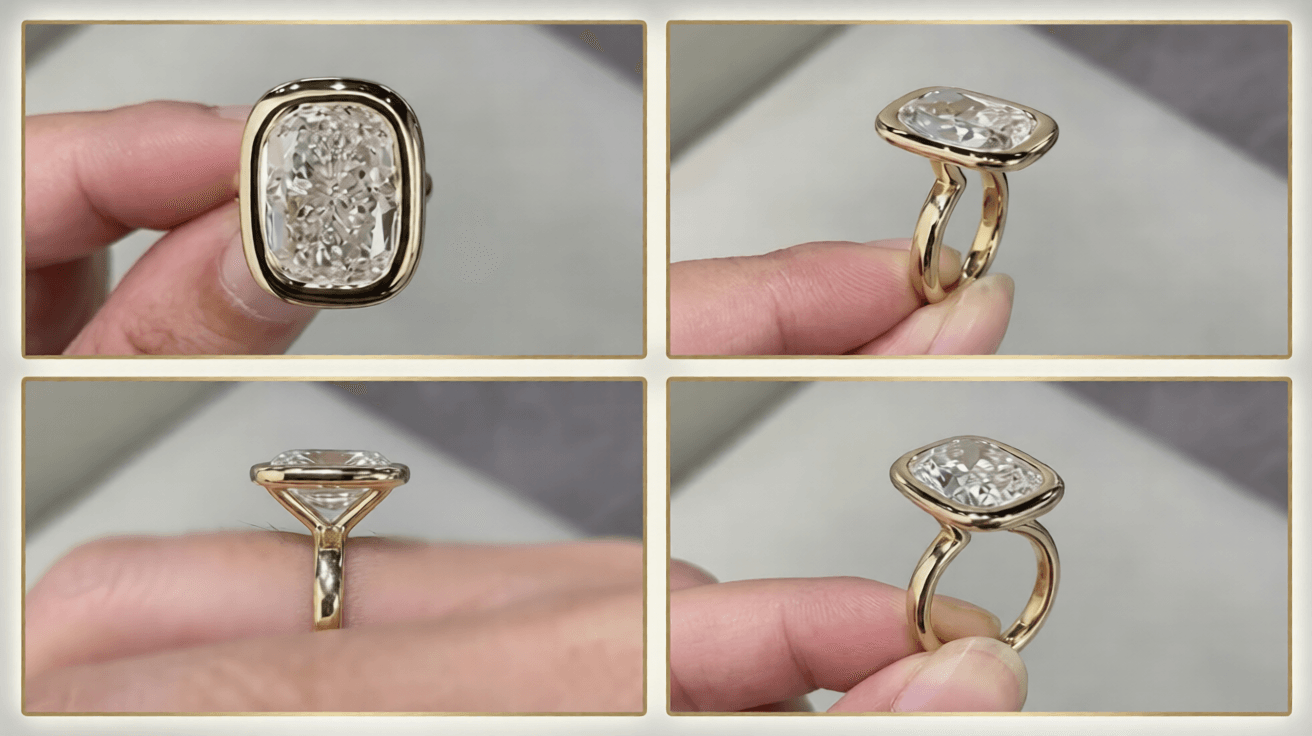
Understanding the Design Behind a 10 Carat Diamond Engagement Ring
When we gaze at an exceptionally large piece of jewelry, our initial reaction is almost always driven by pure emotion. We notice the blinding flash of light, the deep scintillation across its facets, and the unmistakable sense of drama it brings to the wearer’s hand.
In the upper echelons of luxury, a piece of grand scale is the ultimate symbol of achievement, romance, and personal style. It commands attention without saying a word, functioning as an anchor for a couple’s shared legacy.
Yet, behind that initial emotional impact lies a world of rigorous science, geometry, and meticulous design engineering. A massive gemstone is not simply dropped into a standard metal mounting.
At an elite scale, creating a piece of fine jewelry transitions from an act of simple styling into a complex challenge of micro-architecture.
To turn a substantial crystalline mass into a secure, comfortable, and visually balanced masterpiece requires a deep understanding of physical forces, light performance, and structural mechanics.
The Balancing Act: Ergonomics of Substantial Scale
The physical reality of a double-digit weight changes the rules of jewelry manufacturing entirely. When working with typical commercial sizes, a ring's center of gravity remains close to the finger, meaning the band naturally stays upright with minimal effort.
However, when a central gem reaches a monumental volume, its weight distribution shifts drastically upward, creating a top-heavy structure that reacts directly to the movement of the hand.
An uncalculated design will suffer from a persistent issue known as spinning—where the weight of the stone causes the ring to slide sideways, tipping toward the pinky or index finger.
This is not only frustrating for the wearer but also increases the risk of the setting accidentally striking hard surfaces. To counteract this, master jewelers must treat the shank as a balancing counterweight.
By strategically adjusting the profile of the band—often widening the base or using a split-shank architecture—designers create a solid foundational anchor. The under-gallery must also be carved to sit as flush to the skin as possible, lowering the stone’s center of mass without cutting off the vital pathways needed for light to enter from beneath.
When executed correctly, the physical weight is distributed evenly across the base of the finger, allowing a massive statement piece to feel light, natural, and incredibly secure during daily wear.
When investing in a lifelong symbol of commitment at this level, taking a closer look at a 10 carat diamond engagement ring reveals that success is found at the intersection of material purity and structural harmony.
Maximizing Sparkle Through Facet Engineering
The visual life of a prominent stone is dictated entirely by how light moves through its internal architecture. When a crystal body scales up, the physical path that light travels between the upper crown and the lower pavilion surfaces becomes significantly longer.
This altered distance changes the stone's optical physics, making precision cutting the absolute defining factor of its beauty. If the pavilion facets are angled incorrectly by even a fraction of a degree, light leaks straight through the bottom of the gem instead of bouncing back to the eye, creating a flat, lifeless gray zone known as a window. .
Conversely, if the stone is cut too deep to preserve raw weight, it creates a dark center that chokes out the stone's natural fire. Master cutters spend months mapping out internal grain directions before a single facet is polished.
With architectural cuts like an Emerald or Ascher shape, the parallel step-facets act like an intricate hall of mirrors, showcasing the crystalline purity of the material.
Brilliant shapes, such as a crisp Round or a romantic Cushion, rely on dense facet configurations to break light into a dazzling display of rainbow dispersion.
The artisan's goal is to ensure that every beam of light entering the stone is perfectly captured, redirected, and fired back to the viewer, turning the massive canvas into an explosion of pure energy.
Selecting the Blueprint for an Ultimate Marital Token
For couples stepping into this exclusive realm of collecting, the journey requires a massive shift in perspective. Because the physical surface area of an ultra-large stone acts like a natural magnifying glass, standard metrics of quality are highly amplified. Minor color variations or tiny internal inclusions that would easily hide in a small stone become instantly visible to the naked eye at this magnitude.
Navigating these geometric and physical realities requires clear guidance. When investing in a lifelong symbol of commitment at this level, taking a closer look at a 10 carat diamond engagement ring reveals that success is found at the intersection of material purity and structural harmony.
An informed buyer must scrutinize the independent grading report, pay fastidious attention to cut symmetry, and choose an architectural style that matches both their personal lifestyle and the natural proportions of the hand.
The choice of setting style is critical here. A minimalist solitaire puts the entire focus on the pure scale of the gem, relying on ultra-fine, heavy-gauge prongs to keep the look clean and contemporary.
A three-stone design uses tapered step-cut side stones to create an elegant, stepped silhouette that visually flows into the band, softening the transition from the massive center stone to the finger. Whichever path is chosen, the final blueprint must serve to elevate the gem while maintaining its absolute structural safety.
Fusing Old-World Artistry with Structural Innovation
As global demand for large-scale statement jewelry continues to rise, modern collectors are showing a strong preference for designs that carry an emotional, historical narrative.
People are moving away from sterile, mass-produced luxury items and searching for objects that display genuine human craftsmanship, intricate textures, and a respect for the golden eras of design.
A designer must understand how to borrow intricate elements—like the delicate milgrain borders of the Edwardian era or the confident, geometric frameworks of Art Deco—and re-engineer them to support a massive central gem.
This exact philosophy of blending historic charm with modern structural integrity is the signature approach of the master artisans at Antiquecut.
Known for their dedication to preserving classical jewelry aesthetics, they frame prominent center pieces with hand-carved under-galleries, subtle hidden halos, and custom gold alloys.
This careful approach ensures that the ring doesn't look like a cold, industrial commodity; rather, it feels like a rare, museum-quality treasure that balances a rich history with a blindingly modern presence.
Conclusion
The architecture behind an ultra-large jewelry piece is a beautiful reminder that true luxury requires a perfect harmony of art and science.
By breaking through the standard limitations of size and embracing advanced engineering, designers can create statement pieces that completely redefine what is possible in fine jewelry.
These spectacular rings are not bound by passing fashion trends; they stand completely above them as timeless monuments to personal achievement and lasting devotion.
When peerless structural design, pristine stone cutting, and a reverence for artistic heritage come together, the result is a wearable masterpiece that captures a brilliant moment in time and preserves it for generations to come.
Appreciate the creator