Understand the Quran Through Structured Quranic Arabic Word Learning
There is a noticeable difference between recognising Arabic on a page and knowing what a Quranic word is communicating.
A learner might read a passage correctly, recognise several letters and even remember the sound of a familiar word, yet still struggle to recall its meaning. That does not necessarily mean the learner needs a more difficult course. Sometimes the missing part is simply a better way of organising what is being learned.
Quranic Arabic becomes more manageable when vocabulary is introduced in a clear order and brought back through different types of practice. Instead of collecting disconnected words, learners can gradually build a network of familiar Quran words, meanings, sounds and relationships.
This is the idea behind NorAI's structured approach to Quranic Arabic learning.
Why Random Vocabulary Can Be Difficult to Retain
Learning twenty Arabic words from a list may feel productive at the moment. A few days later, however, some of those meanings can disappear because the learner had little reason to connect one word with another.
Vocabulary becomes easier to retain when there is a pattern behind it.
For example, a learner can begin with familiar nouns before moving towards words that refer to people or objects. Later, connectors, pronouns and verbs can be introduced once the earlier vocabulary is already more comfortable.
NorAI organises its Quranic Arabic curriculum into 20 levels across four stages: Foundation, Understanding, Practice and Completion. The sequence moves from reading readiness and early vocabulary towards word relationships, approved Quranic context and later mastery activities.
That structure gives each lesson a reason to exist within the larger learning journey.
Learning Quran Words as Groups Creates Useful Connections
Arabic vocabulary does not appear in the Quran as an unordered collection.
There are nouns, pronouns, verbs and particles, and each group performs a different role in the language.
NorAI gradually introduces these categories rather than presenting everything together.
The early curriculum builds familiarity with letters, sounds and Quranic nouns. The next stage expands into pronouns, reference words, particles, connectors and core Quranic verbs.
For someone trying to Understand the Quran, these categories can make vocabulary easier to organise mentally.
Instead of remembering a word as an isolated item, the learner begins to recognise what kind of word it is and how it may relate to material already studied.
Meaning Becomes Stronger When a Word Returns
A word seen once can be forgotten easily.
A word encountered through several activities has a better chance of becoming familiar.
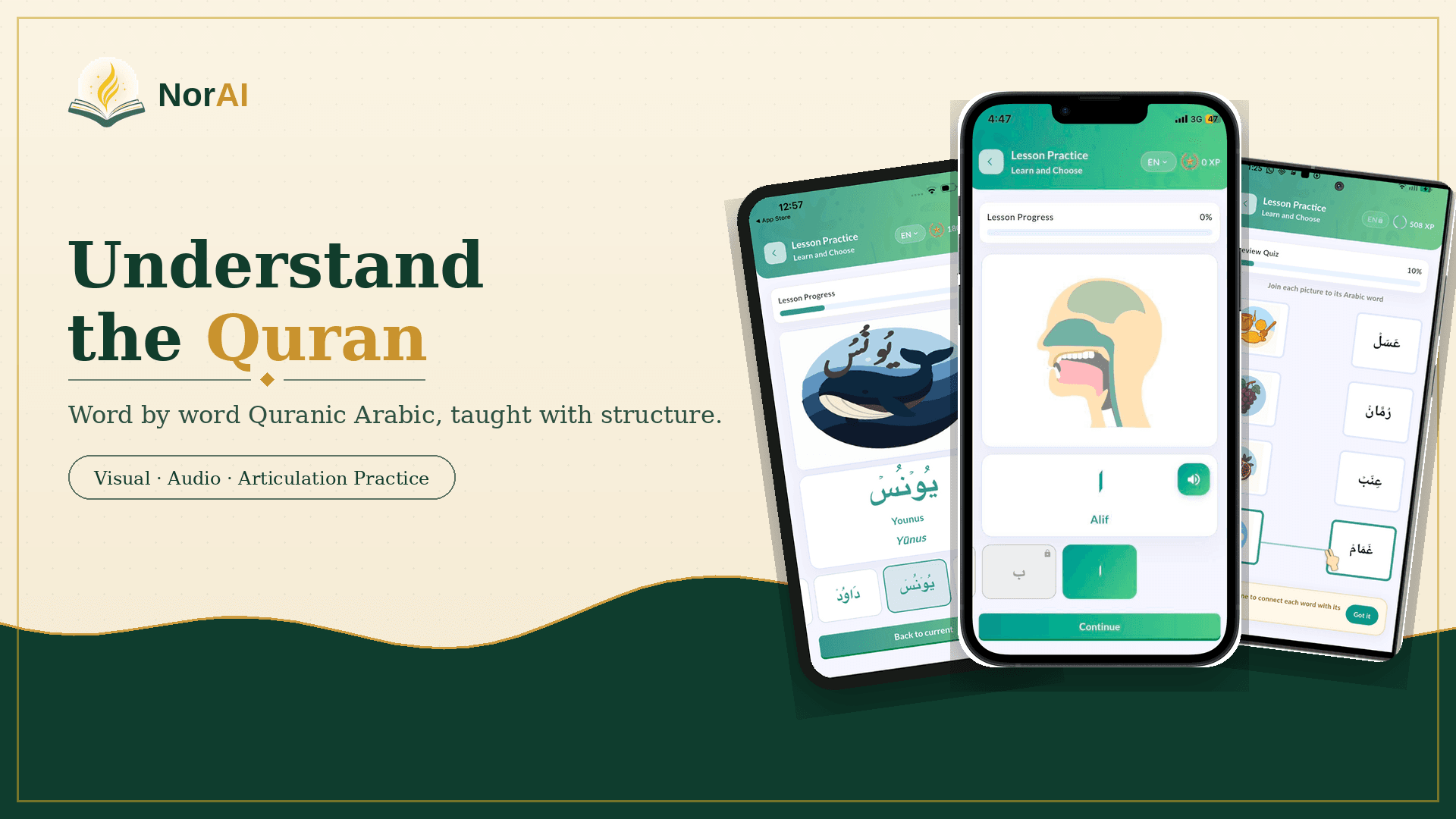
NorAI uses different practice formats so learners can return to studying Quranic Arabic without completing exactly the same task every time. The wider practice system includes visual learning, articulation guidance, audio practice, writing activities, matching and word joining.
A learner might first see a Quranic word with its approved meaning. Later, the same material may appear during listening or recognition practice. Another activity may require matching or writing.
The vocabulary remains related, but the task changes.
This gives Quran word recognition more depth than simply rereading the same list.
Listening Changes the Way Vocabulary Is Recognised
Some learners know a word when they see it but cannot identify it when they hear it.
That is why listening has an important place in Quranic Arabic learning.
NorAI Audio Practice presents a sound or studied word and asks the learner to identify the matching option. The activity focuses on listening recognition instead of showing the written answer first.
It is a small difference in format, but it asks the learner to recall information through another route.
When visual recognition and listening recognition begin to support each other, familiar Arabic vocabulary can become easier to identify across different situations.
Writing Can Make Arabic Forms More Noticeable
Arabic letters change shape depending on how they are positioned and joined.
A learner who only reads may recognise the general appearance of a word without paying much attention to the smaller details inside it.
Guided writing introduces a different kind of attention.
NorAI Writing Practice allows learners to follow the shape and movement of Arabic letters through tracing activities.
The objective is not to turn vocabulary study into handwriting lessons. Writing simply gives learners another opportunity to examine the forms they are already learning.
That additional contact can support familiarity with Quranic Arabic vocabulary.
Understanding Develops Beyond Individual Words
Quran word by word learning is an effective starting point, but individual vocabulary is not the final destination.
Eventually, known words need to be recognised alongside other words.
NorAI's later curriculum stages introduce approved verb forms, attached forms, short phrases and controlled Quranic context. In the final stage, familiar material is brought together through approved Tarkeeb, Quranic blocks and mixed practice.
This means the learner does not stay at the flashcard stage indefinitely.
The learning develops from recognising one Quranic word into noticing how familiar forms occur within more connected material.
Progress Is More Useful When Retention Is Measured
Finishing a lesson is easy to measure.
Remembering its vocabulary several days later is harder.
NorAI separates lesson completion from word mastery. Studied words move through New, Learning, Review and Mastered states depending on how successfully they are recalled across different sessions.
This makes retention part of the learning process rather than something left entirely to the learner.
It also changes the meaning of progress. Moving forward is important, but so is keeping earlier Quran meanings available in memory.
Quranic Learning Requires Clear Content Boundaries
When Quranic Arabic is being taught, accuracy is more important than producing large amounts of material quickly.
NorAI states that its Quranic learning content passes through scholar authoring, peer review, editorial approval and publication lock before learners receive it.
The platform focuses specifically on Quranic Arabic vocabulary and approved word meanings.
It does not provide tafseer, fatwa, religious rulings or AI generated Quranic meanings and interpretations. Tajweed and formal recitation instruction should also continue with a qualified teacher.
Keeping those boundaries clear helps learners understand what the app is designed to teach.
Building Familiarity Changes the Learning Experience
A useful Quranic Arabic routine does not have to begin with hundreds of words.
It can begin with a smaller set of vocabulary that is organised properly, practised in several ways and revisited before too much new material is introduced.
Over time, the learner builds more than a vocabulary list.
They develop familiarity with Quran words, Arabic forms, sounds, meanings and relationships.
That is what can make word by word Quran learning increasingly meaningful. New vocabulary is not replacing yesterday's material. It is being added to a growing foundation.
For learners who want to Understand the Quran through a structured approach, NorAI provides a path that develops Quranic Arabic gradually while keeping recognition, review and retention at the centre of the learning process.
Continue Learning with NorAI
NorAI supports Quranic Arabic learning through structured levels, visual practice, articulation guidance, audio activities, writing practice and repeated review.
Download NorAI on the App Store or Google Play and begin learning Quranic Arabic word by word.
Appreciate the creator