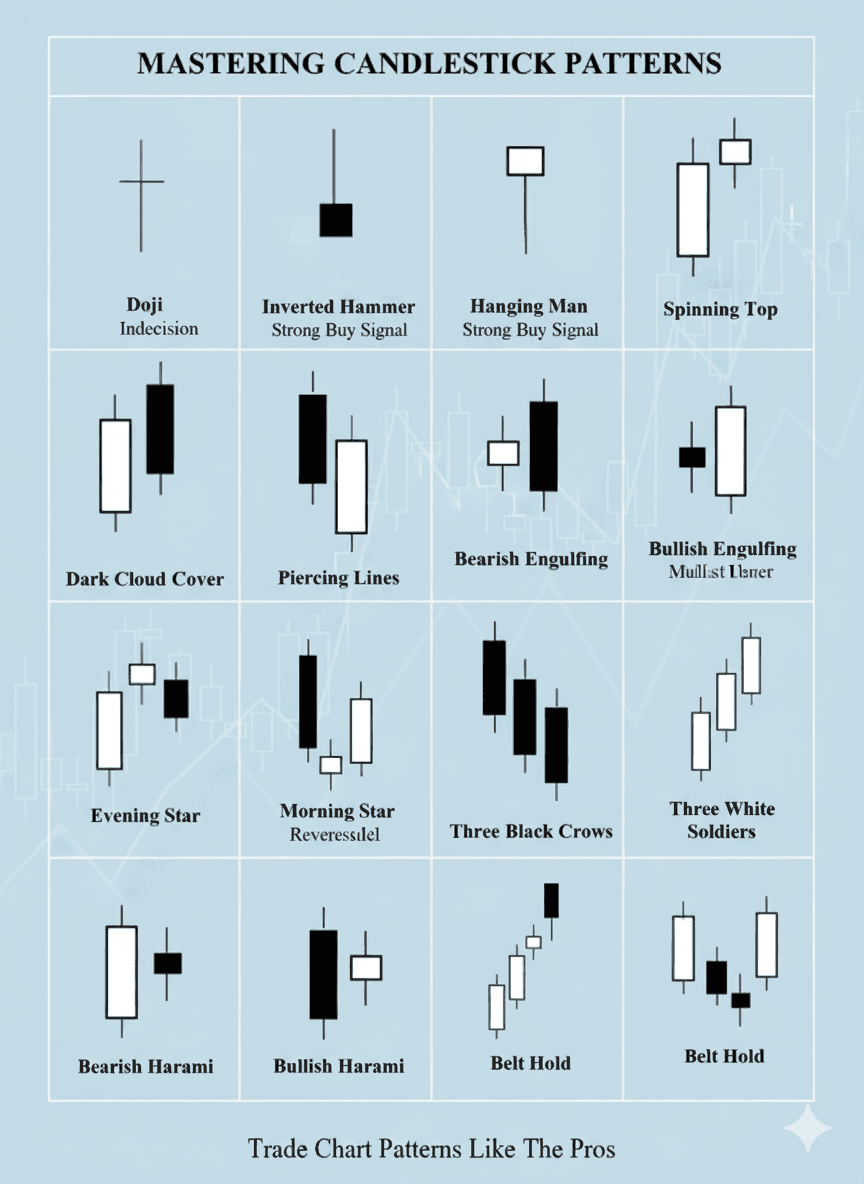
Top 10 Candlestick Patterns Every Trader Should Know
Understanding candlestick patterns is one of the most powerful ways to read price action. Whether you trade Forex, gold, or stocks, recognizing chart patterns can help you spot market reversals, identify trend continuations, and make more confident trades.
In this guide, we’ll cover the top 10 candlestick patterns every trader should know — plus, you can download our free Trade Chart Patterns Guide (PDF) at the end of this article for quick reference.
Download Chart Patterns pdf
It’s your ultimate candlestick chart patterns PDF — perfect for traders who want a quick visual reference while trading.
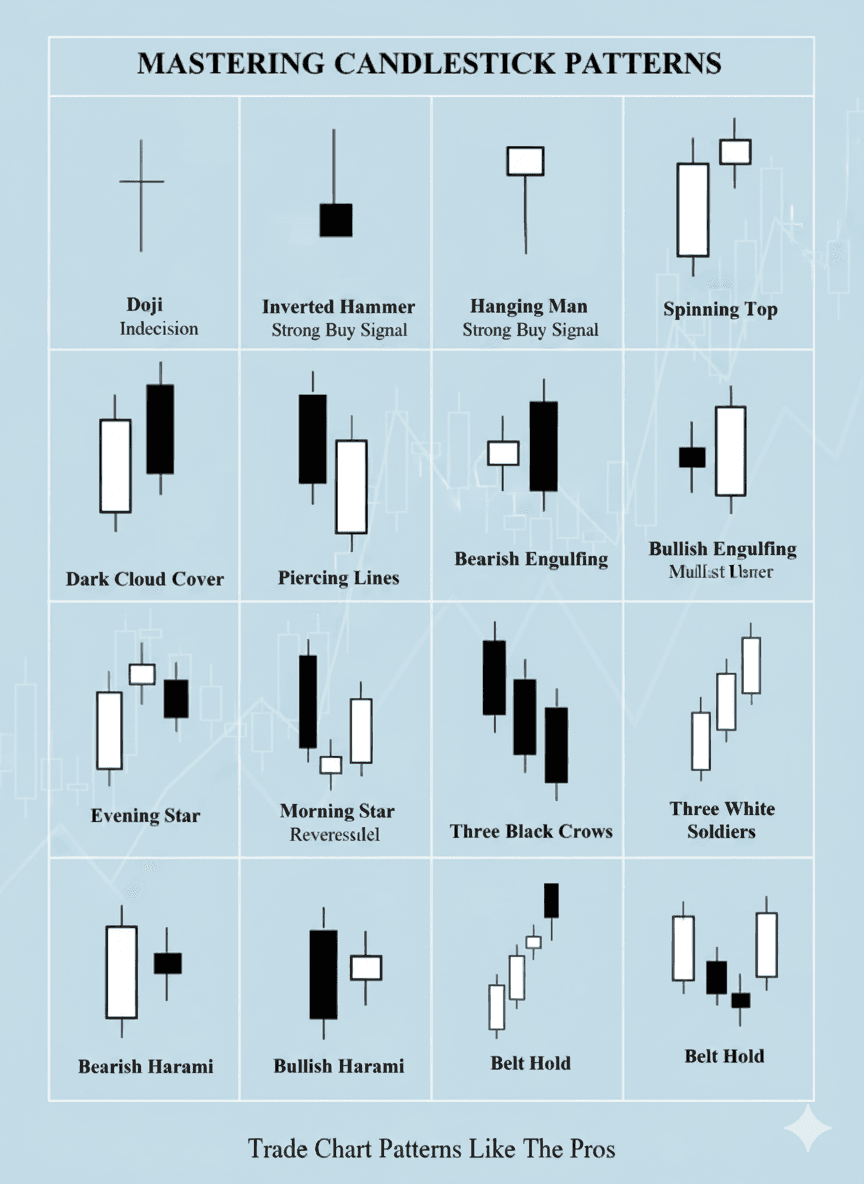
1. Doji Candlestick
A Doji forms when the opening and closing prices are nearly the same, creating a thin body.
It represents market indecision — bulls and bears are equally strong.
Appears at the top or bottom of trends
Signals potential reversals or pauses
2. Hammer Pattern
The Hammer has a small body and a long lower wick.
It appears at the bottom of a downtrend and indicates that buyers are starting to gain control.
Bullish reversal signal
Stronger if supported by high trading volume
3. Inverted Hammer
Similar to the Hammer, but flipped upside down.
It shows rejection of lower prices after an extended downtrend — a potential bullish reversal.
Appears near bottoms
Confirmation required on the next candle
4. Shooting Star
The Shooting Star looks like an inverted hammer but appears at the top of an uptrend.
It signals that buyers pushed prices higher but sellers regained control before the close.
Bearish reversal indicator
Works best with volume confirmation
5. Bullish Engulfing
A Bullish Engulfing occurs when a small red candle is followed by a larger green candle that completely covers the previous body.
This pattern suggests strong buying momentum.
Indicates bullish reversal
Strong when seen after a downtrend
6. Bearish Engulfing
The opposite of the bullish version — a small green candle followed by a larger red candle.
It signals that sellers have taken control after an uptrend.
Bearish reversal signal
Often seen before pullbacks
7. Morning Star
The Morning Star is a three-candle pattern: a bearish candle, followed by a small indecisive candle, and finally a strong bullish candle.
It indicates that bearish momentum is fading and buyers are stepping in.
Strong bullish reversal
Effective on daily and 4H charts
8. Evening Star
The Evening Star is the bearish counterpart to the Morning Star.
It appears after a strong uptrend and often leads to a reversal.
Bearish pattern indicating exhaustion
Confirm with next candles or RSI divergence
9. Bearish Flag Pattern
A Bearish Flag forms when prices consolidate upward within a channel after a sharp decline.
It’s a continuation pattern, not a reversal.
Breakout below the flag signals further downside
Common in gold and SPX charts
10. Falling Wedge (Wedge Bounce Explained)
A Falling Wedge forms when price consolidates between two downward-sloping trendlines.
It often precedes a bullish breakout — a great setup for swing traders.
Indicates slowing bearish momentum
Breakout = buying opportunity
Download Your Free Trade Chart Patterns Guide (PDF)
Want all these patterns in one easy-to-read file?
We’ve created a free downloadable PDF that covers:
Candlestick pattern cheat sheet
Chart patterns for Forex and stocks
Bearish flag and wedge setups explained
Real chart examples and trade setups
Final Thoughts
Candlestick patterns are the building blocks of price action trading.
Once you learn to recognize them, you’ll start seeing opportunities more clearly — whether it’s a reversal setup, a flag breakout, or a wedge bounce.
Keep practicing, backtest your patterns, and always confirm your entries with volume or indicators like RSI or MACD.
Related Reads:
Appreciate the creator