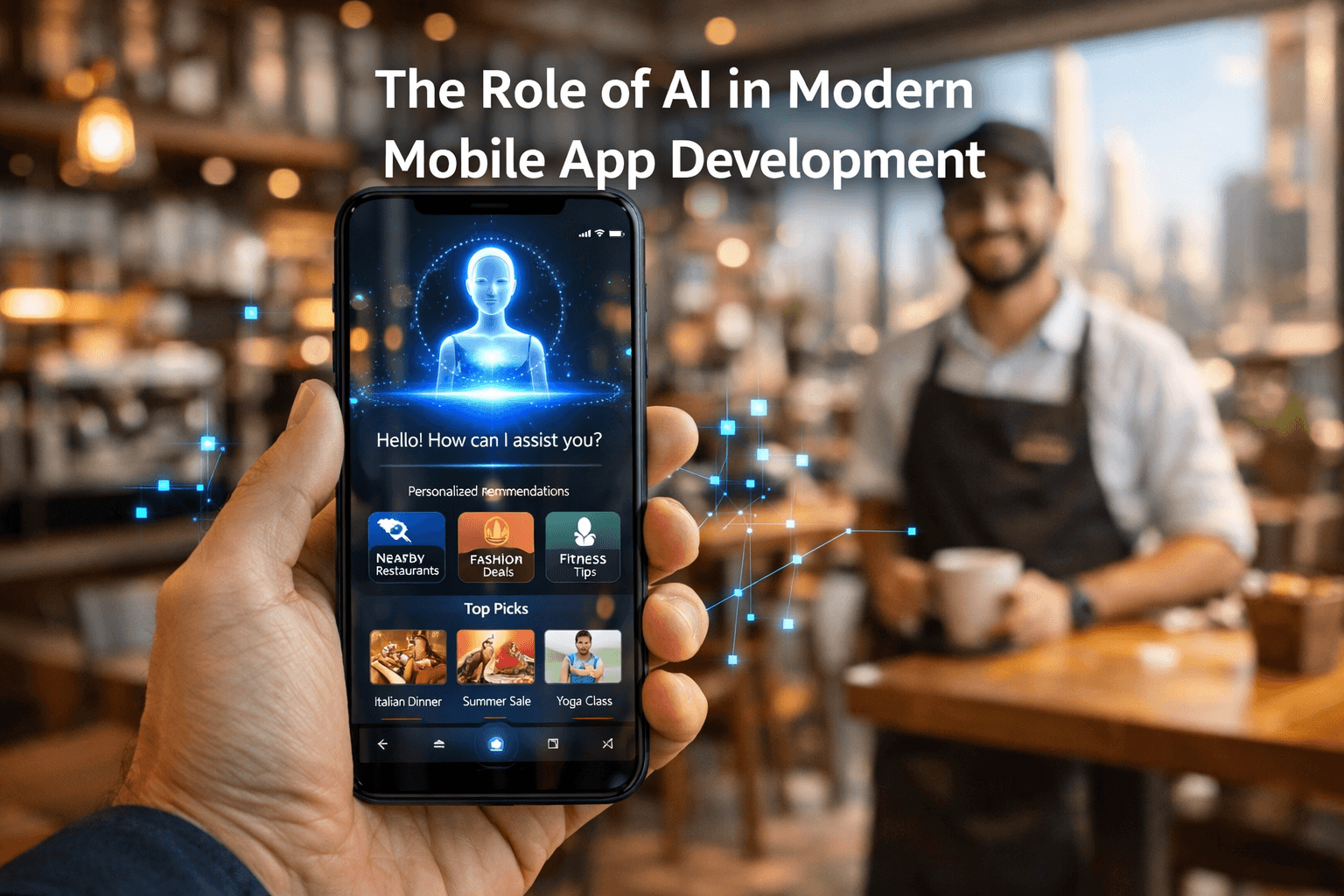
The Role of AI in Modern Mobile App Development
Imagine walking into your favourite local coffee shop. Before you even speak, the barista starts preparing your usual oat-milk latte because they remember you from yesterday. It feels personal, easy, and welcoming. For a long time, mobile apps were just digital tools—useful, but a bit cold. They did exactly what you told them to do, and nothing more.
Today, that is changing fast. If you’ve noticed that your phone seems to "guess" what you want to buy, or if your banking app warns you about a suspicious charge before you even see it, you are experiencing the power of Artificial Intelligence (AI). AI is essentially turning our mobile apps from simple tools into smart assistants that learn, adapt, and help us in real-time.
For any business owner, this shift is a massive opportunity. It’s no longer just about having an app; it’s about having an app that thinks.
What is AI in Mobile App Development?
When we hear "AI," we often think of robots or complex sci-fi movies. In the world of mobile apps, it’s much more grounded. Think of AI as the "brain" of the application. Traditional apps are built on "if-then" logic: If the user clicks this button, then show this screen.
AI-powered apps are different. They use something called Machine Learning to look at data and find patterns. Instead of just following a fixed script, the app learns from how you use it. It’s the difference between a paper map and a GPS that reroutes you because it "sees" traffic up ahead. It’s about making software that can make smart decisions on its own.
Key Roles of AI in Modern Apps
So, how does this actually look in practice? AI isn't just one single feature; it’s a layer that enhances almost everything an app can do. Here are the most impactful ways it is being used right now.
1. Personalisation That Feels Natural
We’ve all experienced "choice fatigue"—that feeling when there are so many options you just want to close the app. AI fixes this by curating the experience. By looking at what you’ve clicked on in the past, an app can move the most relevant items to the top. It’s not just about selling; it’s about making the user’s life easier by saving them time.
2. Chatbots and Better Support
We used to dread clicking the "Contact Us" button because it meant waiting for hours. Modern AI chatbots have changed that. They use Natural Language Processing to understand what a customer is actually asking. They can track orders, reset passwords, or answer complex questions instantly, day or night. This keeps customers happy without needing a massive support team.
3. Predictive Analytics
AI is incredibly good at looking at the past to predict the future. For a business, this is gold. If an app notices a user hasn't opened it in three days, AI can trigger a personalised notification with a discount code to bring them back. It helps businesses stay one step ahead of their customers' needs.
4. Voice and Smart Assistants
Think about how often people use Siri, Alexa, or Google Assistant. Integrating voice recognition into an app makes it more accessible and hands-free. Whether it’s a grocery app where you can dictate your list or a travel app where you ask for flight status, voice AI is becoming the new standard for how we interact with tech.
5. Security Improvements
Security is a top priority for everyone. AI helps by acting as a digital security guard that never sleeps. It can detect "anomalous" behaviour—like a login from a strange location or a series of rapid-fire transactions—and freeze the account instantly. This builds deep trust between the user and the brand.
Real-World Examples
You likely interact with AI dozens of times a day without realising it. When you open Netflix, the "Top Picks for You" is a complex AI algorithm at work. When you use a food delivery app like Tala Bat or Uber Eats, AI is calculating the exact minute your food will arrive based on kitchen prep times and traffic data.
Even simple shopping apps use AI to "see." Some apps now let you take a photo of a pair of shoes you like on the street, and the AI will find that exact pair (or something very similar) in their catalogue. These features make the shopping experience feel like a game rather than a chore.
If you are a business owner in the UAE looking to build these kinds of features, working with a professional mobile app development agency in Dubai can help you navigate these technologies and choose what fits your specific market.
Benefits for Your Business
Why should you invest in AI? It’s not just a "nice to have" feature; it offers real, measurable benefits.
Better User Experience: When an app "just works" and feels personal, users are much less likely to delete it.
Increased Engagement: Because the content is relevant, people spend more time in the app. More time usually leads to more sales.
Cost Efficiency: While AI can be an investment upfront, it saves money over time. Automating tasks like customer service or data entry allows your human team to focus on bigger, more creative goals.
Challenges of Using AI in App Development
Of course, nothing this powerful comes without a few hurdles. It’s important to be realistic about what it takes to get AI right.
First, there is data privacy. Since AI learns from user data, you must be incredibly careful about how that data is stored and protected. Transparency is key here—users need to know their info is safe.
Second is the development cost and complexity. Building a "smart" app requires more specialised skills than building a basic one. You need clean data and the right infrastructure to support it. This is why many companies partner with a specialised mobile app development agency in Dubai to ensure the foundation is built correctly from the start.
The Future of AI in Mobile Apps
Looking forward, the "Intelligence" part of AI is only going to get sharper. We are moving toward a world where apps are "proactive." Instead of you opening an app to do something, the app might notify you: "I noticed your flight is delayed, so I’ve already suggested three nearby lounges where you can wait."
We are also seeing a rise in "Edge AI," which means the AI processing happens right on your phone rather than in the cloud. This makes apps even faster and more private. The goal is to make the technology so seamless that you don't even think of it as "tech" anymore—it just feels like a helpful part of your day.
Conclusion
The role of AI in mobile apps is no longer a futuristic concept—it is the reality of the modern market. It’s the difference between a static digital brochure and a dynamic, helpful partner for your customers. By focusing on personalisation, security, and smart support, businesses can create experiences that people truly love to use.
The best part? You don't have to be a tech giant to start. Even small AI features can make a big difference in how your customers see your brand. As we move forward, the most successful apps won't be the ones with the most features, but the ones that use AI to be the most human.
I hope this article provides a clear and engaging look at how AI is shaping the apps we use every day!
Appreciate the creator