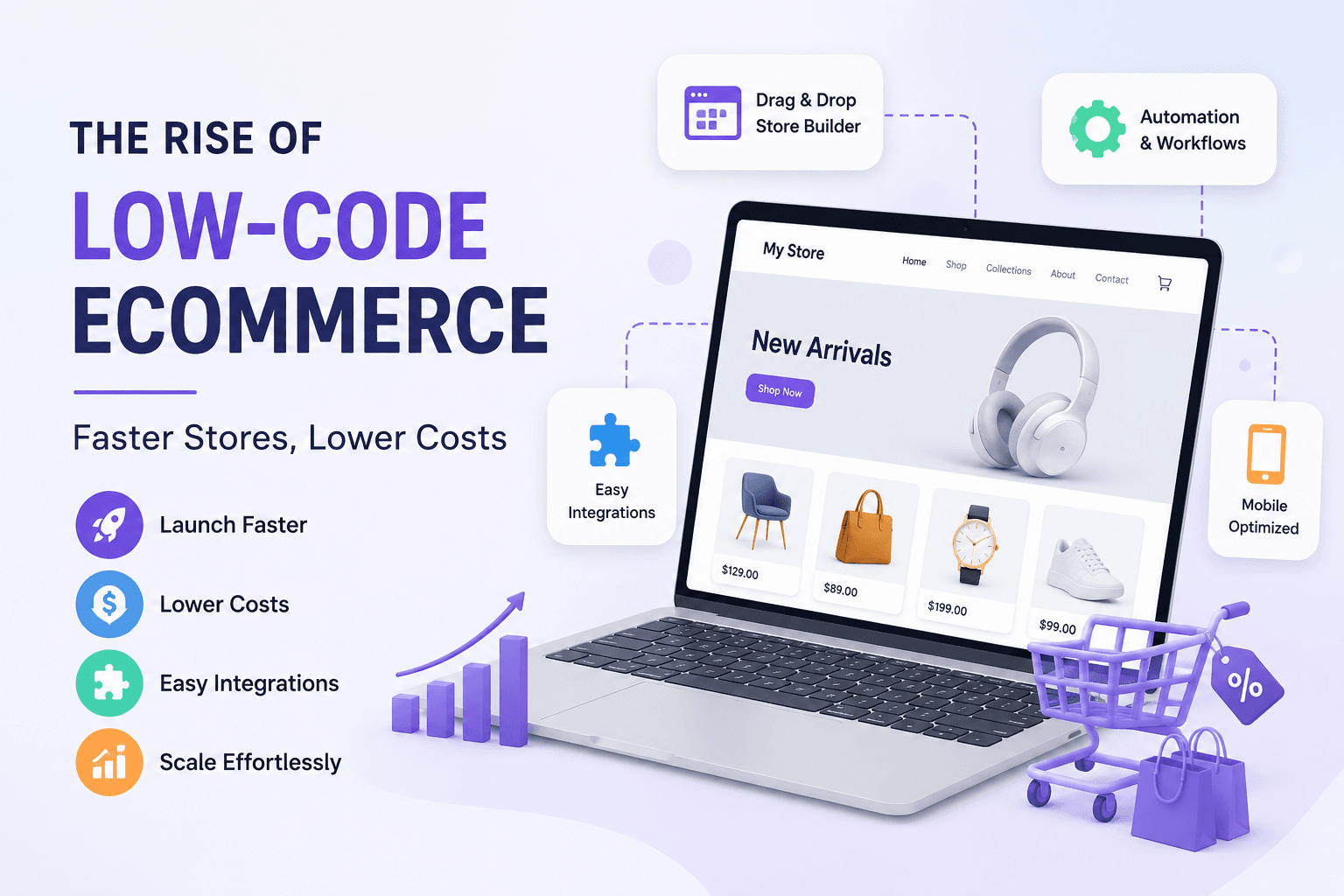
The Rise of Low-Code Ecommerce: Faster Stores, Lower Costs
The ecommerce industry is evolving rapidly, and businesses today are looking for faster, smarter, and more affordable ways to sell online. Traditional ecommerce development often requires long timelines, large technical teams, and ongoing maintenance costs, making it difficult for many businesses to scale efficiently.
This is where low-code ecommerce platforms are changing the game.
By simplifying development and reducing technical complexity, low-code solutions allow businesses to launch stores faster, automate operations, and adapt quickly to changing customer demands. From startups and D2C brands to growing retailers, companies are increasingly adopting low-code ecommerce to improve efficiency without sacrificing flexibility.
What Is Low-Code Ecommerce?
Low-code ecommerce refers to platforms that allow businesses to create and manage online stores with minimal coding. Instead of building everything from scratch, users can rely on visual editors, drag-and-drop builders, prebuilt templates, and integrations to develop and customize their stores.
This approach helps businesses:
Reduce development dependency
Launch stores faster
Lower operational costs
Simplify store management
Scale more efficiently
Many businesses are also combining low-code platforms with modern no code tools to improve flexibility and accelerate digital growth without relying heavily on custom development.
Why Businesses Are Moving Toward Low-Code Solutions
Traditional ecommerce systems often come with several challenges:
High development costs
Long implementation timelines
Difficult maintenance
Complex integrations
Slow feature updates
For many businesses, these issues create delays and increase operational pressure.
Low-code ecommerce platforms simplify the process by making store creation and management more accessible. Businesses can quickly make updates, test new ideas, and launch campaigns without relying heavily on developers for every change.
As ecommerce becomes more competitive, speed and adaptability are becoming critical advantages.
Faster Store Launches
One of the biggest advantages of low-code ecommerce is the ability to launch quickly.
Businesses can:
Set up storefronts faster
Add products easily
Customize pages visually
Integrate payment gateways quickly
Launch marketing campaigns without technical delays
Instead of spending months building a custom ecommerce website, businesses can often create a fully functional store in a much shorter time.
This faster time-to-market allows brands to respond quickly to trends, seasonal demand, and changing customer preferences.
Lower Development and Maintenance Costs
Custom ecommerce development can become expensive, especially for growing businesses with limited technical resources.
Low-code ecommerce platforms help reduce costs by:
Minimizing custom coding requirements
Reducing maintenance efforts
Simplifying updates and modifications
Automating repetitive operational tasks
Non-technical teams can often manage day-to-day store operations without requiring constant developer support. This allows businesses to focus more on growth strategies, customer engagement, and sales optimization.
Easier Integrations and Automation
Modern ecommerce businesses rely on multiple tools to manage operations efficiently. These may include:
Inventory management systems
CRM platforms
Payment gateways
Shipping providers
Marketing automation tools
Low-code ecommerce platforms usually offer prebuilt integrations that simplify these connections and reduce setup complexity.
Automation also improves operational efficiency by handling tasks such as:
Order processing
Customer notifications
Inventory synchronization
Cart recovery emails
Multi-channel order management
This helps businesses save time while improving accuracy and customer experience.
Better Flexibility for Growing Brands
Consumer expectations and ecommerce trends change quickly. Businesses need systems that allow them to adapt without rebuilding their entire infrastructure.
Low-code ecommerce platforms make it easier to:
Launch seasonal promotions
Create landing pages
Test new product categories
Expand into multiple sales channels
Update store experiences quickly
This flexibility gives businesses more control over their growth strategies while reducing technical bottlenecks.
Supporting Omnichannel Commerce
Today’s customers shop across multiple platforms, including:
Ecommerce websites
Online marketplaces
Social media platforms
Mobile apps
Physical retail stores
Managing these channels manually can become complicated.
Low-code ecommerce systems help businesses centralize operations by allowing them to manage products, inventory, and orders across channels from a single platform. This improves efficiency and creates a more consistent customer experience.
Is Low-Code Ecommerce the Future?
As ecommerce continues to evolve, businesses are prioritizing agility, scalability, and operational efficiency more than ever before.
Low-code ecommerce platforms are helping brands:
Reduce technical complexity
Lower costs
Launch faster
Automate workflows
Scale more efficiently
While highly customized enterprise businesses may still require advanced development for certain needs, low-code solutions are becoming a practical and powerful option for many modern ecommerce brands.
Conclusion
The rise of low-code ecommerce reflects a larger shift toward faster and more flexible digital solutions. Businesses no longer want slow development cycles or expensive technical overhead just to maintain an online store.
By simplifying ecommerce management and improving scalability, low-code platforms are helping businesses adapt to changing market demands with greater speed and efficiency.
For brands looking to grow in an increasingly competitive online marketplace, low-code ecommerce offers a smarter and more accessible path forward.
Appreciate the creator