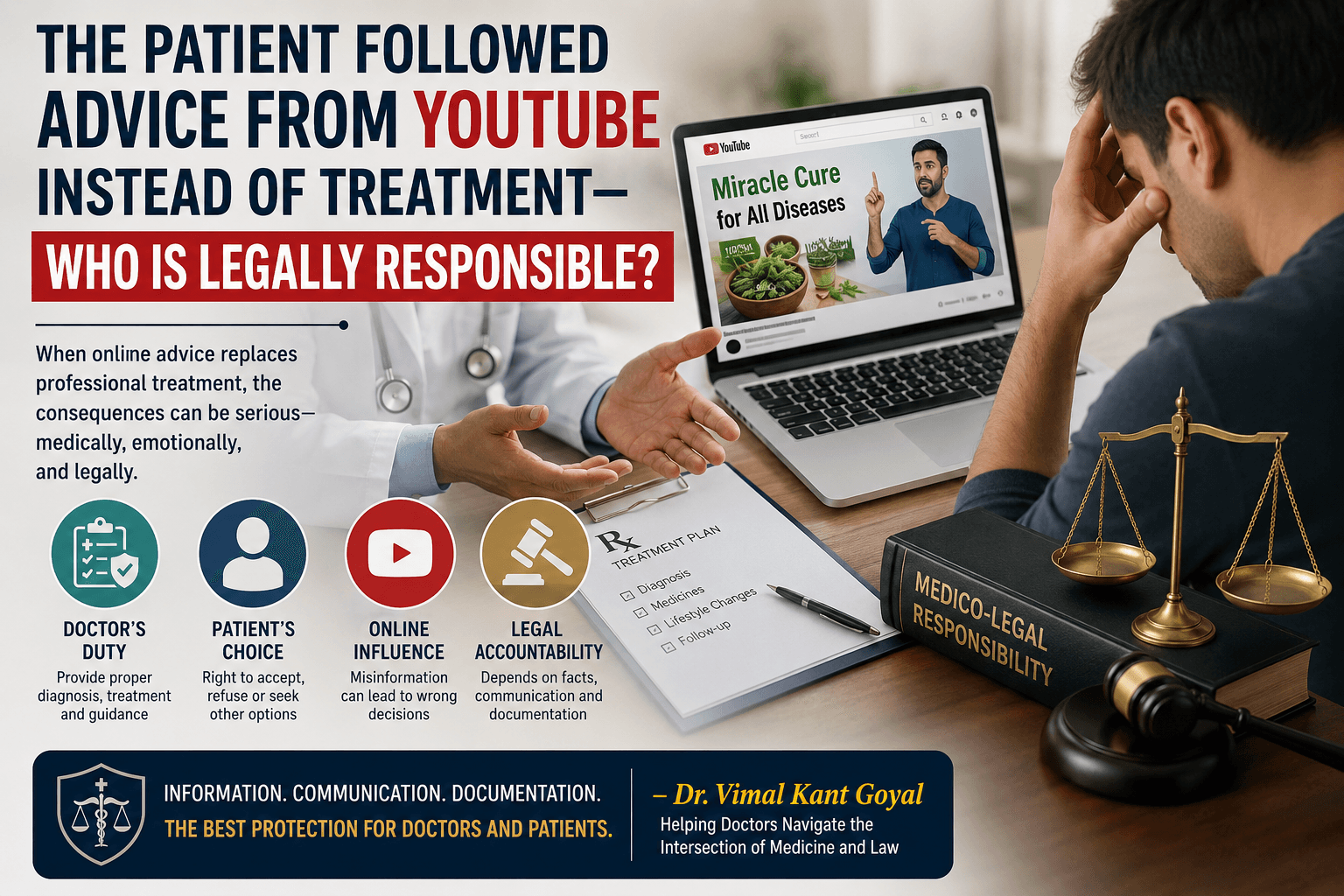
The Patient Followed Advice from YouTube Instead of Treatment—Who Is Legally Responsible?
The internet has changed healthcare forever. Today, patients can search symptoms, watch medical videos, read online reviews, and even follow treatment suggestions without visiting a doctor. While access to information can be helpful, it also creates serious risks when patients start relying on social media influencers or YouTube videos instead of professional medical advice.
As a Medico legal advisor in Delhi, Dr Vimal Kant Goyal often highlights that the growing influence of online medical content is creating new medico-legal challenges for doctors, hospitals, and patients alike.
Imagine this situation. A doctor diagnoses a patient correctly and recommends a specific treatment plan. The patient goes home, watches several YouTube videos, and decides to follow alternative advice from an online creator. Weeks later, the patient's condition worsens significantly.
The question then arises: Who is legally responsible?
Is the doctor responsible because the patient was under treatment? Is the patient responsible for ignoring professional advice? Or can the content creator who shared the information be held accountable?
The answer is more complicated than many people think.
The Growing Influence of YouTube on Medical Decisions
Many patients trust online medical content because it is easily accessible and often presented in a simple format.
Videos promising "natural cures," "instant recovery," or "secret treatments" attract millions of views every year. Unfortunately, not all creators have medical qualifications, and many videos provide incomplete or misleading information.
Patients may begin to believe that online advice is equivalent to professional medical consultation.
This is where problems begin.
Unlike a doctor, a YouTube creator does not know:
The patient's medical history
Existing diseases
Current medications
Allergies
Risk factors
Diagnostic reports
Medical treatment cannot be safely prescribed through generic online videos.
Does the Doctor Remain Responsible?
In most situations, doctors are legally responsible only for the care they provide according to accepted medical standards.
If a doctor:
Properly examined the patient
Made a reasonable diagnosis
Recommended appropriate treatment
Explained risks and consequences
Maintained proper documentation
then their legal responsibility may be significantly reduced if the patient voluntarily ignores medical advice.
However, documentation becomes extremely important.
If the doctor's records clearly show that the patient was advised regarding treatment and potential risks of non-compliance, it strengthens the doctor's legal position.
Without proper records, proving what was discussed can become difficult later.
The Importance of Informed Refusal
Many doctors focus on obtaining consent for treatment.
But fewer doctors focus on documenting refusal of treatment.
When a patient rejects medical advice and chooses another path, the doctor should document:
The recommended treatment
Risks explained to the patient
Alternative options discussed
The patient's decision to refuse
This process is often called informed refusal.
In medico-legal disputes, informed refusal documentation can become crucial evidence.
Can Patients Be Held Responsible?
Yes.
Patients also have responsibilities regarding their healthcare decisions.
Adults who are mentally competent generally have the legal right to:
Accept treatment
Refuse treatment
Seek second opinions
Choose alternative therapies
However, they also bear responsibility for decisions they make after receiving proper medical advice.
If a patient knowingly ignores professional treatment and suffers complications, legal authorities may consider their actions while evaluating responsibility.
This is especially relevant when medical records clearly demonstrate that warnings were provided.
The Challenge of Misinformation
Healthcare misinformation has become one of the biggest concerns worldwide.
A video viewed by millions can spread incorrect health advice within hours.
Examples include:
Unproven cancer remedies
Dangerous dietary practices
Incorrect medication guidance
Anti-vaccination misinformation
Delayed treatment recommendations
Patients who trust such information may postpone critical medical care until it becomes too late.
Doctors frequently face situations where valuable treatment time has already been lost due to online misinformation.
Why Documentation Protects Doctors
Many medico-legal cases are not decided solely on clinical treatment.
They are often decided on documentation.
Good documentation should include:
Diagnosis details
Treatment recommendations
Follow-up advice
Risk explanations
Patient questions
Refusal records when applicable
A skilled Medico legal consultant in Delhi will often advise healthcare professionals that documentation should tell the complete story of patient care.
If a dispute arises years later, medical records become the strongest evidence available.
Dr Vimal Kant Goyal consistently emphasizes that proper documentation is not paperwork—it is professional protection.
How Doctors Can Reduce Legal Risk
Modern healthcare professionals must adapt to the reality that patients increasingly consume online medical content.
Some practical steps include:
Encourage Open Discussion
Doctors should ask patients whether they have researched their condition online.
This creates an opportunity to correct misunderstandings.
Explain Risks Clearly
Patients should understand the consequences of delaying or refusing treatment.
Use Simple Language
Complex medical terminology often creates confusion.
Clear communication improves understanding.
Maintain Written Records
Documentation should capture all significant discussions.
Schedule Follow-Ups
Follow-up visits help identify whether patients are following the recommended treatment plan.
These small steps can greatly reduce medico-legal complications.
The Ethical Side of the Issue
This situation is not always about legal responsibility alone.
It is also about trust.
Doctors invest years in education and clinical training. Patients trust them with their health and often their lives.
When online misinformation replaces professional guidance, both healthcare outcomes and doctor-patient relationships suffer.
The goal should not be to discourage patients from learning. Instead, patients should be encouraged to verify information with qualified healthcare professionals before making important medical decisions.
Balanced awareness benefits everyone.
Frequently Asked Questions
Can a doctor be blamed if a patient follows YouTube advice?
Not necessarily. If proper medical advice was provided and documented, responsibility may shift depending on the circumstances.
What is informed refusal?
Informed refusal occurs when a patient refuses recommended treatment after understanding the risks and consequences.
Can YouTube creators be legally responsible for medical advice?
In some situations, misleading or harmful health claims may attract legal scrutiny, but liability depends on specific facts and applicable laws.
Why is documentation important in medico-legal cases?
Documentation provides evidence of diagnosis, treatment recommendations, patient communication, and informed decision-making.
How can doctors protect themselves legally?
Doctors should maintain detailed records, communicate clearly, obtain proper consent, and document treatment refusals when necessary.
Conclusion
The digital age has transformed how patients access health information, but online content should never replace professional medical evaluation. When patients choose YouTube advice over prescribed treatment, determining legal responsibility depends on communication, documentation, patient decisions, and the specific circumstances of the case.
For healthcare professionals, prevention remains the strongest protection. Clear communication, informed consent, informed refusal, and proper records can significantly reduce medico-legal risk.
Dr Vimal Kant Goyal continues to educate healthcare professionals on these emerging challenges, helping doctors navigate the complex intersection of medicine, technology, and law. For practitioners seeking guidance in today's evolving healthcare environment, consulting the Best Medico legal expert in Delhi can provide valuable support in building legally safe and ethically strong medical practices.
Appreciate the creator