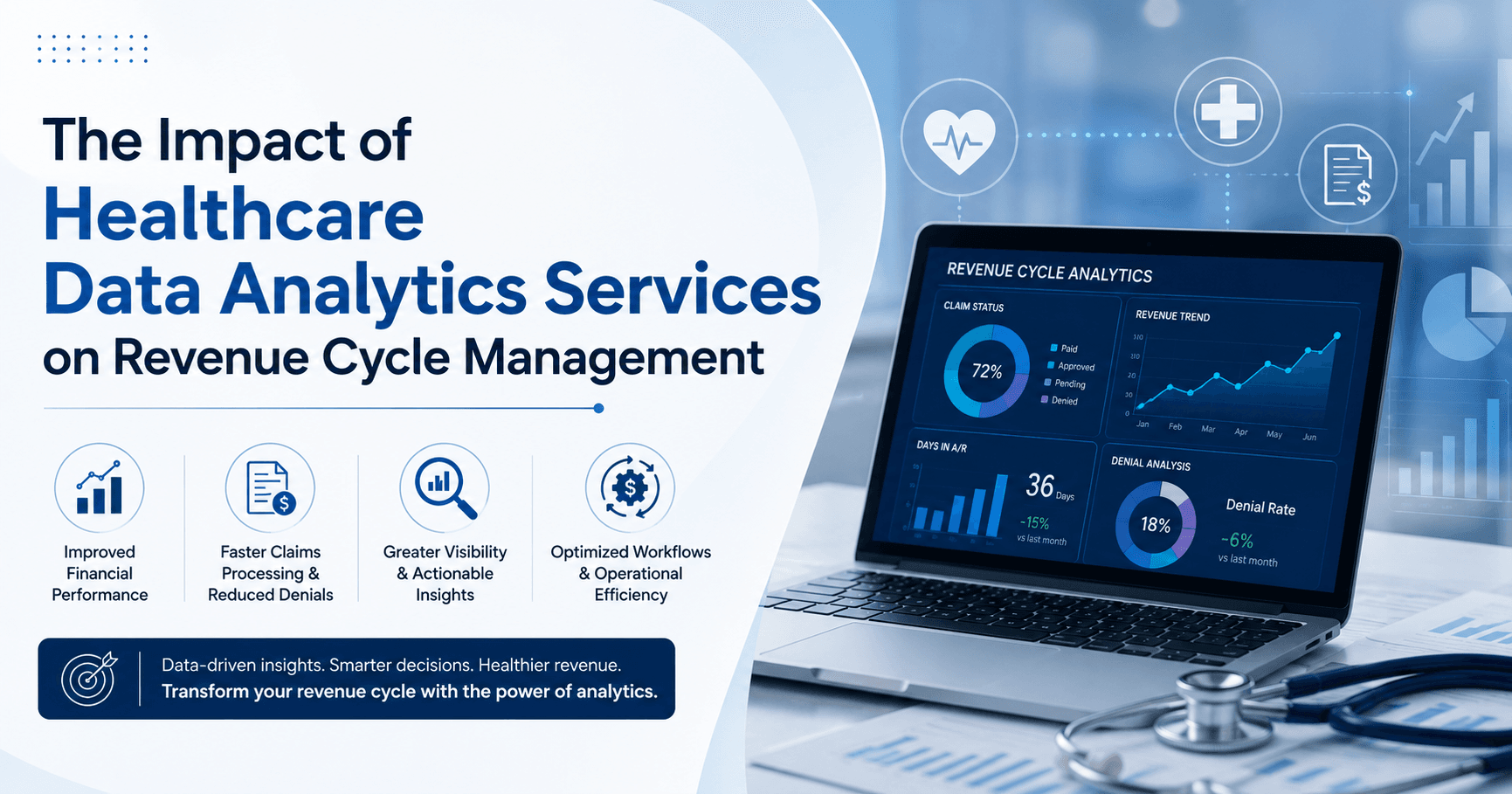
The Impact of Healthcare Data Analytics Services on Revenue Cycle Management
In today’s rapidly evolving healthcare industry, financial stability has become just as important as quality patient care. Hospitals, clinics, and healthcare organizations are under constant pressure to improve operational efficiency, reduce billing errors, speed up reimbursements, and maintain regulatory compliance. This is where Healthcare Data Analytics Services are making a major difference, especially in Revenue Cycle Management (RCM).
Healthcare providers generate massive amounts of data every day — from patient records and insurance claims to billing information and payment histories. Without proper analysis, this data often remains underutilized. Healthcare Data Analytics Services help organizations convert raw healthcare data into actionable insights that improve financial performance and optimize revenue cycles.
What is Revenue Cycle Management in Healthcare?
Revenue Cycle Management (RCM) refers to the complete financial process healthcare providers use to manage patient service revenue. It includes everything from patient registration and appointment scheduling to medical billing, insurance claims processing, payment collections, and final reimbursement.
The main goal of RCM is to ensure healthcare organizations receive accurate and timely payments for the services they provide. However, traditional revenue management systems often face several challenges, including:
Claim denials
Coding inaccuracies
Delayed reimbursements
Billing inefficiencies
Regulatory compliance issues
High administrative costs
Lack of financial transparency
Healthcare Data Analytics Services help solve these challenges by providing real-time visibility into the financial and operational performance of healthcare organizations.
How Healthcare Data Analytics Services Improve Revenue Cycle Management
1. Reducing Claim Denials
Claim denials are one of the biggest revenue losses for healthcare providers. Incorrect patient information, coding errors, missing documentation, and insurance eligibility issues often lead to rejected claims.
Healthcare Data Analytics Services analyze historical claims data and identify patterns that commonly result in denials. By using predictive analytics, healthcare organizations can detect high-risk claims before submission and correct errors in advance.
Benefits include:
Higher claim acceptance rates
Faster reimbursements
Reduced manual rework
Lower administrative burden
This proactive approach significantly improves the overall efficiency of the revenue cycle.
2. Improving Medical Billing Accuracy
Billing errors can lead to delayed payments, compliance penalties, and patient dissatisfaction. Healthcare Data Analytics Services help healthcare providers improve billing accuracy by automating data validation and monitoring billing patterns.
Advanced analytics tools can:
Detect duplicate charges
Identify missing billing codes
Verify insurance coverage
Ensure accurate charge capture
Reduce coding mistakes
Accurate billing improves cash flow while minimizing financial leakages.
3. Enhancing Patient Payment Collections
Patient payment responsibility has increased significantly in recent years due to rising healthcare costs and insurance deductibles. Many healthcare organizations struggle with delayed or incomplete patient payments.
Healthcare Data Analytics Services help providers better understand patient payment behavior and financial risk patterns. Using analytics, healthcare organizations can:
Predict payment delays
Segment patients based on payment history
Offer personalized payment plans
Improve collection strategies
This leads to higher patient satisfaction and improved revenue recovery.
4. Real-Time Financial Visibility
Traditional revenue cycle systems often lack real-time reporting capabilities, making it difficult for healthcare leaders to track financial performance.
Healthcare Data Analytics Services provide real-time dashboards and reporting tools that help organizations monitor:
Claims status
Payment trends
Revenue leakage
Outstanding balances
Collection performance
Operational bottlenecks
With real-time insights, healthcare providers can make faster and smarter financial decisions.
5. Optimizing Insurance Verification Processes
Insurance verification errors are a common reason for delayed claims and denied reimbursements. Manual verification processes are time-consuming and prone to mistakes.
Healthcare Data Analytics Services streamline insurance verification by integrating data from multiple systems and automating validation checks. This helps healthcare organizations:
Verify patient eligibility instantly
Reduce authorization delays
Prevent billing errors
Improve claim accuracy
Automation reduces administrative workload and speeds up the reimbursement cycle.
6. Supporting Regulatory Compliance
Healthcare organizations must comply with strict healthcare regulations and billing standards. Failure to comply can result in financial penalties and reputational damage.
Healthcare Data Analytics Services help monitor compliance with industry regulations by:
Tracking coding accuracy
Identifying unusual billing activities
Monitoring audit risks
Detecting fraudulent claims
Ensuring documentation completeness
Analytics-driven compliance management reduces legal and financial risks for healthcare providers.
7. Predictive Analytics for Revenue Forecasting
Predictive analytics is one of the most valuable features of Healthcare Data Analytics Services. By analyzing historical financial and operational data, healthcare organizations can forecast future revenue trends more accurately.
Predictive models help providers:
Estimate reimbursement timelines
Forecast patient volumes
Predict seasonal revenue fluctuations
Identify financial risks early
Improve budgeting and resource planning
This enables better long-term financial planning and operational stability.
8. Improving Operational Efficiency
Healthcare organizations often struggle with disconnected systems and inefficient workflows. Healthcare Data Analytics Services help identify bottlenecks and inefficiencies across the revenue cycle.
Analytics can improve:
Staff productivity
Workflow automation
Resource allocation
Scheduling efficiency
Payment processing speed
As operational efficiency improves, healthcare organizations can focus more on delivering quality patient care.
The Role of AI and Machine Learning in Healthcare Data Analytics
Modern Healthcare Data Analytics Services increasingly use Artificial Intelligence (AI) and Machine Learning (ML) technologies to automate revenue cycle processes and improve accuracy.
AI-powered analytics systems can:
Detect anomalies in claims
Automate medical coding
Predict payment trends
Identify fraud risks
Recommend billing optimizations
Improve denial management
These intelligent systems continuously learn from data patterns and help healthcare providers make data-driven decisions.
Key Benefits of Healthcare Data Analytics Services for Revenue Cycle Management
Healthcare organizations that invest in Healthcare Data Analytics Services experience several long-term benefits, including:
Increased Revenue
Improved claim accuracy and reduced denials directly increase revenue generation.
Faster Reimbursements
Automated analytics speed up claims processing and payment collection cycles.
Reduced Operational Costs
Automation reduces manual tasks and administrative expenses.
Better Patient Experience
Accurate billing and flexible payment solutions improve patient satisfaction.
Improved Decision-Making
Real-time financial insights support smarter strategic planning.
Enhanced Compliance
Analytics-driven monitoring helps maintain regulatory standards.
Challenges in Implementing Healthcare Data Analytics Services
Although Healthcare Data Analytics Services offer significant advantages, implementation can still present challenges such as:
Data integration complexities
High initial investment
Data privacy concerns
Staff training requirements
Legacy system compatibility
Healthcare organizations must choose scalable and secure analytics solutions to achieve maximum ROI.
Future of Healthcare Revenue Cycle Management
The future of Revenue Cycle Management will become increasingly data-driven. As healthcare organizations continue adopting digital transformation strategies, Healthcare Data Analytics Services will play a critical role in improving financial sustainability and operational efficiency.
Emerging technologies like AI, cloud computing, predictive analytics, and automation will continue transforming how healthcare providers manage claims, billing, reimbursements, and patient payments.
Organizations that leverage data analytics effectively will gain a competitive advantage while delivering better patient outcomes and financial performance.
Conclusion
Healthcare Data Analytics Services are revolutionizing Revenue Cycle Management by helping healthcare organizations improve billing accuracy, reduce claim denials, optimize payment collections, and enhance operational efficiency. With real-time insights and predictive analytics, healthcare providers can make smarter financial decisions while maintaining compliance and improving patient satisfaction.
As the healthcare industry becomes more data-centric, investing in advanced Healthcare Data Analytics Services is no longer optional — it has become essential for long-term financial success and sustainable healthcare operations.
Appreciate the creator