The Hidden Cost of Poor Asset Visibility in Construction
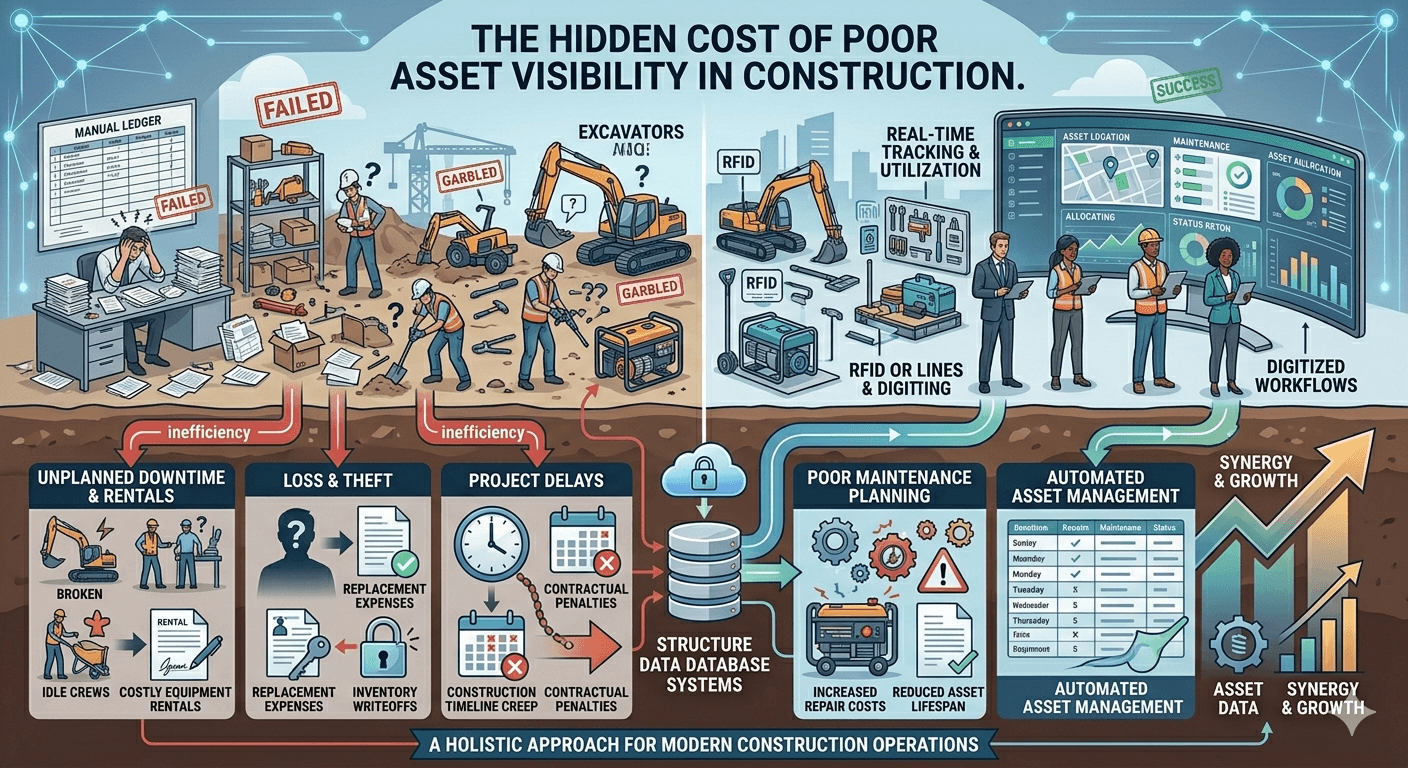
Construction companies own, rent, move, and manage a wide range of assets every day. Heavy equipment, attachments, tools, trucks, trailers, generators, pumps, and small equipment all have to be tracked across jobsites, yards, shops, and storage areas. When visibility is weak, costs quietly increase. This is why construction asset tracking software is becoming more important for contractors that want better control over their operations.
Poor asset visibility does not always look like a major failure at first. It may look like a missing tool, an idle generator, a machine sitting at the wrong site, or a rental that stayed two weeks longer than needed. But over time, these small gaps add up. They create waste, delays, duplicate purchases, unnecessary rentals, and frustrated teams.
The real problem is simple: if contractors cannot see what they own, where it is, and how it is being used, they cannot manage it properly.
What Asset Visibility Really Means
Asset visibility means having clear, current information about every important item in the business. It includes location, status, ownership, assignment, usage, condition, and cost.
For construction teams, visibility should answer questions like:
Where is this asset right now?
Who is using it?
Is it available, assigned, idle, damaged, or under repair?
When was it last inspected?
Is it owned, rented, or leased?
Is it being used enough to justify its cost?
Does another jobsite need it more urgently?
Without these answers, teams rely on phone calls and assumptions. That is where waste begins.
Why Poor Asset Visibility Gets Expensive
The hidden cost of poor asset visibility shows up in several ways.
Duplicate purchases
When teams cannot find tools or small equipment, they often buy replacements. That may solve the immediate issue, but it creates long-term waste. Over time, companies end up with more assets than they need and still struggle to find the right item when it matters.
Unnecessary rentals
A jobsite may rent a generator, compressor, or machine because the team does not know one is already available elsewhere. This is one of the most common ways poor visibility hurts profit.
Idle assets
Some assets sit unused while others are overbooked. Without visibility into usage, contractors cannot balance resources across jobsites.
Lost productivity
Crews lose time searching for tools, waiting for equipment, or calling around for asset updates. That lost time is not always tracked, but it affects project performance.
Weak accountability
When asset movement is unclear, it becomes harder to know who used an item, where it went, or when it was damaged.
This is why construction asset tracking software is not just a tracking tool. It is a cost-control system.
Why Spreadsheets Fall Apart
Spreadsheets are common because they are familiar. Almost every contractor has used them to track equipment, tools, rentals, or inventory at some point. But spreadsheets have a serious weakness: they depend on people updating them manually.
In construction, assets move fast. A trailer may leave the yard in the morning. A tool may shift from one crew to another. A rental may be extended. A machine may go to the shop. A spreadsheet only works if every movement is updated correctly and immediately.
That rarely happens.
As a result, the spreadsheet becomes outdated. People stop trusting it. Then they go back to phone calls and text messages. At that point, the company has a list, but not real visibility.
Modern contractors need systems that reflect field reality, not yesterday’s version of it.
How Better Asset Tracking Improves Control
A better asset tracking process gives contractors one place to see assets, locations, assignments, and status. It helps teams manage both large and small assets with less confusion.
For heavy equipment, asset tracking can show where machines are located, whether they are active, and how often they are being used. For smaller tools and attachments, it can help teams reduce loss and improve accountability. For rentals, it can help managers avoid keeping items longer than necessary.
Good tracking also improves communication between departments. The field, shop, dispatch, and office can work from the same information instead of maintaining separate lists.
This is especially important for growing contractors. As the number of jobsites increases, informal tracking becomes harder to control. What worked for one yard and two crews will not work for multiple regions, mixed fleets, and large teams.
The Role of Mobile Access
Field teams need access to asset information where the work happens. If tracking only works from an office desktop, it will not solve the real problem.
Mobile access lets crews update asset status, report issues, confirm location, complete inspections, and request equipment from the field. This improves accuracy because updates happen closer to the source.
It also reduces back-and-forth communication. Instead of calling the office to ask where something is, users can check the system directly.
For contractors, this matters because the field is where asset data is created. If the field cannot easily update the system, the system will always be incomplete.
What to Look For in Asset Tracking
A strong asset tracking system should help contractors manage more than GPS location. It should support the full asset lifecycle.
Useful features include:
Asset location tracking
Assignment history
Status updates
Mobile check-in and check-out
Inspection records
Maintenance connection
Rental tracking
Utilization reporting
Cost history
Jobsite-level visibility
Contractors can see assets in context, including maintenance, utilization, dispatch, and jobsite needs. That is more useful than a basic list of items.
Better Visibility Leads to Better Decisions
Asset visibility helps contractors make smarter decisions about what to keep, move, rent, repair, or replace.
If an asset is rarely used, the company may not need more of it. If a tool type is constantly missing, the company may need better accountability. If a rental is being extended again and again, it may be time to buy. If a machine is always in demand, it may need a different dispatch plan.
Good data turns asset management from guesswork into decision-making.
Final Thoughts
Poor asset visibility quietly drains construction profits. It creates duplicate purchases, idle equipment, unnecessary rentals, lost time, and weak accountability.
Construction asset tracking software helps contractors take control by making asset location, status, usage, and ownership easier to see. When teams know what they have and where it is, they can move faster, reduce waste, and make better operational decisions.
For contractors, visibility is not a nice-to-have anymore. It is the foundation of better control.
Appreciate the creator