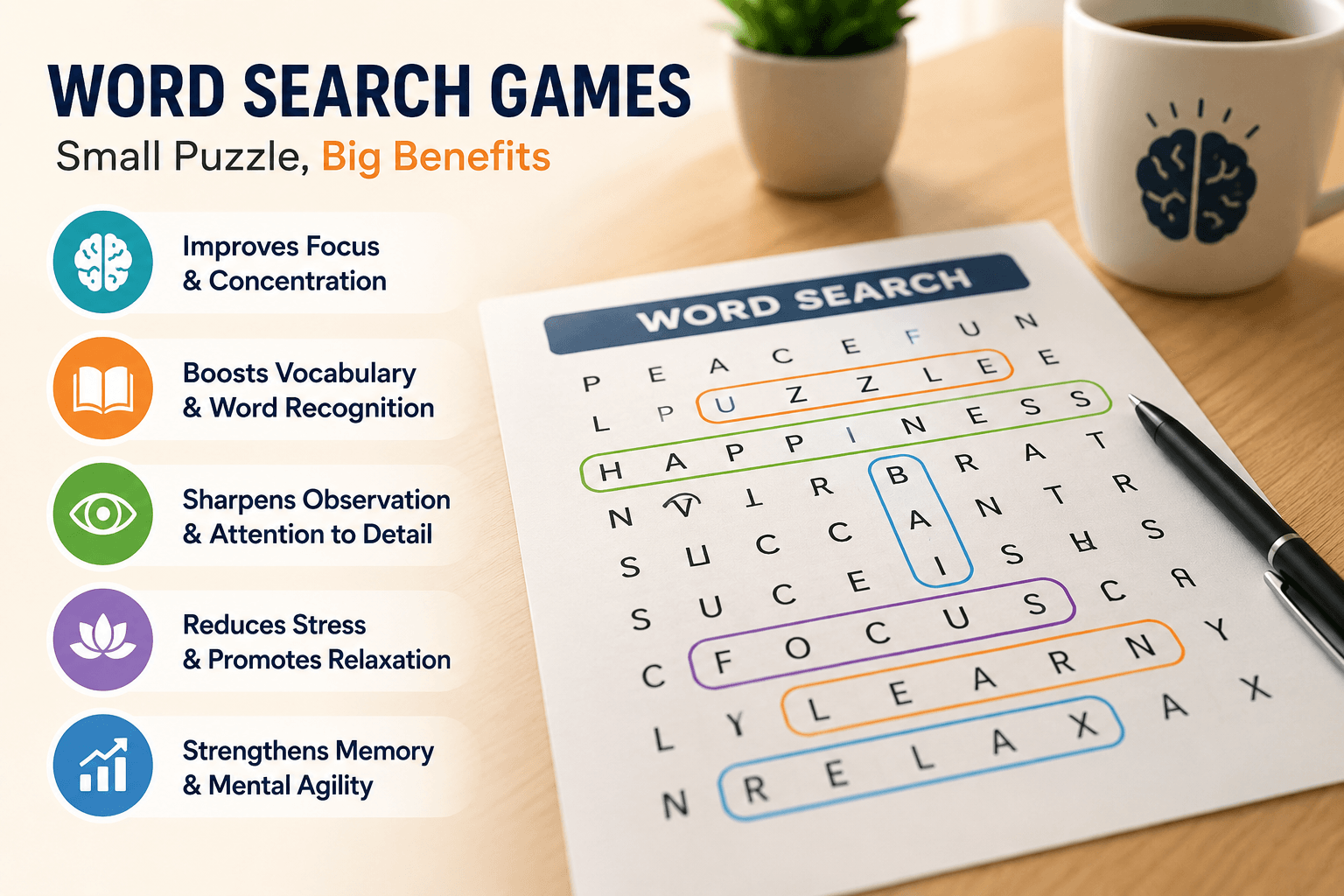
The Hidden Benefits of Word Search Games Most Players Never Notice
Ask someone why they play word search puzzles, and you'll probably hear answers like "they're fun," "they help me relax," or "they help pass the time." Those reasons are true, but they only tell part of the story.
What many players don't realize is that these games are doing far more behind the scenes than simply helping them fill a few spare minutes. While you're scanning rows of letters looking for a hidden word, your brain is constantly working—recognizing patterns, filtering distractions, and staying focused on a single goal.
The interesting part? Most of these benefits happen so naturally that players rarely notice them.
The Puzzle Is Simple, but the Brain Activity Isn't
One of the biggest misconceptions about word search puzzles is that they're "too easy" to offer any real mental value.
Think about what actually happens when you're searching for a word. Your eyes move across the puzzle, checking different letter combinations. Your brain quickly decides which patterns are worth following and which should be ignored. At the same time, you're remembering the list of words you're trying to find.
That's a surprisingly active process.
Unlike scrolling through social media or watching videos, word search games require participation. You can't solve the puzzle by simply looking at it. You have to engage with it.
That small difference is what makes these puzzles more beneficial than many people assume.
Why Some People Lose Track of Time While Playing
Have you ever opened a word search puzzle intending to spend five minutes on it, only to realize twenty minutes have passed?
There's a reason for that.
Word searches create a level of concentration that psychologists sometimes refer to as a "flow state." It's a situation where your attention becomes fully absorbed in what you're doing.
You're not thinking about tomorrow's meeting. You're not checking notifications every few seconds. You're focused on finding the next hidden word.
In a world full of distractions, that kind of uninterrupted focus is becoming increasingly rare.
The Vocabulary Benefit Most Adults Overlook
People often associate vocabulary building with children, students, or language learners. However, adults benefit from word exposure as well.
Many word search puzzles online are built around specific topics such as travel, science, sports, history, nature, or technology. As players encounter words repeatedly, they become more familiar with spellings and terminology they may not use every day.
You might not notice it immediately, but regular exposure helps strengthen word recognition.
It's similar to hearing a song several times before knowing the lyrics. The learning happens gradually rather than all at once.
They Quietly Train Observation Skills
One thing experienced word search players often develop is an eye for detail.
Imagine searching for the word "knowledge" in a large puzzle. You spot several rows beginning with the same letters, but only one leads to the correct answer.
Your brain learns to notice tiny differences between similar patterns.
That skill doesn't stay inside the puzzle forever.
Many people find that activities requiring attention to detail—reading documents, editing text, reviewing information, or spotting mistakes—feel easier when they regularly engage in observation-based games.
A Rare Type of Screen Time
Not all screen time is equal.
Some online activities leave people feeling mentally drained. After spending an hour jumping between videos, posts, and notifications, it can be difficult to remember what was actually accomplished.
It creates a different experience.
Instead of consuming information endlessly, players interact with a clear challenge. There is a beginning, a goal, and a satisfying finish.
That's one reason free online word search puzzles continue to attract people who want entertainment without feeling like they've wasted their time.
The Unexpected Stress-Relief Factor
Many players don't start solving word searches because they're looking for stress relief. Yet that's often one of the first benefits they notice.
The reason is simple.
When you're focused on locating hidden words, your attention shifts away from whatever is causing stress. For a short period, your mind has something specific and manageable to work on.
There's no pressure to be perfect. No competition. No complicated rules.
Just a puzzle and a list of words waiting to be found.
For many people, that simplicity feels refreshing.
Why Word Search Games Appeal to Every Generation
Very few activities can entertain children, teenagers, adults, and older adults at the same time.
These puzzles manage to do exactly that.
Children enjoy the challenge of finding words they've recently learned. Students use them as educational tools. Adults appreciate them as a quick mental break during the day. Older players often enjoy them because they're easy to start and mentally engaging without being overwhelming.
This broad appeal explains why online word search games have remained popular despite countless new gaming trends appearing over the years.
Small Habits Often Create the Biggest Results
Most players won't solve a puzzle today and suddenly feel smarter tomorrow.
That's not how the benefits work.
The value comes from repetition.
A few minutes here and there may not seem significant, but small habits performed consistently tend to have the greatest long-term impact. Whether it's reading, exercising, learning a skill, or solving puzzles, progress usually happens gradually.
Word search games are no different.
The focus, patience, observation, and vocabulary exposure build little by little with every completed puzzle.
Final Thoughts
The next time you open it, remember that you're doing more than searching for hidden words.
You're practicing concentration in a world full of distractions. You're strengthening observation skills without realizing it. You're exposing yourself to new vocabulary and giving your brain a light but meaningful workout.
Perhaps that's the real reason word search games have remained popular for so long. They're simple enough for anyone to enjoy, yet valuable enough to keep people coming back.
And often, the best benefits are the ones we never notice while they're happening.
Appreciate the creator