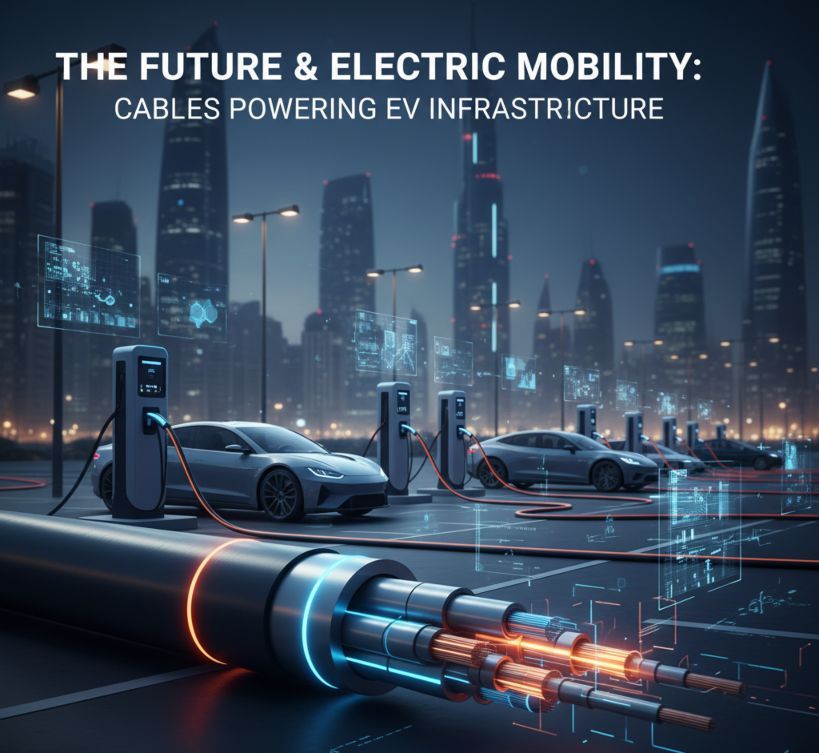
The Future of Electric Mobility: Cables Powering EV Infrastructure
The global shift to Electric Mobility ($\text{EV}$) is one of the most defining trends of the century, promising cleaner air and sustainable transport. While battery technology captures the headlines, the real-world success of this transition rests on the charging infrastructure—and the cables that power it. The demands placed on $\text{EV}$ cables are unique and extreme, requiring specialized engineering to handle high current, manage immense heat, and deliver power efficiently to enable the next generation of rapid-charging networks.
The Technical Challenge of Rapid Charging
Early $\text{EV}$ charging used simple $\text{AC}$ power, but the future is defined by DC fast charging. This technology drastically reduces charging times, but it places enormous stress on the cables and connectors.
1. High-Current, High-Voltage Demands
Bulk Power Delivery: Modern DC fast chargers are rated from $50 \text{ kW}$ up to $350 \text{ kW}$, requiring the cables connecting the charging station to the grid to handle massive, sustained current loads. This necessitates extra-thick conductors and specialized insulation.
On-Vehicle Cables: The cable connecting the station to the car needs to safely handle these high currents, which generates significant heat, all while remaining flexible enough for drivers to handle.
2. Thermal Management Innovation
Heat is the enemy of efficiency, cable longevity, and safety. The higher the current, the greater the heat generated (I²R loss).
Active Cooling Systems: For ultra-rapid charging ($200 \text{ kW}$ and above), the charging cable itself is becoming "smart." Specialized cables incorporate thin, flexible fluid channels (liquid cooling) running alongside the conductors. This actively dissipates heat, allowing the cable to carry significantly higher current without overheating, enabling lightning-fast charging.
High-Temperature Polymers: Insulation and jacketing materials must be highly resistant to sustained heat exposure and thermal cycling, ensuring the cable’s integrity over its lifespan.
Cables in the Infrastructure Backbone
The $\text{EV}$ charging network relies on specialized cable systems both above and below ground:
Grid Connection Cables: High-capacity power cables must link the charging stations to the utility grid. For large charging hubs, this involves deploying heavy-duty medium-voltage ($\text{MV}$) cables.
Charging Station Wiring: Inside the station, specialized shielded cables manage data communication between the charger, the car, and the network provider (for billing and monitoring). This ensures a secure and reliable transaction.
Urban Integration: As $\text{EV}$ adoption grows, city infrastructure will require the deployment of mass $\text{MV}$ distribution cables to support clusters of fast-charging hubs. This planning and manufacturing capability is a key focus for $\text{HV}$ experts like cable manufacturers in uae.
Safety, Durability, and User Experience
The cables used in public infrastructure must also meet high standards for safety and usability:
Robust Jacketing: Cables must be protected from constant abuse, chemical exposure, and weather. $\text{PUR}$ and $\text{TPE}$ jackets provide superior resistance to abrasion and environmental stress.
Safety Certification: All components must be certified by global safety bodies ($\text{UL/IEC}$) to ensure public safety in high-current applications.
Supply Chain Resilience: The rapid scaling of the $\text{EV}$ sector requires a reliable supply of high-purity copper and polymer materials, necessitating consistent quality verification from quality cable suppliers in uae.
Your EV Cable Questions Answered (FAQs)
What is the biggest technical challenge for ultra-rapid $\text{EV}$ charging cables?
The biggest challenge is thermal management. High charging currents generate immense heat, which must be safely and efficiently dissipated to prevent cable overheating, energy loss, and system failure.What role does liquid cooling play in charging cables?
Liquid cooling (active cooling) uses flexible fluid channels within the cable to carry heat away from the conductor. This allows the cable to safely handle the extremely high currents required for $\text{DC}$ rapid charging ($200 \text{ kW}$ and above).Why do EV chargers need to be connected to the grid by $\text{MV}$ cables?
Large charging hubs often have multiple rapid chargers running simultaneously, creating a demand load equivalent to a small factory or large apartment complex. This bulk power requirement necessitates a direct, high-capacity connection using medium-voltage ($\text{MV}$) infrastructure.What type of cable material is preferred for the outer jacket of public charging cables?
$\text{PUR}$ (Polyurethane) and high-grade $\text{TPE}$ (Thermoplastic Elastomer) are preferred. They offer excellent durability, abrasion resistance, and resistance to oils and chemicals, ensuring the cable withstands frequent public use.What is the difference between $\text{AC}$ and $\text{DC}$ charging from a cable perspective?
$\text{AC}$ (Level 1/2) uses the car's onboard converter and is slower, requiring less specialized cables. $\text{DC}$ (Level 3/Fast Charging) bypasses the car's converter, delivering power directly from the station's rectifier, requiring highly specialized, thermally managed, high-current cables.
Appreciate the creator