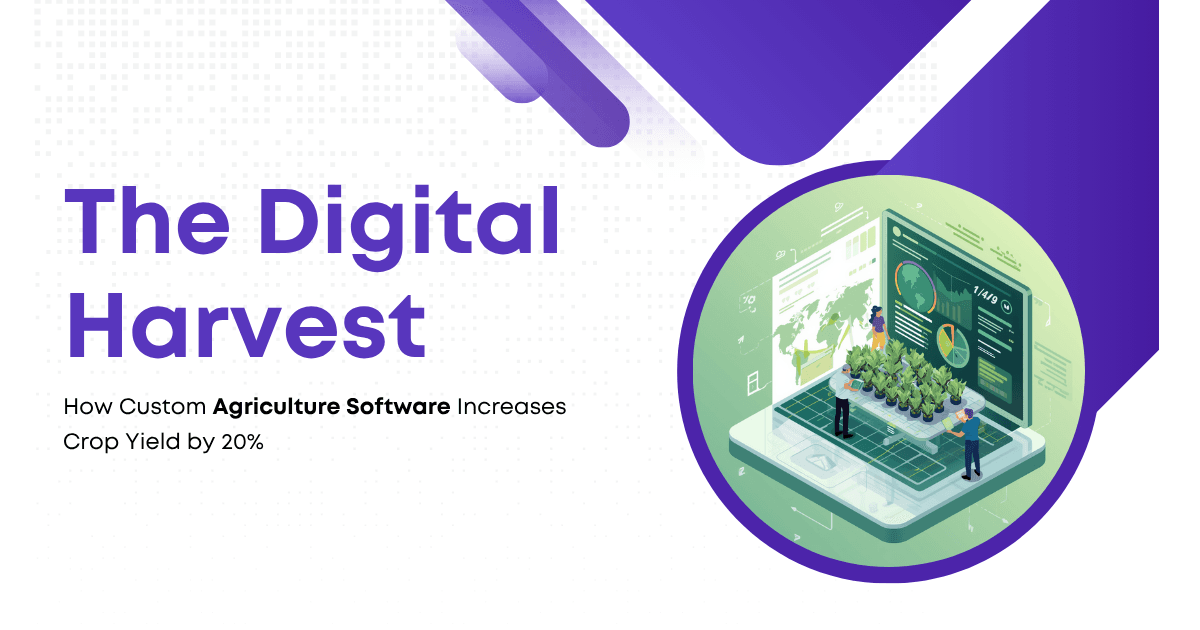
The Digital Harvest: How Custom Agriculture Software Increases Crop Yield by 20%
The global food system faces a massive challenge in 2026. Farmers must feed more people with less land and less water. Climate change has made traditional growing seasons unpredictable. To survive, the industry has turned to technology. Specifically, Agriculture Software Development has become the primary driver of farm efficiency. Custom digital tools allow farmers to monitor every square inch of their fields in real time. This technical shift has led to a measurable "Digital Harvest."
Recent studies show that integrated AgTech platforms increase crop yields by an average of 20%. These gains do not come from magic. They come from precise data and automated decision-making. By using professional Agriculture Software Development Services, agribusinesses transform from traditional operations into data-driven powerhouses.
The Shift to Precision Agriculture
Precision agriculture is the practice of managing fields at a granular level. In the past, a farmer treated a whole 100-acre field the same way. They applied the same amount of water and fertilizer everywhere. This was wasteful and inefficient. Modern software allows for "Variable Rate Application" (VRA).
VRA systems divide a field into small zones. Sensors measure the nitrogen levels and moisture in each zone. The software then tells the machinery exactly how much input to provide. This prevents over-fertilization, which can actually harm crop growth. It also ensures that thirsty plants get water before they wilt. This level of detail is only possible through custom Agriculture Software Development.
Technical Foundations of Modern AgTech
Building a successful farm management system requires a complex tech stack. It involves more than just a simple mobile app. It requires a deep integration of hardware and software.
1. High-Frequency IoT Data Ingestion
Modern farms use thousands of sensors. These devices measure soil temperature, humidity, pH levels, and wind speed. The software must ingest this data constantly. Developers use "Edge Computing" to process data locally in the field. This reduces the need for expensive satellite bandwidth. It also ensures that the system reacts instantly to a sudden frost or a heatwave.
2. Computer Vision for Pest Detection
Pests and diseases can destroy a crop in days. Manual scouting is slow and often misses early signs of trouble. Custom Agriculture Software Development Services now include computer vision models. Drones or fixed cameras take high-resolution photos of leaves. The AI identifies specific insects or fungus patterns. It can spot a disease before a human eye can see it. This allows for targeted spraying, which saves money and protects the environment.
3. Satellite Imagery and NDVI Analysis
Normalized Difference Vegetation Index (NDVI) is a critical metric for crop health. It measures how much near-infrared light plants reflect. Healthy plants reflect more of this light. Custom software pulls this data from satellites like Sentinel-2. The platform then generates "heat maps" of the farm. Red areas show stressed plants, while green areas show thriving ones. Farmers use these maps to prioritize their labor and resources.
Why Custom Software Beats Generic Apps
Many farmers try to use "off-the-shelf" apps. However, these generic tools often fail to meet the specific needs of a farm. Every farm has different soil, weather, and crop types.
1. Localized Climate Models
A generic app might give you the weather for the nearest city. But a large farm can have its own microclimate. Custom Agriculture Software Development integrates with on-site weather stations. It creates a hyper-local forecast for your specific GPS coordinates. This accuracy is vital for choosing the right day to spray pesticides or harvest a delicate crop.
2. Legacy Hardware Integration
Farmers rarely buy all their equipment at once. They might have a ten-year-old tractor and a brand-new irrigation system. These machines often use different communication protocols. Custom developers build "middleware" that allows these different tools to talk to each other. This creates a unified "Farm Operating System" where every machine works in sync.
Enhancing Soil Health Through Data
Soil is a living ecosystem. If the soil is healthy, the crops are strong. Agriculture Software Development Services now focus heavily on "Regenerative Agriculture."
Software monitors the carbon levels and microbial activity in the soil over time. It suggests "Cover Crops" that restore nutrients naturally. By tracking soil health data across several seasons, the software helps farmers reduce their reliance on chemical fertilizers. This not only increases yield but also improves the long-term value of the land.
Automated Irrigation and Water Management
Water is the most valuable resource in agriculture. In many regions, water is scarce and expensive. Custom software manages irrigation with extreme precision.
AI agents monitor soil moisture at multiple depths. They also check the upcoming weather forecast. If rain is coming tomorrow, the software cancels today's irrigation. This "Smart Irrigation" prevents waterlogging and root rot. It also ensures that the crop gets exactly what it needs to reach its maximum weight. Optimized water management alone can account for a 10% increase in yield for corn and soybean crops.
The Role of AI in Harvest Planning
Harvesting at the wrong time can ruin a whole season. If you harvest too early, the fruit is small. If you harvest too late, it might rot or lose its flavor.
Predictive algorithms analyze the whole growing season. They track "Growing Degree Days" (GDD) to predict the exact moment of peak ripeness. Custom Agriculture Software Development provides a harvest schedule for every block of the farm. This allows the farmer to hire the right amount of labor and book transport in advance. This efficiency reduces post-harvest waste, which adds to the total yield that reaches the market.
Challenges in Agricultural Software Implementation
Moving to a digital system is a big step. Farmers face several technical hurdles.
1. Connectivity in Remote Areas
Many farms sit in "dead zones" with no cellular signal. This makes cloud-based apps useless. Professional Agriculture Software Development Services solve this with "Offline-First" design. The app stores all data on the device. It syncs with the cloud only when the farmer returns to the office or finds a signal.
2. User Interface and Accessibility
Farmers work in the dirt and the sun. They cannot use complex menus on a tiny screen. Custom software must have a simple, high-contrast interface. Voice commands are also becoming popular. A farmer can say, "Record a pest sighting in Block B," while they are driving a tractor. This ensures that important data is captured without stopping the work.
3. Data Security and Privacy
Farm data is valuable. It shows exactly how much a farm produces and what its costs are. Many farmers worry about big corporations stealing this data to manipulate prices. Custom software allows the farmer to own their data. They can choose exactly who sees it and how it is used.
Future Trends: Agentic AgTech
As we move past 2026, the industry is moving toward "Autonomous Agronomy." This means the software will do more than just provide advice. It will take action.
Autonomous tractors already exist. In the future, these machines will receive their instructions directly from the farm's AI agent. The agent will monitor the field and send a tractor to spray a specific spot without any human input. This 24/7 operation will push yields even higher by ensuring that every plant gets perfect care at every moment of its life.
ROI of Agriculture Software Development Services
Investing in custom code provides a rapid return. Most large farms see the following benefits:
Labor Efficiency: Workers spend less time scouting fields and more time fixing problems.
Input Savings: Precise application of water and fertilizer reduces waste by 30%.
Market Premium: Detailed data logs allow farmers to prove their "Organic" or "Sustainably Grown" status. This lets them charge higher prices.
Risk Mitigation: Early warnings for frost or pests prevent catastrophic crop loss.
Conclusion
The 20% increase in yield is the result of thousands of small improvements. It is the result of better water, better soil, and better timing. Agriculture Software Development makes these improvements possible by turning guesses into facts.
Professional Agriculture Software Development Services provide the customized tools needed for this precision. These services bridge the gap between ancient farming traditions and modern data science. By using sensors, satellites, and AI, farmers can finally master their environment.
The digital harvest is not a one-time event. It is a continuous process of improvement. As the software gets smarter, the yields will continue to rise. For the modern agribusiness, software is no longer a luxury. It is the most powerful seed a farmer can plant. In the economy of 2026, the farms that use data will feed the world. Those who do not will struggle to survive the changing climate. Custom software ensures that every drop of water and every grain of fertilizer creates a return. This is the true meaning of the digital harvest.
Appreciate the creator