The Best Pen for Everyday Writing — And Why Most People Are Getting It Wrong
Let's be honest. Most of us have never actually chosen a pen. We just use whatever's lying around — the one from the bank counter, the freebie from some event, or the mystery pen that somehow survived three bag cleanouts. And somehow, we're surprised when writing feels like a chore.
Here's the thing — the right everyday pen makes a bigger difference than you'd expect. Not in a dramatic, life-changing way. But in that quiet, satisfying way where things just work. No skipping. No hand cramps. No embarrassing scratching sounds during a meeting.
So if you've never actually thought about what makes a good everyday pen, this one's for you.
WHY DOES YOUR PEN EVEN MATTER?
Think about how much you actually write in a day. Sign a document. Jot a number down. Take notes in a meeting. Fill out a form. Scribble a reminder before you forget it.
It adds up. And every time your pen skips, smears, or feels wrong in your hand, there's a tiny friction that slows you down.
A good pen removes that friction entirely. You stop thinking about the pen and start thinking about what you're writing. That's the whole point.
There's also a professional angle nobody talks about enough. When you're in a meeting, at a client's desk, or signing something important — people notice the details. A solid, well-designed pen quietly signals that you pay attention to things. A flimsy plastic throwaway signals the opposite.
WHAT ACTUALLY MAKES A PEN GOOD FOR EVERYDAY USE?
Not all pens are built the same. Here's what separates the ones worth keeping from the ones you lose on purpose.
A grip that doesn't fight you Your fingers should rest on the pen naturally — not squeeze it for control. The best everyday pens have a grip zone that's slightly contoured or textured so your fingers stay put without effort.
The right weight This is underrated. A pen that's too light feels like you're writing with a twig. Too heavy and your wrist tires fast. The sweet spot is a pen with enough weight to feel solid but balanced near where you hold it.
Ink that just works Consistent, clean, first-stroke every time. No blobbing. No dry patches halfway through a word. This sounds basic but a surprising number of pens fail here.
Built to survive your bag Everyday carry is brutal. Keys, chargers, notebooks, random stuff — all grinding against your pen. A cheap plastic body cracks or snaps. A metal body survives all of it and still looks fine a year later.
Looks that don't embarrass you You should be able to pull your pen out anywhere — at a café, in a boardroom, during a lecture — without thinking twice about it.
BALLPOINT, GEL, OR ROLLERBALL — WHICH ONE SHOULD YOU ACTUALLY CARRY?
This question comes up a lot and the answer is simpler than most pen enthusiasts want it to be.
For everyday use: go ballpoint.
Gel pens write beautifully. Seriously, if you've never tried a good gel pen, you're missing out. But they smear when your hand drags across fresh ink, they dry out faster, and they're more fussy about paper. Not ideal for the person who writes on everything from receipts to sticky notes to meeting agendas.
Rollerballs are expressive and smooth but drain ink quickly and smear even more than gel. Great for journaling. Annoying for daily carry.
Fountain pens are a whole hobby. Wonderful if you're into it. Not practical if you just need to sign something in a hurry.
Ballpoint ink is oil-based, which means it dries almost instantly, barely smears, works on any paper, and lasts a very long time. It's the most forgiving ink type for real-world, messy everyday life.
Pro tip: If you find regular ballpoint ink too dry or scratchy, look for newer hybrid ballpoint formulas. They combine ballpoint's practicality with gel's smoothness. Many quality metal-body pens now use these.
THE PEN WORTH TALKING ABOUT: SHAPE TRITON BALL PEN
Now let's get specific.
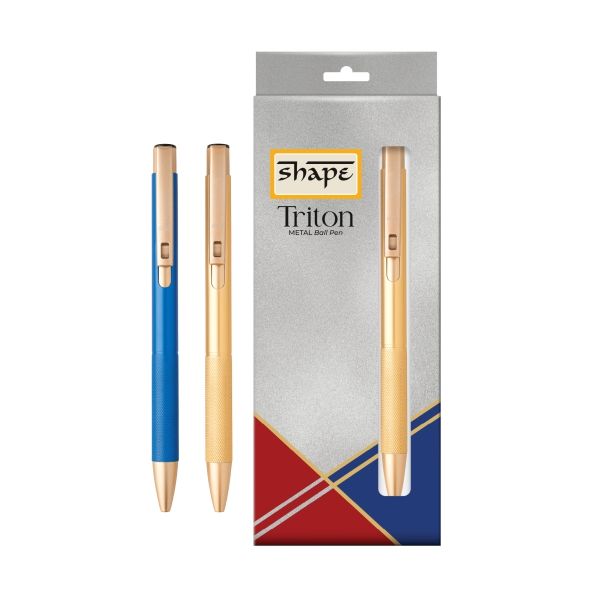
The Shape TRITON Ball Pen was built with one clear purpose — to be the pen you actually use every day without thinking about it. Not a collector's piece. Not a gift-box showpiece. A daily writer.
What you get with the TRITON:
Metal body — It feels solid in hand the moment you pick it up. None of that hollow, cheap feel. The metal build also means it survives daily carry without showing up cracked or bent a month later.
Ergonomic grip — The grip zone is designed around where your fingers naturally land on a pen. Less squeezing, less fatigue, more control during longer writing sessions.
Balanced weight — Not too heavy, not too light. It sits in your hand with the kind of weight that makes writing feel effortless rather than effortful.
Ballpoint ink system — Consistent, reliable, low-smear. First-stroke every time. Works on all paper types including the cheap stuff.
A look that fits anywhere — Professional enough for a client meeting, understated enough for everyday use. No flashy logos, no gimmicks.
Shape Stationery — the brand behind the TRITON — is an Indian manufacturer with a proper manufacturing setup across school, professional, and gifting stationery segments. The TRITON comes from their professional writing line, which means the quality bar is noticeably higher than a classroom ballpoint.
Check out the Shape TRITON Ball Pen here: https://shapestationery.com/product/triton-ball-pen/
WHO IS THIS PEN FOR?
The TRITON makes the most sense for:
Students and working professionals who write for long stretches and want a pen that doesn't punish their hand for it.
People who've had enough of pens that skip, leak, or break within weeks.
Anyone who wants one pen that handles everything — notes, signatures, forms — without carrying three different types.
Those who want to look put-together in professional settings without spending big money on a luxury pen.
It's probably not your first choice if you're a journalling enthusiast chasing a specific ink feel, or if you need a gift pen with personalization options (Shape does have a gifting line worth checking for that).
5 SIGNS YOU NEED A BETTER EVERYDAY PEN
You've pressed harder mid-sentence because the ink stopped flowing.
You've finished writing something and found a smear across half of it.
Your pen rattles when you shake it — and you have no idea why.
You're borrowing pens from colleagues more often than you'd like to admit.
Your current pen is embarrassing enough that you hide it during meetings.
If two or more of those hit home — it's time.
FREQUENTLY ASKED QUESTIONS
What is the best type of pen for everyday writing? Ballpoint. It's the most practical choice for daily use — oil-based ink that dries fast, works on all paper types, doesn't smear, and lasts a long time without drying out between uses.
Is it worth spending more on a metal pen? For daily carry, yes. Metal pens survive the inside of a bag far better than plastic ones. They also feel more substantial, which genuinely helps with control and comfort during writing.
Can left-handed people use the TRITON? Yes. Ballpoint ink is actually the best ink type for left-handed writers because it dries quickly and doesn't smear as your hand moves across the page.
How is the TRITON different from a regular ballpoint pen? The main difference is build and design. The TRITON has a metal body, an ergonomic grip zone, and balanced weight — features you don't find in standard plastic ballpoints. It's designed for extended, comfortable everyday use rather than just getting the job done.
Where can I buy the Shape TRITON Ball Pen? Directly on the Shape Stationery website: https://shapestationery.com/product/triton-ball-pen/
The Bottom Line
A good everyday pen isn't a luxury. It's just the right tool for something you do every single day. The Shape TRITON Ball Pen gets the basics right — solid build, comfortable grip, reliable ink — without overcomplicating it.
Sometimes that's exactly what you need.
View the Shape TRITON Ball Pen: https://shapestationery.com/product/triton-ball-pen/
Appreciate the creator