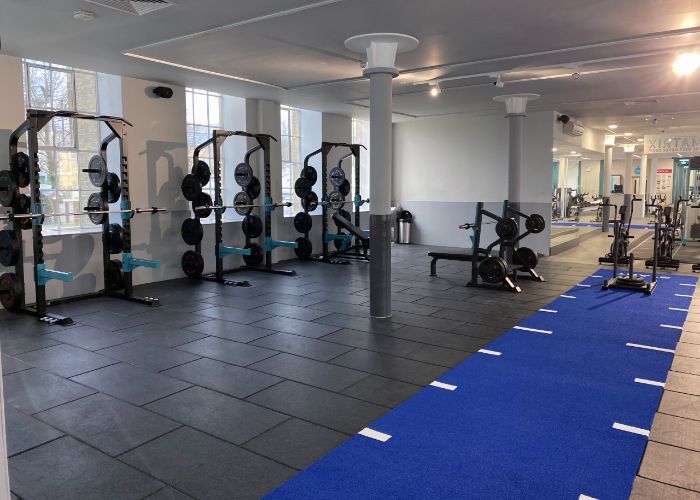
The 5 Best Materials for Commercial Gym Flooring
Choosing the right flooring for a commercial gym is as critical as the equipment itself. The ideal material must balance durability, user safety, and acoustic performance to withstand high traffic and heavy impact while maintaining a professional aesthetic. As of 2026, the industry has shifted toward high-performance materials that offer specialized benefits for different training zones.
Below are the five best materials for commercial gym flooring, categorized by their performance and ideal use cases.
1. Rubber Flooring: The Industry Gold Standard
Rubber remains the most popular choice for commercial facilities due to its unmatched resilience. Available in rolls, interlocking tiles, or mats, it is engineered to absorb the shock of dropped weights and provide a non-slip surface even when exposed to moisture.
Best For: Free weight zones, heavy machinery areas, and high-traffic weightlifting sections.
Key Advantage: It offers superior joint protection and extreme durability, resisting dents, scratches, and scuffs from heavy equipment.
Pro Tip: For 2026, many owners are opting for rubber composite tiles with built-in foam underlays, which can reduce ambient noise by up to 20 dB—a crucial feature for gyms in multi-use buildings.
2. Artificial Turf: The Performance Accelerator
Artificial turf has seen a surge in popularity for CrossFit boxes and functional training areas. Unlike traditional surfaces, turf provides a low-impact, cushioned feel that mimics outdoor training environments.
Best For: Sled pushes/pulls, sprinting, agility drills, and functional training.
Key Advantage: The synthetic fibers provide excellent traction for explosive movements while remaining easy to sanitize with standard commercial sprays.
Aesthetics: Turf adds a modern, "fresh" look to a facility, often used to define specific zones and attract members looking for high-intensity training options.
3. Vinyl Flooring: Versatility and Style
Vinyl is the preferred material for boutique studios and multi-purpose spaces. While not designed for heavy weightlifting, it excels in aesthetics and ease of maintenance.
Best For: Yoga studios, Pilates areas, dance halls, and cardio zones.
Key Advantage: It is highly moisture-resistant and available in a variety of patterns, including wood and stone finishes, providing a high-end look at a lower cost per square meter than rubber.
Maintenance: Vinyl’s non-porous surface makes it exceptionally easy to mop and sanitize, ensuring a hygienic environment for floor-based classes.
4. Foam (EVA) Tiles: Comfort and Affordability
For lighter activities, foam—often made from Ethylene Vinyl Acetate (EVA)—offers a lightweight and cost-effective solution. It is frequently used as a secondary layer or for specialized low-impact zones.
Best For: Stretching zones, rehabilitation areas, and children's fitness spaces.
Key Advantage: It provides high anti-fatigue properties, reducing joint stress during prolonged standing or floor workouts.
Limitation: It is not suitable for heavy machinery or dropping weights, as it can compress permanently under extreme pressure.
5. PVC (Interlocking Tiles): The Durable Hybrid
PVC tiles offer a middle ground between the density of rubber and the versatility of foam. They are known for their "jigsaw" design, which allows for fast, adhesive-free installation.
Best For: Multi-functional studios and home-to-commercial garage gym conversions.
Key Advantage: They are resistant to oils, chemicals, and heavy wear, making them a durable choice for facilities that might also host non-fitness events.
Flexibility: Because they do not require glue, individual tiles can be easily replaced if damaged, saving long-term maintenance costs.
Summary Comparison Table
MaterialShock AbsorptionHeavy Weight SupportMaintenancePrimary Use CaseRubberExcellentHighLowFree Weights & PowerliftingTurfModerateModerateModerateSleds & Agility DrillsVinylModerateLowVery LowYoga & CardioFoamHigh (Soft)Very LowLowStretching & RehabPVCModerateModerateLowMulti-purpose Studios
Final Considerations for 2026
When choosing your material, prioritize zonal flooring. Most successful commercial gyms in 2026 use a combination: thick rubber (15–20mm) in lifting areas, turf for functional tracks, and vinyl for cardio sections to maximize both performance and budget. Always consider long-term durability over initial cost; high-quality rubber and vinyl may be more expensive upfront but offer significantly better value over time by reducing repair needs.
Appreciate the creator