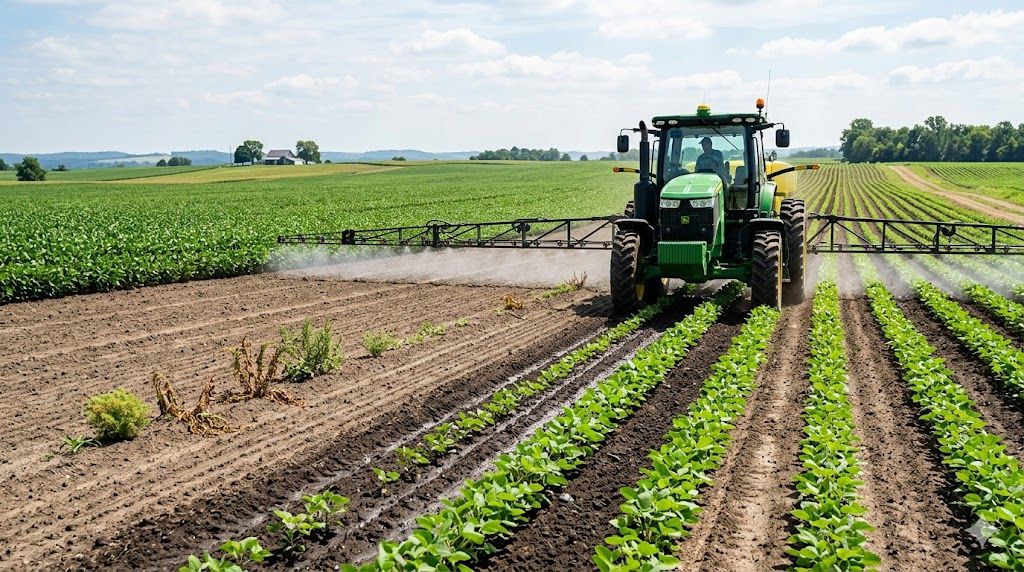
Strategic Use of Residual Herbicides with Glyphosate to Prevent Resistance in Annual Weeds
Glyphosate has been one of agriculture’s most relied-upon tools for decades, delivering fast, effective knockdown of a broad spectrum of annual weeds. Its convenience, cost-effectiveness, and consistent performance have cemented its value across cropping systems. Yet over-dependence on any single herbicide eventually carries consequences. In many regions, growers have begun to experience what agronomists call “knockdown fade”—the gradual decline in long-term weed suppression when glyphosate is used alone, season after season.
Knockdown fade doesn’t mean glyphosate has stopped working; rather, it reveals the limitations of a non-residual herbicide when fighting increasingly adaptive weed populations. Annual weeds that emerge after application, or those with slight natural tolerance, survive, reproduce, and eventually contribute to resistance selection. As resistant biotypes build, growers face higher weed pressure and reduced flexibility at critical times of the season.
To combat this trend, many producers are strategically pairing glyphosate with soil-active residual herbicides—an approach that strengthens early-season weed control and significantly slows resistance development.
Understanding Knockdown Fade: Why Reliance on Glyphosate Alone Falls Short
Glyphosate remains a powerful tool, but its mode of action has boundaries. As a foliar, non-residual herbicide, it controls only the weeds present at the time of application. New flushes that emerge days or weeks later have no exposure. In systems where early moisture triggers heavy emergence, this can leave growers managing a second wave of weeds that compete aggressively with young crops.
Over-reliance accelerates selection pressure. When glyphosate is used repeatedly as the primary or sole weed control tool, even small variations in weed tolerance matter. A few naturally tolerant individuals can survive, set seed, and spread their traits through the seed bank. Over time, a once-sensitive population becomes increasingly difficult to control with glyphosate alone.
This is the essence of knockdown fade: the herbicide still controls many weeds but loses staying power, forcing growers into additional passes, higher costs, and more complicated management decisions.
The Role of Residual Herbicides: Strengthening Early-Season Weed Defense
One of the most reliable ways to prevent knockdown fade is to pair glyphosate with a residual herbicide. This strategy delivers two modes of action, attacking existing weeds while creating a protective barrier in the soil to stop the next flush from emerging.
Residual herbicides offer several advantages:
1. Extended Control After Seeding
With a soil-active product in the mix, weeds that germinate after the glyphosate pass are intercepted before reaching the surface. This maintains cleaner fields during the crop’s vulnerable early growth stages.
2. Lower Resistance Pressure
Two effective modes of action dramatically reduce the likelihood that a weed population will adapt. By killing weeds at multiple points—both emerged and germinating—growers disrupt the reproductive cycle of individuals that might otherwise escape a knockdown-only program.
3. Reduced Need for Repeat Applications
With soil residual activity suppressing new flushes, growers often eliminate the need for a second burnoff or early in-crop treatment, saving time and improving operational efficiency.
4. Cleaner Seedbeds and Improved Crop Vigor
Young crops benefit when early competition is minimized. Soil-active herbicides enhance seedling vigor by removing early-season pressure that reduces moisture and nutrient access.
How Tank Mixing Works: Building a Strong, Two-Layer Defence
When glyphosate is tank mixed with a residual herbicide, the system becomes far more robust.
● Glyphosate provides immediate knockdown, ensuring emerged annual weeds do not compete with the crop.
● The residual product forms a weed-suppressing layer in the soil, controlling germinating seedlings for weeks—sometimes months—after application.
This one-two approach minimizes escapes and significantly reduces the chance of resistant survivors replenishing the seed bank.
Tank mixing also addresses some of the weaker points of glyphosate. For example:
● Small-seeded broadleaf weeds such as kochia, redroot pigweed, lamb’s-quarters, and wild mustard germinate throughout the early season. Residual herbicides are highly effective against these species.
● Early flushes induced by spring moisture can overwhelm a knockdown-only approach but are easily intercepted by soil-active herbicides.
The combination provides a more complete program than glyphosate can offer on its own.
Why This Matters for Herbicide Resistance Management
Herbicide resistance is now one of the most significant challenges in modern agronomy. Many annual weeds have already developed resistance to Group 2 and Group 1 herbicides. In some regions, glyphosate resistance is rising. Preventing resistance is far easier—and far less expensive—than managing it once it appears.
Tank mixing a herbicide with glyphosate provides the diversified mode-of-action approach that resistance management programs strongly recommend. By delivering two simultaneous pathways for weed control, the mix reduces the probability that a weed will escape treatment and pass on resistant traits.
This approach also improves the sustainability of glyphosate itself. Preserving its utility is vital, as it remains one of the most effective and economical knockdown tools available.
Integrating Tank Mixes into a Broader Weed Management Strategy
While tank mixing improves performance and protects chemistry, it should not stand alone. Growers benefit most by combining this strategy with:
● Crop rotation to disrupt weed life cycles
● Mechanical harvest weed seed control in some regions
● Competitive crop varieties and optimal seeding rates
● Timely in-crop herbicide passes using diverse modes of action
Knockdown fade is not a sign that glyphosate is failing—it is evidence that annual weeds are adapting and that non-residual programs can no longer keep fields clean on their own. By tank mixing glyphosate with a reliable soil-active product, growers expand the window of protection, improve early-season crop competition, and greatly reduce the selection pressure that leads to resistance.
For growers focused on long-term sustainability, efficiency, and yield stability, integrating residual herbicides into their spray program is one of the most effective steps they can take. Supported by a full range of crop protection products, this approach keeps fields cleaner, maintains chemical diversity, and ensures that glyphosate remains a dependable tool for years to come.
Appreciate the creator