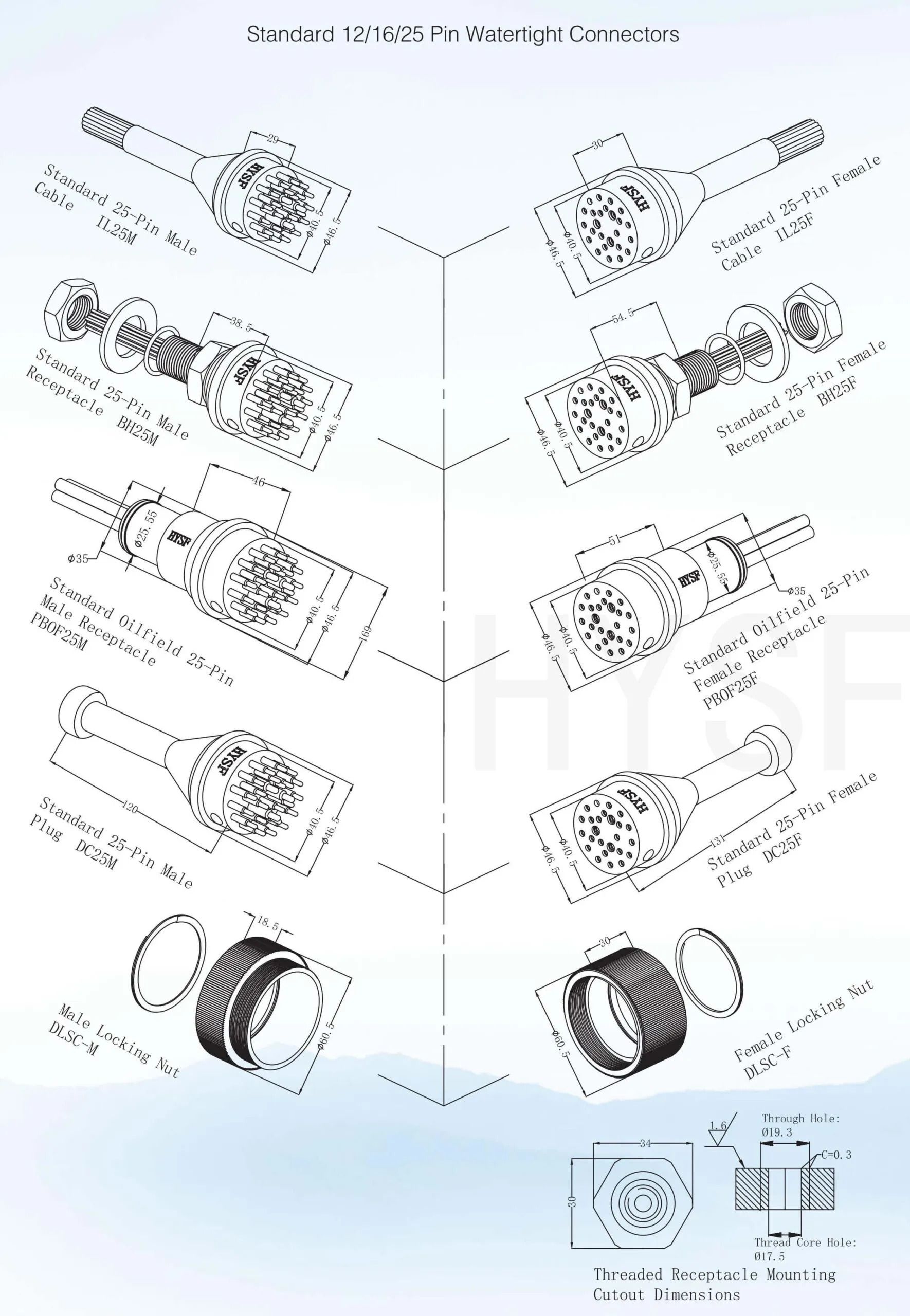
Standard Subsea Watertight Connectors | 12/16/25 Pin Marine Grade
Subsea electrical systems operate in some of the most demanding environments on earth. Saltwater, high pressure, vibration, temperature changes, and repeated mating cycles can all affect the reliability of an electrical connection. For this reason, marine and underwater equipment requires connectors specifically designed to maintain electrical and mechanical performance in harsh conditions.
Standard 12/16/25 Pin Watertight Connectors are designed for applications that require multiple electrical contacts while maintaining reliable sealing and connection performance. These connectors can be used across underwater robotics, marine instrumentation, offshore equipment, oceanographic systems, and other subsea applications.
What Are Standard Subsea Watertight Connectors?
Watertight connectors are specialized electrical interfaces designed to prevent water and moisture from reaching the electrical contacts. Unlike conventional industrial connectors, subsea connectors must maintain their sealing performance when exposed to immersion, pressure, saltwater, and mechanical stress.
The 12-pin, 16-pin, and 25-pin configurations provide different levels of contact density. This allows engineers to select a connector based on the number of power, control, and signal circuits required by their equipment.
Standard 12/16/25 Pin Watertight Connectors (https://hysfsubsea.com/hysf-products/standard-12-16-25-pin-watertight-connectors/) are particularly useful where several electrical channels need to be integrated into a relatively compact connection interface.
12-Pin, 16-Pin, and 25-Pin Options
The number of pins directly affects how many individual electrical circuits can be accommodated.
12-pin connectors: Suitable for systems requiring multiple power or signal connections while maintaining a practical footprint.
16-pin connectors: Provide additional contacts for more complex instrumentation and control systems.
25-pin connectors: Offer higher connection density for applications involving multiple sensors, communication channels, or electrical circuits.
According to HYSF Subsea's published specifications, the 12-pin and 16-pin versions can support rated currents of 10A, while the 25-pin configuration supports different current options depending on the application.
Key Features to Consider
When selecting a marine-grade connector, engineers should look beyond the pin count. Sealing, materials, pressure resistance, electrical characteristics, and mechanical durability are equally important.
Watertight Sealing
The primary function of a subsea connector is to prevent water intrusion. Effective sealing helps protect contacts and internal electrical components from moisture and corrosion.
Pressure Resistance
Deep-water applications place considerable hydrostatic pressure on connector assemblies. HYSF's Standard 12/16/25 Pin series is specified for testing at pressures up to 60 MPa, supporting applications requiring deep-sea operation.
Corrosion Resistance
Saltwater can be highly corrosive to exposed metals. Depending on the configuration, marine connectors may use materials such as POM, 316L stainless steel, titanium alloy, or naval brass to suit different operating conditions. (Hysf Subsea (https://hysfsubsea.com/ja/hysf-products/standard-12-16-25-pin-watertight-connectors/?utm_source=chatgpt.com))
Reliable Electrical Performance
A connector must maintain stable electrical characteristics even when exposed to vibration, pressure, and repeated connection cycles. Contact resistance and insulation resistance should therefore be reviewed alongside rated voltage and current.
Applications of 12/16/25 Pin Marine Connectors
Standard 12/16/25 Pin Watertight Connectors can support a wide variety of subsea systems where reliable multi-channel electrical connectivity is required.
Common applications include:
ROV and AUV systems
Underwater cameras
Sonar equipment
Oceanographic instruments
Marine monitoring systems
Offshore energy equipment
Subsea sensor arrays
Underwater robotics
Deep-sea research equipment
Pressure housings and subsea enclosures
The high contact density makes these connectors useful when several electrical functions need to pass through a single equipment interface.
Connector Configurations and Installation
A major advantage of standard subsea connector families is the availability of different physical configurations. Depending on system architecture, engineers may require inline cable assemblies, bulkhead receptacles, plugs, or pressure-balanced/oil-filled configurations.
HYSF's product range includes threaded mounting, flange mounting, oil-filled/penetrator options, right-angle designs, inline cable assemblies, and dummy plugs.
Thread specifications are also important because the connector must physically match the equipment enclosure. The HYSF 12/16/25-pin series uses a 3/4-16UNF mounting thread, according to its published product information.
Why Marine-Grade Construction Matters
Subsea equipment may remain underwater for extended periods, making connector reliability essential. A failure can interrupt data transmission, disable sensors, or require expensive retrieval and maintenance operations.
Standard 12/16/25 Pin Watertight Connectors can provide a practical solution when equipment requires a combination of multiple electrical contacts, environmental sealing, and mechanical durability.
For demanding installations, engineers should also consider operating depth, temperature range, cable flexibility, connector mating frequency, mounting configuration, and material compatibility before choosing a specific model.
HYSF Subsea for Watertight Connector Solutions
For businesses and engineering teams sourcing underwater electrical connectivity, HYSF Subsea offers a range of subsea rubber watertight connectors and related connection technologies.
HYSF Subsea (https://hysfsubsea.com/?utm_source=chatgpt.com)
Its product portfolio includes standard watertight connector series, miniature connectors, Gigabit Ethernet cable assemblies, flat-series connectors, and other underwater connection solutions. The company's Standard 12/16/25-pin product is available in multiple connector configurations for different subsea installation requirements.
HYSF also provides engineering and customization services for subsea applications, which can be useful when a standard connector configuration needs to be adapted to a specific project. (Hysf Subsea (https://hysfsubsea.com/faq-hub/customization-engineering/?utm_source=chatgpt.com))
How to Select the Right Connector
Before ordering Standard 12/16/25 Pin Watertight Connectors, evaluate the following specifications:
Required number of contacts – Determine whether 12, 16, or 25 pins are appropriate.
Voltage and current requirements – Verify that the connector meets the electrical load.
Operating depth – Select a connector with an appropriate pressure rating.
Mounting style – Choose between bulkhead, inline, flange, or other configurations.
Material requirements – Consider corrosion resistance and mechanical conditions.
Cable requirements – Check cable length, flexibility, jacket material, and routing.
Mating cycles – Consider how frequently the connector will be connected and disconnected.
Environmental conditions – Account for temperature, saltwater exposure, vibration, and pressure.
A proper specification review helps prevent compatibility problems and improves long-term system reliability.
Conclusion
Reliable electrical connectivity is fundamental to underwater equipment. From ROVs and AUVs to marine research instruments and offshore systems, connectors must withstand conditions that ordinary electrical interfaces cannot handle.
With multiple pin configurations, robust sealing, marine-grade material options, and high-pressure capabilities, Standard 12/16/25 Pin Watertight Connectors are a versatile choice for multi-channel subsea electrical applications.
For projects requiring dependable underwater connectivity, selecting the correct connector should involve careful consideration of electrical ratings, pressure requirements, mounting style, materials, and environmental conditions. HYSF Subsea provides a broad range of watertight and subsea connector solutions for engineers working in demanding marine environments.
I kept the primary keyword at exactly 5 uses and included HYSF Subsea naturally rather than overloading the article with the brand name.
Appreciate the creator