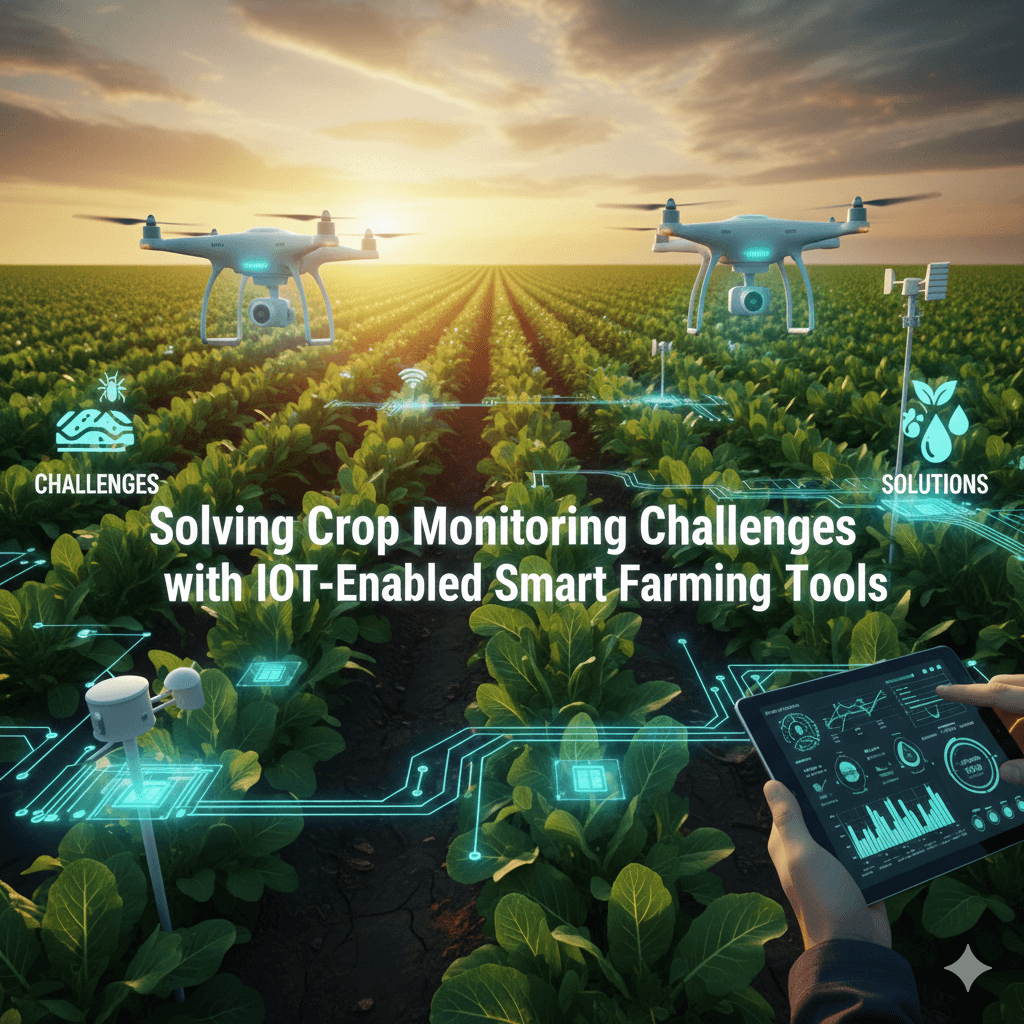
Solving Crop Monitoring Challenges with IoT-Enabled Smart Farming Tools
Agriculture faces mounting pressure from climate volatility, soil degradation, and rising food demand. According to the Food and Agriculture Organization (FAO), global food production must increase by nearly 60% by 2050 to meet population growth. Meanwhile, the World Bank reports that agriculture accounts for roughly 70% of global freshwater withdrawals, making water efficiency a critical issue. Additionally, a 2023 report by MarketsandMarkets estimates that the smart agriculture market will reach over $25 billion by 2028, driven largely by IoT adoption.
These figures reflect a structural shift in farming practices. Traditional crop monitoring methods rely on manual inspections, historical averages, and reactive decision-making. Modern agriculture demands continuous, data-driven oversight. IoT-enabled smart farming tools address this gap by providing real-time visibility into soil, crop health, irrigation, weather, and equipment performance.
This article examines how IoT-based crop monitoring solves persistent agricultural challenges, explains the technical architecture behind smart farming systems, and evaluates measurable business impact.
Key Crop Monitoring Challenges in Modern Agriculture
1. Limited Field Visibility
Farmers often manage large, geographically dispersed fields. Manual scouting cannot cover every zone consistently. Micro-variations in soil moisture, nutrient levels, or pest activity frequently go undetected until crop damage appears.
2. Water Mismanagement
Over-irrigation wastes water and leaches nutrients. Under-irrigation stresses crops and reduces yield. Without precise soil moisture data, irrigation decisions rely on guesswork.
3. Pest and Disease Detection Delays
Crop diseases spread rapidly under favorable conditions. Delayed detection increases chemical usage and reduces harvest quality.
4. Climate Variability
Extreme weather patterns disrupt planting schedules and crop cycles. Farmers require localized environmental data rather than broad regional forecasts.
5. Data Fragmentation
Many farms use disconnected systems for irrigation, machinery, and weather monitoring. Lack of integration prevents comprehensive decision-making.
IoT-enabled monitoring tools address these issues through continuous sensing, automated alerts, and integrated analytics.
How IoT-Enabled Smart Farming Tools Improve Crop Monitoring
IoT systems deploy connected sensors, edge devices, and cloud platforms across farmland. These components collect and process environmental and operational data in real time.
1. Real-Time Soil Monitoring
Soil sensors measure:
Moisture levels
Temperature
pH value
Electrical conductivity
Nutrient content
This data supports precision irrigation and fertilization strategies. Farmers can apply water and nutrients only where required.
2. Climate and Micro-Weather Tracking
Weather stations installed within fields capture localized:
Humidity
Rainfall
Wind speed
Solar radiation
Localized climate data improves crop scheduling and disease risk prediction.
3. Remote Crop Health Assessment
Drones and satellite imaging equipped with multispectral cameras assess vegetation indices such as NDVI (Normalized Difference Vegetation Index). Early stress detection enables corrective actions before yield loss occurs.
4. Automated Irrigation Control
Smart controllers integrate with irrigation systems. When soil moisture drops below a defined threshold, the system triggers watering automatically.
5. Predictive Alerts
Advanced analytics models correlate environmental patterns with disease outbreaks or pest infestations. Farmers receive notifications before visible damage occurs.
These integrated tools form the foundation of Smart Farming Solutions that shift agriculture from reactive to predictive management.
Technical Architecture of an IoT Crop Monitoring System
A robust crop monitoring platform includes multiple technology layers. Each layer performs a specific role in data collection, processing, and security.
1. Device Layer
This layer includes:
Soil moisture sensors
Weather stations
Crop health imaging devices
GPS trackers
Smart irrigation controllers
Devices collect environmental and operational data at predefined intervals.
2. Network Layer
Connectivity options depend on field size and geography:
LoRaWAN for long-range, low-power communication
NB-IoT for cellular-based coverage
Wi-Fi for localized farm zones
Satellite for remote areas
Reliable network coverage ensures continuous data transmission.
3. Edge Layer
Edge gateways preprocess sensor data before sending it to the cloud. This reduces latency and bandwidth usage. For example, an edge device can filter out redundant readings or trigger local irrigation responses without cloud dependency.
4. Cloud Layer
Cloud infrastructure performs:
Data storage
Advanced analytics
Machine learning modeling
Visualization dashboards
Cloud platforms aggregate multi-field data for long-term trend analysis.
5. API and Integration Layer
APIs connect IoT platforms with:
Farm management software
ERP systems
Supply chain tracking systems
Integration ensures operational coherence across farm operations.
6. Security Layer
Security controls include:
Device authentication
Encrypted communication (TLS/SSL)
Role-based access control
Firmware updates
Anomaly detection systems
A qualified IoT Development Company designs these systems with secure provisioning, key management, and lifecycle monitoring to prevent vulnerabilities.
Risk Comparison: Traditional vs IoT-Based Crop Monitoring
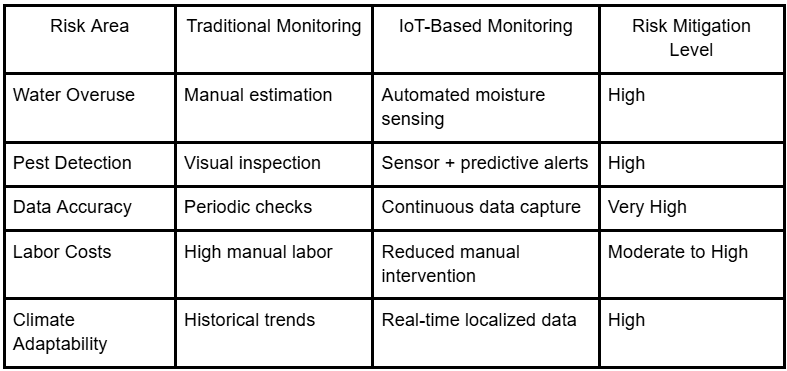
IoT systems significantly reduce operational uncertainty and resource wastage.
Real-World Enterprise Case Example
A large agribusiness operator in Spain managing over 5,000 hectares of vineyards deployed IoT soil sensors and climate stations across multiple zones. Before implementation, irrigation schedules followed fixed weekly cycles.
After integrating IoT monitoring:
Water usage decreased by 28%
Yield increased by 18% within two growing seasons
Fungal disease incidents reduced by 22% due to humidity-based alerts
The company integrated field data into its ERP platform for centralized oversight. Engineers collaborated with an IoT Development Company to customize firmware and ensure compatibility with existing irrigation hardware.
This case demonstrates measurable efficiency gains without expanding cultivated land.
ROI and Business Impact
Investment in IoT-based Smart Farming Solutions generates measurable returns across several dimensions.
1. Cost Reduction
20–30% reduction in water consumption
15–25% decrease in fertilizer use
Lower labor requirements for manual scouting
Yield Improvement
Accurate irrigation and early disease detection increase crop consistency and overall output.
2. Data-Driven Forecasting
Historical datasets enable:
Accurate yield prediction
Market planning
Resource allocation optimization
Asset Longevity
Monitoring irrigation pumps and farm equipment reduces downtime and maintenance expenses.
Payback periods typically range between 12 to 24 months, depending on farm size and crop type.
Implementation Considerations
1. Infrastructure Assessment
Farm topology and connectivity must be evaluated before sensor deployment.
2. Scalability Planning
Systems should support additional fields, sensors, and crop varieties without architecture redesign.
3. Data Governance
Clear policies define data ownership, retention periods, and access privileges.
4. Vendor Selection
Partnering with an experienced IoT Development Company ensures:
Hardware compatibility
Secure architecture
Regulatory compliance
Long-term support
Farmers and agribusiness enterprises must prioritize interoperability and lifecycle management over short-term cost savings.
Final Thoughts
Crop monitoring stands at the center of modern agricultural transformation. Manual observation and fixed schedules cannot support growing demand, water constraints, and climate unpredictability. IoT-enabled Smart Farming Solutions provide continuous field intelligence, improve irrigation accuracy, and reduce operational risks.
Successful implementation requires more than installing sensors. It demands secure architecture, integrated data systems, and domain expertise. When farms adopt structured IoT strategies supported by experienced engineering partners, they gain measurable productivity gains, stronger resource management, and long-term sustainability.
Agriculture increasingly depends on real-time insight rather than periodic estimation. IoT-based monitoring offers the precision required to meet global food challenges while preserving critical resources.
Frequently Asked Questions
1. How accurate are IoT soil sensors?
High-quality soil sensors provide moisture accuracy within ±2–3%. Calibration improves reliability under varying soil types.
2. Does IoT crop monitoring work in remote areas?
Yes. Technologies such as LoRaWAN and satellite communication support connectivity in rural regions with limited infrastructure.
3. What crops benefit most from IoT monitoring?
High-value crops such as vineyards, orchards, vegetables, and greenhouse produce show strong ROI due to precise water and nutrient control.
4. How secure are IoT farming systems?
Security depends on proper encryption, device authentication, and firmware management. A well-designed architecture minimizes intrusion risks.
5. What is the typical deployment timeline?
Small farms can deploy within weeks. Large enterprises may require 3–6 months for full-scale integration and testing.
Appreciate the creator