Solid-State Batteries and Smart Charging Propel the Electric Vehicle Market in 2025
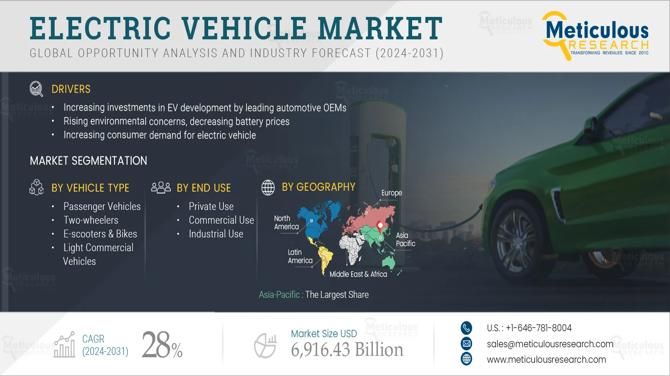
According to Meticulous Research®'s most recent publication, the global Electric Vehicle market is expected to reach $6,916.43 billion by 2031, growing at a 28.0% CAGR between 2024 and 2031. By volume, this market is expected to reach 446.54 million units by 2031, with a 20.5% CAGR from 2024 to 2031.
The global electric vehicle market is growing due to factors such as supportive government policies and regulations, increased investments in EV development by leading automotive OEMs, rising environmental concerns, lower battery prices, and rising consumer demand for electric vehicles. The growing use of self-driving electric vehicles, as well as the rising emphasis on electric mobility in developing countries, are likely to offer opportunities for market participants.
The Driving Forces Behind 2025's EV Surge
The global electric vehicle (EV) market is rising, with over 4 million EVs supplied in Q1 2025, a 35% increase from 2024. This increase is being driven by lower battery costs, strong government incentives, and changing consumer preferences. Battery prices, which were formerly the most major barrier, have dropped substantially, making EVs more accessible to the general public. Government incentives and pollution laws are driving adoption. Growing environmental awareness, particularly among younger consumers, is also driving demand, positioning EVs as both environmentally friendly and technologically advanced solutions.
Solid-State Batteries: The Game-Changing Technology
Solid-state batteries will change EVs by 2025, with 500-mile ranges, 15-minute charging, and increased safety. Solid-state technology outperforms ordinary lithium-ion batteries in terms of energy density, recharge durations, and the absence of flammable electrolytes, addressing critical issues such as range anxiety, charging speed, and fire risk. These developments position EVs as superior to gasoline vehicles in key areas. However, production scalability is still a considerable hurdle. Companies like QuantumScape, Toyota, and Nissan are working hard to overcome production challenges and deliver this breakthrough to the masses.
Regional Dynamics Shaping Global Growth
The global EV industry exhibits significant geographical variety in adoption tactics. China is the leader in both manufacturing and consumption, with a fully integrated EV ecosystem that decreases prices. Europe follows a regulation-driven paradigm, with strict emissions restrictions and widespread adoption of small electric vehicles tailored for urban living. The United States has mixed adoption—some states, such as California, lead while others lag—but federal investment in infrastructure and battery manufacturing is accelerating expansion. Electric two- and three-wheelers are gaining popularity in emerging markets, particularly in South Asia, where they offer affordable transportation options.
Infrastructure: The Foundation of EV Success
In 2025, EV infrastructure investment has increased, breaking the cycle of charging availability and EV sales. Public charging now prioritizes speed and dependability, with ultra-fast stations allowing for long-distance travel. Home charging has gotten smarter and more cheap, with grid-optimized scheduling and even bi-directional electricity for domestic use. Workplace charging is growing popularity as a corporate benefit to encourage adoption. Meanwhile, the user experience has improved with standardized connectors, dependable equipment, and mobile apps that provide real-time availability and pricing updates, making EV charging more convenient than ever.
Looking Forward: The Momentum Continues
The global electric vehicle industry is predicted to grow by 6.95% (2025-2029), reaching US$1,084.0 billion by 2029, implying that 2025 marks the start of a larger revolution. The move to electric vehicles is gaining traction, thanks to technological advancements, strong governmental support, increased infrastructure, and shifting consumer attitudes. While concerns such as rural charging difficulties and supply chain resilience exist, the switch to electric mobility is unquestionably permanent. By 2025, the question is no longer whether EVs will dominate, but how quickly they can expand to meet surging demand, transforming transportation, energy, and environmental thinking in the process.
Key Players:
The key players operating in the global electric vehicle market are Tesla, Inc. (U.S.), BMW AG (Germany), BYD Company Ltd. (China), Volkswagen AG (Germany), Hyundai Motor Company (South Korea), Volvo Group (Sweden), Mercedes-Benz Group AG (Germany), Ford Motor Company (U.S.), Honda Motor Co., Ltd. (Japan), General Motor Company (U.S.), Nissan Motor Co., Ltd. (Japan), Tata Motors Limited (India), Alcraft Motor Company Ltd. (U.K.), Zero Electric Vehicle Inc. (U.S.), and Faraday & Future Inc. (U.S.).
Download Sample Report Here @ https://www.meticulousresearch.com/download-sample-report/cp_id=5179
Contact Us:
Meticulous Research®
Email- sales@meticulousresearch.com
Contact Sales- +1-646-781-8004
Connect with us on LinkedIn- https://www.linkedin.com/company/meticulous-research
Appreciate the creator