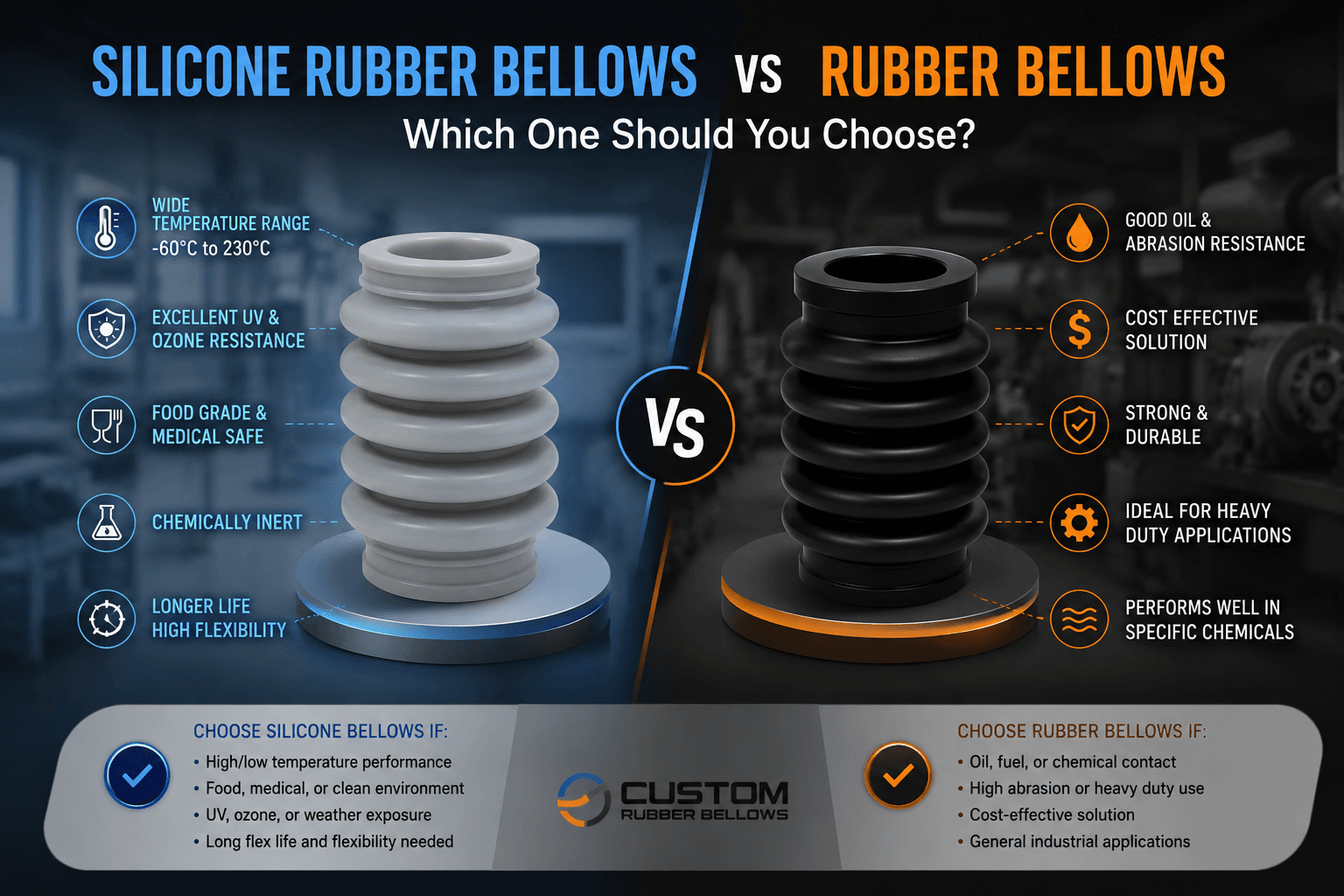
Silicone Rubber Bellows vs Rubber Bellows Which One Should You Choose
Bellows are core functional parts inside all modern industrial machines. They seal connection points, flex with movement and protect sensitive internal components.
Two top available options are silicone rubber bellows (https://www.customrubber-bellows.com/silicone-rubber-bellows-company) and standard rubber bellows. Both look visually similar but perform very differently under operating conditions.
The right selection depends on heat range, chemical exposure, flex cycles, and industry. A silicone rubber bellows manufacturer provides guidance on the right material selection for every project.
What Are Silicone Rubber Bellows?
The silicone rubber bellows manufacturer produces these flexible accordion components from high purity silicone elastomers. Silicone is a versatile elastomer suited for a wide range of industrial use cases. It functions reliably across a very broad temperature range from -60°C to 230°C.
Withstands short duration peak temperatures up to 300°C without deformation
Resists UV rays, ozone and harsh long term weather exposure
Chemically inert and resistant to most common oils and industrial chemicals
Compression set occurs rarely with no permanent deformation
Approved for use in food, medical, automotive and aerospace industry sectors
Compression sets occur far less often than standard rubber and rarely leads to permanent deformation. Units maintain full flexible properties even after thousands of flex cycles.
The durable silicone rubber bellows hold their shape and performance for years of continuous use.
What Are Standard Rubber Bellows?
These are flexible components made from natural or synthetic rubber compounds. Common material types include EPDM, Neoprene, Nitrile and Natural Rubber.
Natural rubber: Excellent tensile strength and tear resistance
EPDM: Performs very well outdoors where exposed to constant water
Neoprene: Balances decent oil resistance with good weather protection
Nitrile: Excels when petroleum products contact the bellows surface
Rubber bellows (https://www.customrubber-bellows.com/custom-rubber-bellow-manufacturer) protect mechanical parts by absorbing vibrations, sealing systems, and compensating for movement. They provide the same core sealing function as silicone but with different performance limits.
How Are They Made Differently?
Rubber bellows are manufactured through compression molding, LSR injection, or extrusion forming. Silicone bellows are typically made using compression molding or liquid silicone injection. High precision molding maintains consistent wall thickness across all units. Many custom molded silicone bellows are produced using the same high precision manufacturing processes.
Vulcanization creates cross linked polymer chains for dimensional stability
Post curing achieves specific hardness levels and eliminates volatile compounds
Silicone requires controlled cleanroom environments for food and medical use
Process choice depends on material, design complexity and production volume
Temperature Performance — Where Each Material Stands
Silicone has a clear advantage in continuous high temperature tolerance across all use cases. Hot engine compartments up to 200°C and arctic conditions at -50°C pose no problems.
Silicone: -60°C to 230°C continuous, 300°C short term peak
Neoprene: Better flexibility at lowest end of rated temperature range
Standard rubber: Not ideal for sustained extreme heat exposure
The silicone bellows for pharmaceutical industry need consistent performance across sterilization cycles. They maintain full properties even after repeated high temperature autoclave cycles.
Flexibility and Compression Set — Which Holds Its Shape?
Silicone offers superior overall flexibility across the full operating temperature range. They lack abrasion resistance but have excellent rebound resilience after flexing.
Silicone: Lasts 2 to 3 times longer under dynamic cycling load
Standard rubber: Holds shape well under pressure but stiffens in cold
Standard rubber: Lasts 4 times longer under sliding contact applications
Silicone: Resists permanent set better over long repeated cycles
Standard rubber holds shape well under pressure but stiffens significantly in cold conditions. For dynamic cycling, silicone usually lasts two to three times longer than standard rubber. For sliding contact applications, neoprene lasts four times longer than silicone.
Silicone resists permanent sets far better over long repeated flex cycles. It returns to its original shape immediately after the load is removed.
A silicone rubber bellows manufacturer tests all material formulations for compression set performance. Test data gets shared with clients during the initial quoting process.
Chemical and Environmental Resistance Compared
Silicone is chemically inert and resistant to most common oils and industrial chemicals. It resists UV rays, ozone and harsh long term weather exposure.
Nitrile: Excellent oil and solvent resistance, poor flame resistance
EPDM: Handles ozone and water better than natural rubber
Viton: Handles fuel exposure and high heat with minimal degradation
Nitrile rubber offers excellent oil and solvent resistance but has poor inherent flame resistance. EPDM handles ozone and water exposure better than natural rubber formulations.
Viton handles fuel exposure and high heat with minimal long term degradation.
Chemical match to the operating environment is critical for long service life. All environmental factors must be reviewed during material selection.
Many custom size silicone rubber bellows use formulations tuned to specific chemical exposure conditions. The engineers test the batch for compatibility with the specified operating environment.
Which Industries Use Silicone Rubber Bellows?
The automotive sector uses silicone for CV joint boots, steering seals and engine protection. Medical applications include ventilator systems, pharmaceutical processing and surgical instrument protection. Food processing uses non toxic FDA compliant silicone for product contact.
OEM custom silicone rubber bellows manufacturer supplies units to all these regulated industry sectors. The third party certification is provided upon request for all regulated use cases.
Which Industries Use Standard Rubber Bellows?
Heavy machinery uses standard rubber in high abrasion operating zones. General automotive uses include steering columns, axle boots and general sealing points. HVAC systems use rubber for consistent vibration dampening inside ductwork.
The marine industry uses neoprene which excels in continuous wet operating environments. The oil and gas sector uses nitrile which holds up against constant petroleum exposure. Production plants use rubber for flexible connections and stress free movement transfer.
Does the Application Environment Determine the Right Pick?
The operating environment is the number one deciding factor for material selection. The working environment determines which material is most suitable for the condition.
High abrasion plus oil contact means standard nitrile or neoprene is best
Outdoor UV exposure means silicone or EPDM are the preferred options
Always select based on the most demanding operating requirement
Compromising on the highest requirement leads directly to early failure
High abrasion plus oil contact means standard nitrile or neoprene is the best option. Outdoor UV exposure means silicone or EPDM are the preferred material choices. Selection should always be based on the most demanding operating requirement for the application.
Compromising on the highest requirement always leads to unexpected early failure. All environmental elements that the bellows will contact must be considered.
Can Both Be Fully Customised?
The custom silicone protective bellows can be customized in design, size, shape, and material to match requirements. Custom solutions accommodate unique shapes, durometer requirements, and dimensional specs. Multi durometer designs combine different properties in a single component.
Insert molding integrates metal reinforcements or attachment features
Both silicone and rubber can be produced from a single prototype to bulk production
Wall thickness, convolution count and end fittings are all fully customizable
Insert molding integrates metal reinforcements or attachment features into the part. Both silicone and rubber can be produced from single prototype to bulk production runs. The wall thickness, convolution count and end fittings are all fully customizable.
FAQ
1. Are silicone bellows better than rubber bellows?
Silicone is better for high temperatures, UV exposure, and flexibility, while standard rubber may perform better against abrasion, oil, or specific chemicals.
2. How long do silicone rubber bellows last?
Their service life depends on temperature, movement, chemicals, and flex cycles. Properly selected silicone can provide long-term performance.
3. Can silicone bellows handle extreme temperatures?
Yes. Silicone bellows can remain flexible across a wide temperature range, making them suitable for both hot and cold environments.
4. Which rubber is best for oil exposure?
Nitrile rubber is commonly preferred for applications involving petroleum-based oils and fuels.
5. Can I order custom silicone rubber bellows?
Yes. Silicone bellows can be customized by size, shape, wall thickness, hardness, convolutions, and end connections.
About Custom Rubber Bellows
Custom Rubber Bellows (https://www.customrubber-bellows.com/) specializes in making rubber bellows for various industries and applications. This custom silicone bellows manufacturer provides all these capabilities and consistent, reliable service.
All projects receive dedicated support from initial inquiry through final delivery. All project details remain fully confidential at every stage of the process. This custom size silicone bellows manufacturer with flanged ends supplies units ready for immediate installation.
Contact Our Team Today
A silicone rubber bellows manufacturer delivers reliable, consistent parts for every application requirement. All production follows strict internal quality control standards with zero tolerance for defects. Every unit gets fully tested before final packaging and shipment.
Call our team at +1 917-730-4350, or send full project specifications to info@customrubber-bellows.com.
Appreciate the creator