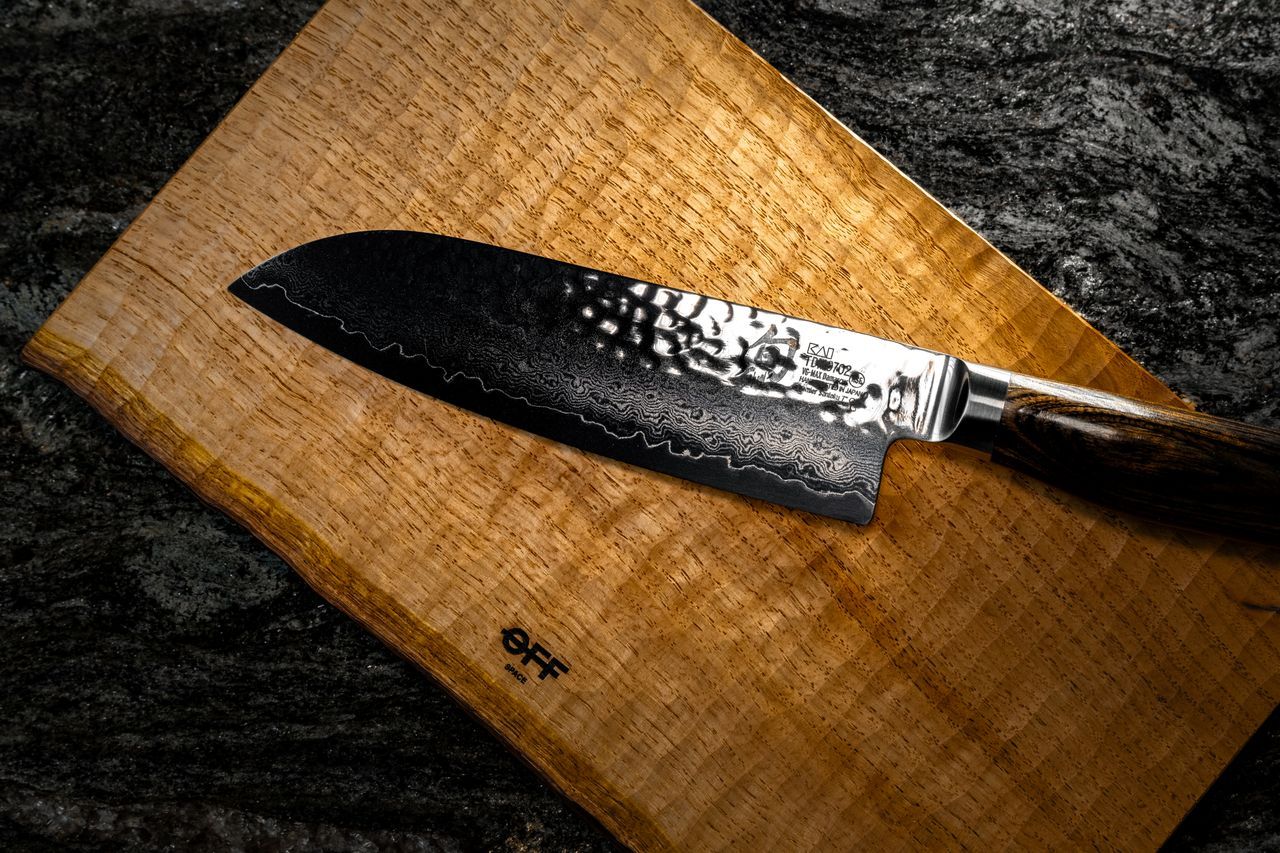
Santoku or Gyuto? A Home Cook's Honest Guide to Choosing Between Japan's Two Most Popular Kitchen Knives
Walk into any conversation about Japanese knives and within a few minutes someone will ask the same question: santoku or gyuto? It sounds like a small decision, but it shapes how comfortable you feel at the cutting board every single day. Both knives do a lot of the same jobs. Both are versatile enough to become your main knife. And both have loyal followings among home cooks who swear theirs is the better choice. The truth is less dramatic than the debate suggests. It comes down to how your hand moves, what you cook most often, and how much blade you actually want to manage.
What a santoku is actually built for
The santoku's name translates to "three virtues," a nod to its balance across slicing, dicing, and chopping. The blade is shorter than a typical chef's knife, usually between 165 and 180 millimeters, with a flatter edge and a blunter tip that curves gently upward rather than sweeping to a sharp point. That flatter profile is the whole story here. It means the santoku wants to move up and down through food rather than rock back and forth the way a Western chef's knife does. For someone who chops vegetables in a straight push cut, or who works in a smaller kitchen where a shorter blade is easier to maneuver, that's a genuinely comfortable way to cut.
The reduced tip also makes the santoku feel less intimidating to people who are newer to Japanese knives. There's less blade to think about, less length to control, and the weight tends to sit closer to the handle. It's often the knife people recommend first, not because it's simpler in a lesser sense, but because it asks less of your technique while still cutting cleanly through onions, herbs, fish, and most everyday vegetables.
Where the gyuto pulls ahead
The gyuto is Japan's answer to the Western chef's knife, and it shows in the silhouette: a longer blade, typically 210 to 240 millimeters, with a pronounced curve near the tip that supports a rocking motion. If you learned to cook using a European-style chef's knife, a gyuto will feel immediately familiar. The extra length matters more than people expect. It lets you break down a whole chicken, portion a larger cut of meat, or slice a stack of vegetables in fewer strokes, which adds up over a long prep session.
The rocking motion the gyuto enables is also worth understanding on its own terms. Instead of lifting the blade fully off the board between cuts, you pivot the tip and let the curve carry the motion forward. Once that rhythm clicks, it's noticeably faster for high-volume prep. Someone who cooks for a family every night, or who does a lot of batch cooking on weekends, tends to reach for the gyuto more often simply because it keeps pace with bigger jobs.
The steel matters as much as the shape
Here's where the santoku-versus-gyuto conversation often skips something important: the shape only gets you halfway to a good knife. The steel behind the edge determines how long that edge lasts and how it responds to sharpening. Higher-carbon Japanese steels, the kind used in traditional forging, tend to take a finer edge and hold it longer than softer stainless alloys, though they also ask for a bit more care to avoid rust and chipping. This is part of a much older tradition of Japanese metalwork. The same forging philosophy that shaped centuries of Japanese swordsmithing, layering and hammering steel to control its hardness and grain, carries directly into how modern kitchen blades are made. It's worth knowing that history exists even if you never plan to hold a sword, because it explains why a well-made Japanese blade feels different in the hand than a mass-produced stamped knife.
So which one should you actually buy first?
If you had to pick just one knife to build a kitchen around, the honest answer depends on your cutting board reality, not on which knife photographs better. Cooks who prep mostly vegetables, fish, and smaller portions tend to settle happily with a santoku. Cooks who work with larger cuts of meat, cook for bigger groups, or already have muscle memory from a Western chef's knife usually find the gyuto the more natural fit. Neither one is a downgrade from the other; they're built around different habits.
Once you know which shape suits you, the more interesting decision is steel and finish, since that's where Japanese knives actually differentiate themselves from everything else in a kitchen drawer. Kazoku's prestige collection is where that range lives, from Ginsan Nashiji's stainless clad blades to the carbon-core Aogami #2 and Kaji Black lines, so it's a reasonable place to compare finishes side by side rather than guessing from a single product photo.
If a gyuto is the direction you're leaning, the Uteki line is one of the more established starting points, with enough weight and blade length to handle bigger prep sessions without feeling unwieldy in the hand.
Whichever shape you land on, the goal is the same: a knife that disappears into the task instead of fighting you through it. That's really the only test that matters, more than any general encyclopedia entry on Japanese kitchen knives can tell you, since only your own hands know what feels right.
Frequently Asked Questions
Can a santoku replace a chef's knife entirely?
For most home cooking, yes. It handles vegetables, herbs, fish, and boneless meat comfortably. It struggles a bit with very large produce, like whole squash, where the shorter blade runs out of length.
Is a gyuto harder to learn to use than a santoku?
Not harder exactly, but different. The rocking motion takes a little adjustment if you've never used a curved blade before, though most people pick it up within a few sessions.
Do I need both a santoku and a gyuto?
Plenty of serious home cooks eventually own both, using the santoku for quick, precise cuts and the gyuto for heavier prep. It's not necessary to start with two, though.
Does blade length affect control more than sharpness?
Both matter, but for beginners, length tends to affect confidence first. A shorter blade like the santoku often feels more controllable before technique catches up.
How do I know if a knife's steel is good quality?
Look for clear information on the steel type and hardness rating from the maker. Vague descriptions like "premium steel" without specifics are usually a sign to ask more questions before buying.
Originally published at https://kazokuknive.weebly.com/
Appreciate the creator