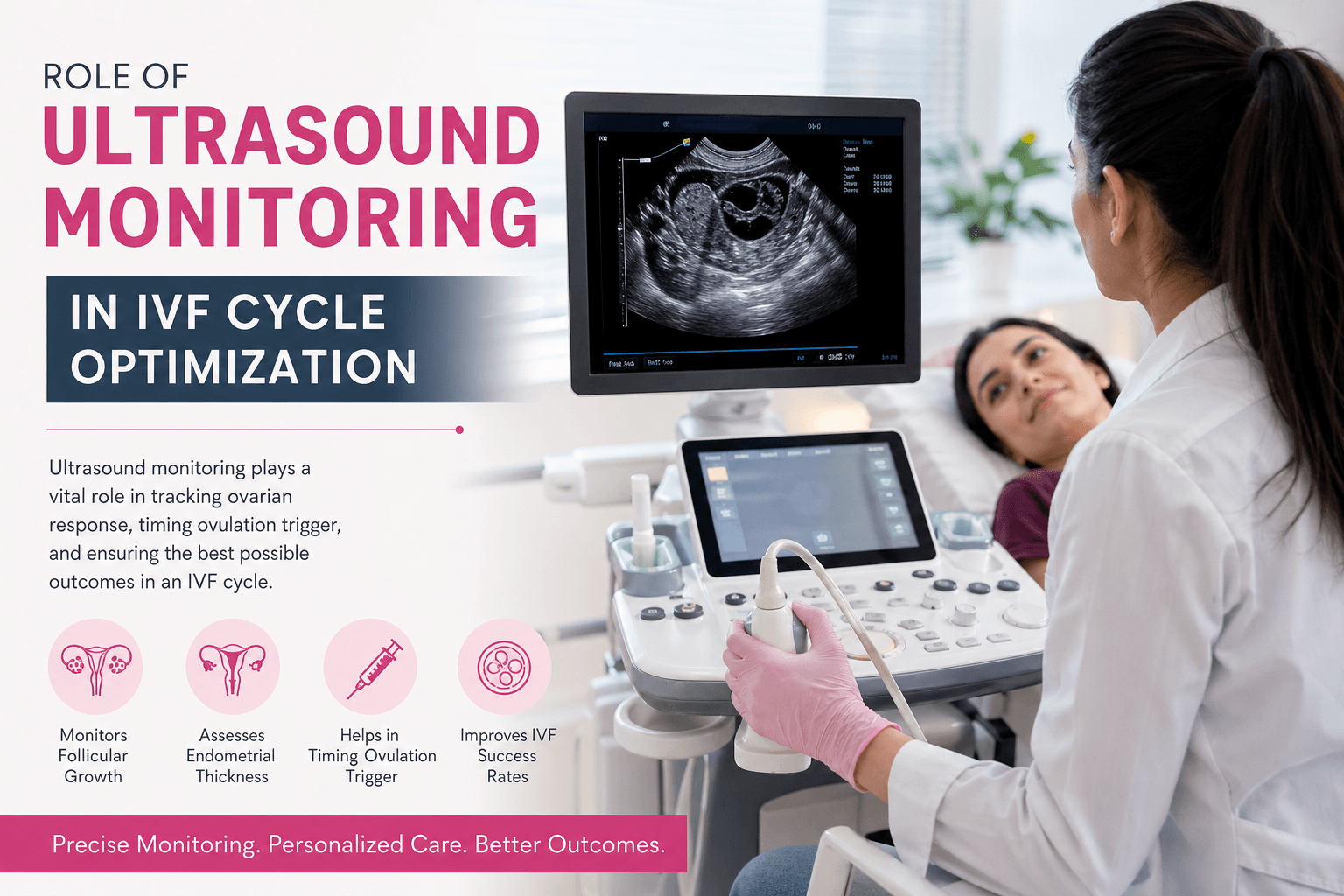
Role of Ultrasound Monitoring in IVF Cycle Optimization By Dr. Poonam Goyal.
Infertility treatment today is guided by precision, personalization, and continuous monitoring. Among all the tools used in assisted reproductive techniques, ultrasound monitoring plays a central role in optimizing every stage of an IVF cycle. It allows real-time assessment of ovarian response, guides treatment modifications, and helps achieve better clinical outcomes.
As an Infertility specialist in Delhi, I strongly believe that success in IVF is not only dependent on medication protocols but also on how effectively the cycle is monitored and managed. Ultrasound provides that essential clinical insight which helps tailor treatment for each individual patient.
Understanding Ultrasound Monitoring in IVF
Ultrasound monitoring, particularly transvaginal sonography, is used throughout the IVF cycle to evaluate ovarian follicles, endometrial lining, and overall reproductive readiness. Unlike static diagnostic tests, ultrasound offers a dynamic and real-time view of how the body is responding to treatment.
It helps clinicians assess
Growth and number of ovarian follicles
Thickness and pattern of the endometrium
Timing for ovulation trigger
Early detection of complications
This individualized monitoring approach is one of the key reasons why leading centers recognized for the Best obstetrics and gynecology in Delhi emphasize ultrasound-guided IVF protocols.
Key Phases of Ultrasound Monitoring in IVF
Baseline Ultrasound Assessment
The IVF cycle begins with a baseline scan, usually performed on day 2 or 3 of the menstrual cycle. This scan is crucial to evaluate the ovaries for cysts or abnormalities, assess antral follicle count which reflects ovarian reserve, and ensure the uterus is in a suitable condition to begin stimulation.
A clear baseline ensures that the cycle starts under optimal clinical conditions.
Monitoring During Ovarian Stimulation
Controlled ovarian stimulation is a critical phase where medications are used to stimulate the ovaries to produce multiple follicles. During this period, serial ultrasounds are performed every few days to track the number of developing follicles, size and growth rate of follicles, and symmetry of ovarian response.
Based on these findings, medication doses may be adjusted. This helps prevent under-response or over-response, which could lead to complications such as ovarian hyperstimulation syndrome.
Endometrial Monitoring
A successful IVF cycle depends not only on good-quality eggs but also on a receptive uterine environment. Ultrasound is used to assess endometrial thickness ideally between 7 to 10 mm and endometrial pattern especially the triple-line appearance.
If the lining is not optimal, clinicians may modify hormonal support to improve receptivity. This level of precision is expected from centers known for the Best obstetrics and gynecology near me, where patient outcomes are prioritized through individualized care.
Timing the Ovulation Trigger
One of the most critical decisions in IVF is determining the correct timing for the trigger injection, which induces final maturation of eggs before retrieval.
Ultrasound helps identify mature follicles typically 18 to 22 mm in size and synchronization of follicular growth.
Accurate timing ensures retrieval of mature, high-quality oocytes, directly impacting fertilization rates and embryo quality.
Pre Embryo Transfer Evaluation
Before embryo transfer, ultrasound is used to confirm that the uterus is ready for implantation. It helps in assessing endometrial readiness, detecting fluid or abnormalities within the uterine cavity, and guiding embryo placement in some cases.
This final assessment ensures that conditions are optimal for embryo implantation.
Clinical Benefits of Ultrasound Monitoring
Ultrasound-guided IVF cycles offer multiple advantages that significantly improve treatment outcomes.
Personalized treatment approach ensures that every patient receives care based on their unique response
Improved egg quality and yield by retrieving eggs at the right stage
Enhanced endometrial receptivity which increases implantation chances
Reduced risk of complications through early detection
Higher success rates due to precise monitoring and timely decisions
This level of care reflects the clinical standards followed by the Best obstetrics and gynecology in Delhi, where patient safety and success are the top priorities.
Why Expertise in Ultrasound Interpretation Matters
While ultrasound machines are widely available, the accuracy of IVF monitoring depends on the expertise of the clinician interpreting the results. Small variations in follicle size, growth patterns, or endometrial characteristics can significantly influence outcomes.
As an Infertility specialist in Delhi, my approach involves continuous and careful monitoring, evidence-based clinical decision-making, individualized treatment protocols, and transparent patient communication.
This ensures that each IVF cycle is managed with precision and care, aligning with the standards of the Best obstetrics and gynecology near me patients often look for.
Patient Perspective What to Expect
Patients undergoing IVF may need multiple ultrasound scans during the cycle. While this may seem frequent, it is essential for tracking treatment progress, ensuring safety, and maximizing success rates.
The procedure itself is quick, minimally uncomfortable, and provides valuable insights that guide every step of treatment.
Conclusion
Ultrasound monitoring is not just a supportive tool it is a core component of IVF cycle optimization. From baseline evaluation to embryo transfer, it enables precise, informed decisions that improve outcomes and ensure patient safety.
Choosing an experienced Infertility specialist in Delhi who integrates advanced ultrasound monitoring into treatment protocols can make a significant difference in your fertility journey. When searching for the Best obstetrics and gynecology in Delhi or the Best obstetrics and gynecology near me, it is important to consider clinics that emphasize personalized and ultrasound-guided care.
FAQs
1 How many ultrasound scans are required during an IVF cycle
Typically 4 to 6 scans are required depending on how the ovaries respond to stimulation
2 Is ultrasound monitoring painful
Transvaginal ultrasound is generally painless though mild discomfort may be experienced
3 Can IVF be done without ultrasound monitoring
No ultrasound is essential for tracking follicular growth and timing key steps in the IVF cycle
4 Why is endometrial thickness important
A properly developed endometrial lining is crucial for embryo implantation and pregnancy success
Appreciate the creator