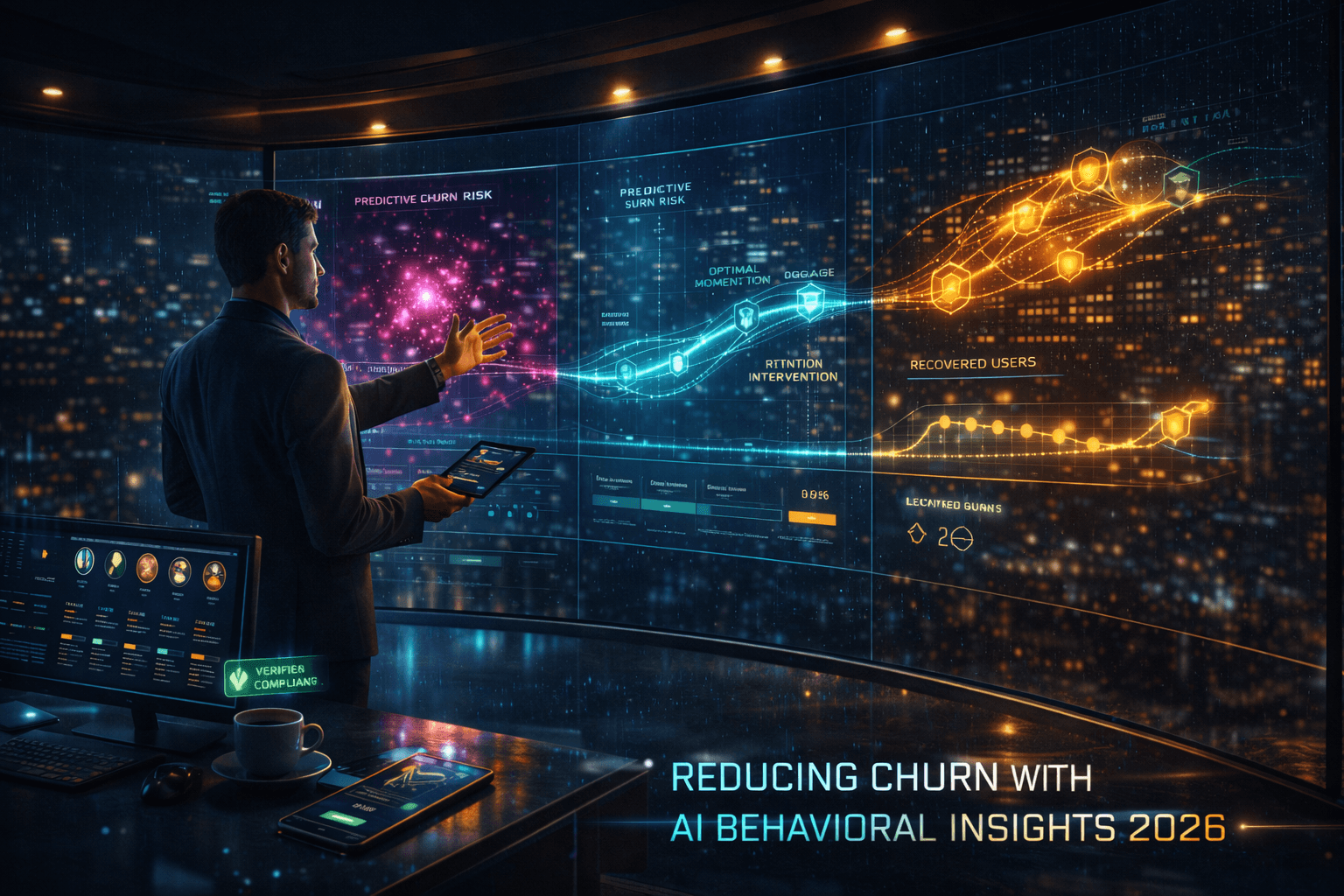
Reducing Churn with AI Behavioral Insights in 2026
Retention has shifted from a reactive struggle to a predictive science. By 2026, waiting for a "cancel" click is widely recognized as a failure of data utilization. Modern product teams now rely on behavioral markers—subtle shifts in how users interact with a platform—to intervene weeks before a user consciously decides to leave.
This guide is designed for product managers and growth leads who have moved past basic usage metrics. We will explore how to synthesize disparate data points into a cohesive retention engine that values user intent over simple activity.
The 2026 Retention Landscape: Why Static Metrics Fail
In 2026, the "Active User" metric has lost its standing as a reliable health indicator. High-frequency usage can often mask "frustration loops"—where a user is active only because they are struggling to complete a task. Conversely, low usage may simply indicate a high-efficiency user who gets what they need quickly.
The industry has moved toward Sentiment-Adjusted Behavioral Modeling. This approach recognizes that churn is rarely a sudden event; it is the conclusion of a "silent withdrawal" phase. During this phase, users often exhibit "feature regression," where they stop using advanced capabilities and revert to the most basic functions before disappearing entirely.
Common Misunderstandings in 2026
The "NPS Fallacy": Relying on annual surveys. By the time a user provides a low NPS score, their psychological exit has usually already occurred.
Over-reliance on Discounts: Offering a 20% discount to a user who finds the product fundamentally confusing does not solve the root cause.
Metric Myopia: Tracking logins instead of "Time to Value" (TTV).
Core Framework: The Behavioral Signal Hierarchy
To effectively reduce churn, teams must categorize behavioral data into three distinct layers of predictive power.
1. Friction Signals
These are immediate technical or UI hurdles. In 2026, AI agents monitor "rage clicks" and "circular navigation" in real-time. If a user visits the documentation page three times in five minutes without completing the target action, the system flags an immediate friction risk.
2. Utility Decay
This is the most critical MOFU (Middle of Funnel) metric. It tracks the narrowing of a user’s "feature footprint." When a power user stops using the API or stops exporting reports, it indicates they may be trialing a competitor or have lost the internal use case for your tool.
3. Social and Administrative Markers
For B2B platforms, churn is often preceded by administrative changes. The removal of a high-authority seat or a sudden drop in shared workspace collaboration are high-probability churn indicators that data science teams prioritize in 2026.
Real-World Application: From Insight to Intervention
Consider a hypothetical mid-market SaaS company. Their AI model identifies that when a user’s "session depth" drops by 40% over two weeks, there is an 85% probability of churn within 30 days.
Instead of a generic "We miss you" email, the system triggers a Value-Based Intervention:
Detection: The AI notes the decay in advanced feature usage.
Diagnosis: The system identifies that the user hasn't successfully integrated their CRM—a key "stickiness" factor.
Action: The user receives a personalized video walkthrough or an invite to a "Quick-Win" workshop specifically addressing CRM integration.
For organizations looking to build these capabilities into their native mobile experiences, partnering with experts in Mobile App Development in Georgia can ensure that behavioral tracking is integrated at the architectural level rather than as a performance-draining afterthought.
AI Tools and Resources
Amplitude 2.0 (Predictive Suite) — An industry standard for behavioral cohorting and churn prediction.
Best for: Identifying the "Aha! Moment" vs. the "Churn Trigger" across large user bases.
Why it matters: Automates the correlation between specific feature usage and long-term LTV.
Who should skip it: Early-stage startups with insufficient data volume for statistically significant modeling.
2026 status: Fully integrated with generative UI to suggest real-time app changes based on user frustration.
Gainsight CE (Customer Experience) — A platform focusing on the human side of retention for B2B.
Best for: Account managers needing a "Health Score" based on behavioral and sentiment data.
Why it matters: Blends "hard" usage data with "soft" relationship data (emails, meetings).
Who should skip it: Purely B2C apps with millions of low-ACV (Annual Contract Value) users.
2026 status: Now features "Autonomous Success Plans" that draft outreach based on predicted account risks.
Mixpanel Spark — Real-time event tracking and anomaly detection.
Best for: Developers and PMs who need to see where users drop off in a specific conversion funnel.
Why it matters: Offers the lowest latency for behavioral triggers.
Who should skip it: Teams without the engineering resources to implement custom event tagging.
2026 status: Enhanced with "Natural Language Querying" for non-technical stakeholders.
Risks, Trade-offs, and Limitations
While AI insights are powerful, they are not infallible. Over-automation can lead to "Engagement Fatigue," where a user feels harassed by a system that over-analyzes every click.
When Predictive Modeling Fails: The "False Positive" Trap
Scenario: An AI model flags a user for churn because their activity dropped to zero for 10 days. The system sends an aggressive "Save" offer.
Warning signs: High unsubscribe rates from "Retention" emails; users complaining about intrusive automation.
Why it happens: The model failed to account for external factors like a scheduled company holiday or a user’s personal leave. It mistook a temporary break for a permanent exit.
Alternative approach: Implement "Cooldown Periods" and cross-reference behavioral data with calendar/seasonal trends before triggering high-friction interventions.
Key Takeaways
Behavioral Context is King: In 2026, it is not about if they used the app, but how and why their usage patterns shifted.
Prioritize Feature Depth: Track the transition from power user to basic user; this is the most reliable "early warning" of churn.
Human-in-the-Loop: Use AI to flag the risk, but ensure the intervention feels personal and value-driven, not algorithmic.
Data Integrity: Ensure your tracking is clean at the source. Sophisticated AI cannot fix garbage data from a poorly implemented SDK.
Appreciate the creator