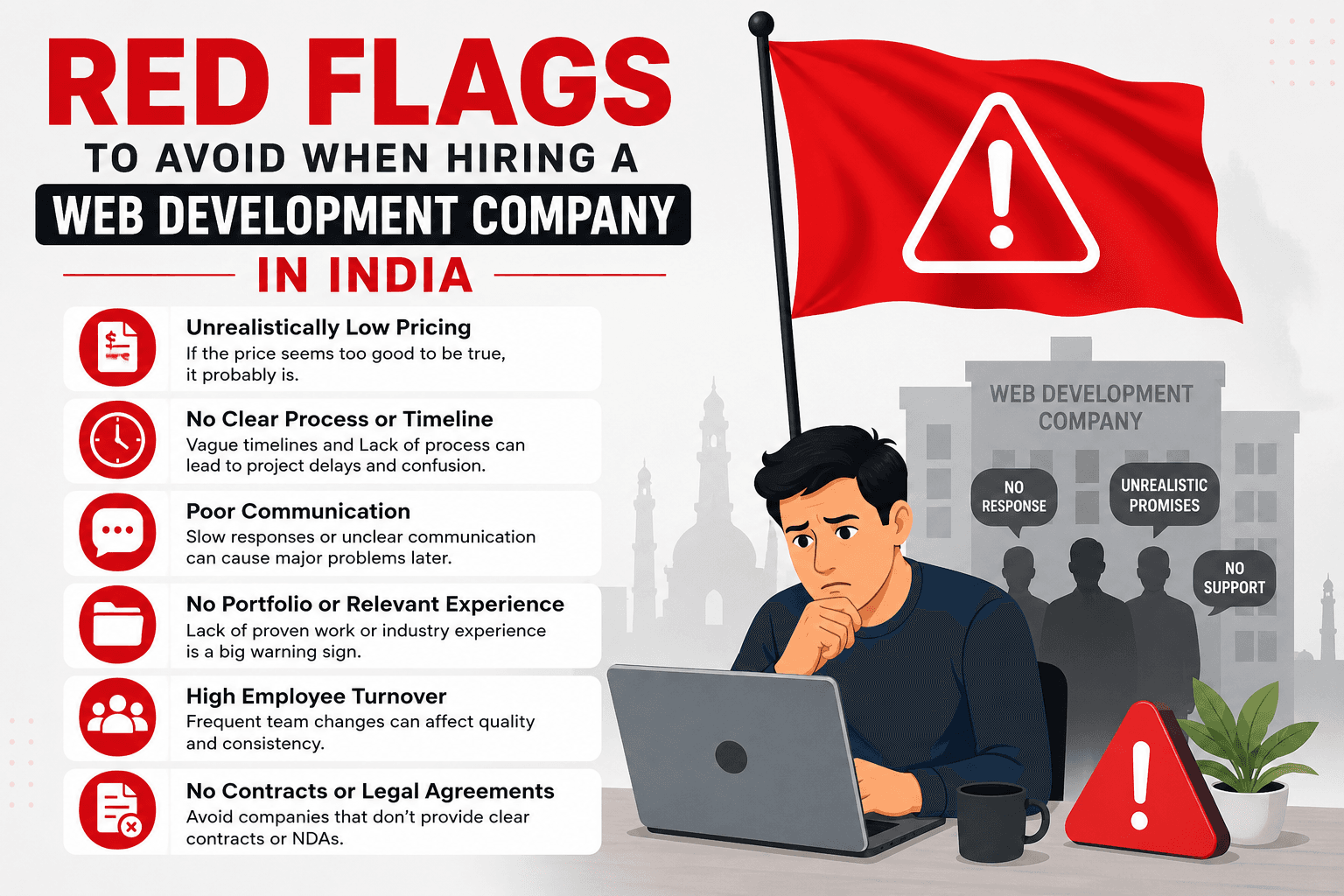
Red Flags to Avoid When Hiring a Web Development Company in India
In today's digital-first world, your website is often the first interaction customers have with your business. Whether you're launching a startup, running an eCommerce store, or expanding an established company, choosing the right web development partner can significantly impact your success.
India has become one of the leading destinations for web development services because of its vast talent pool, competitive pricing, and technical expertise. However, not every agency delivers the same quality of work. While there are many reliable companies, there are also agencies that overpromise, underdeliver, or disappear after receiving payments.
To help you make an informed decision, here are the major red flags you should watch out for when hiring a web development company in India.
1. Lack of a Professional Portfolio
A reputable web development company should proudly showcase its previous work. If an agency cannot provide examples of websites they have built, it is a major warning sign.
Before hiring, check:
Their portfolio and case studies
Industries they have worked with
Website designs and functionality
Mobile responsiveness of previous projects
Performance and loading speed of their websites
If their own website looks outdated or poorly designed, it's reasonable to question the quality they will deliver for your business.
Questions to Ask
Can you show websites you've developed recently?
Have you worked with businesses in my industry?
What technologies did you use for these projects?
2. Unrealistically Low Pricing
Everyone wants to save money, but choosing the cheapest option often becomes expensive in the long run.
Some agencies attract clients by offering extremely low prices. Once the project starts, they may:
Compromise on quality
Use pre-built templates instead of custom development
Outsource work to inexperienced freelancers
Charge hidden fees later
Deliver incomplete projects
If a quote is significantly lower than other agencies, understand exactly what is included.
Remember:
A website is an investment, not an expense. Choosing quality over the cheapest price usually leads to better long-term results.
3. No Clear Development Process
Professional web development companies follow a structured process.
A typical process includes:
Requirement gathering
Planning and wireframing
UI/UX design
Development
Testing
Deployment
Maintenance and support
If an agency cannot explain how they manage projects or simply says, "We'll handle everything," proceed with caution.
Why It Matters
Without a defined process:
Timelines become uncertain
Communication suffers
Features may be missed
Project costs can increase unexpectedly
Ask for a project roadmap before signing any agreement.
4. Poor Communication
Communication is one of the most overlooked aspects of outsourcing web development.
Some common warning signs include:
Slow responses to emails or messages
Vague answers to technical questions
No dedicated project manager
Difficulty scheduling meetings
Lack of transparency regarding progress
If communication is poor before you become a client, it is unlikely to improve afterward.
A Good Agency Will:
Respond promptly
Explain technical concepts clearly
Provide regular project updates
Assign a dedicated point of contact
Maintain transparent communication throughout the project
5. No Client Reviews or Testimonials
Reviews and testimonials provide valuable insights into a company's reliability.
If a web development company has:
No reviews on search engines
No client testimonials
No case studies
No references
you should investigate further.
Look for reviews that discuss:
Project quality
Communication
Timely delivery
After-sales support
Problem-solving capabilities
Don't rely solely on testimonials displayed on the company's website. Check independent review platforms and business directories for unbiased feedback.
6. Ownership of Code and Website Is Unclear
One of the biggest mistakes businesses make is failing to clarify ownership rights.
Some agencies retain ownership of:
Source code
Website design files
Domain names
Hosting accounts
CMS access
This creates problems if you decide to switch vendors in the future.
Before Signing Any Contract, Confirm:
Who owns the website after completion?
Will you receive the source code?
Will you have admin access?
Can you move the website to another hosting provider?
The answer to all these questions should ideally be yes.
7. No Maintenance or Support Services
Launching a website is only the beginning.
Websites require:
Security updates
Plugin upgrades
Performance optimization
Bug fixes
Content updates
Server maintenance
If a company disappears after launch or doesn't offer maintenance plans, you may struggle to resolve issues later.
Ask About:
Post-launch support
Response times for issues
Maintenance packages
Security monitoring
Backup and recovery services
Reliable agencies view the relationship as a long-term partnership rather than a one-time project.
8. Overpromising Unrealistic Results
Be cautious of agencies making claims like:
"We'll rank your website #1 on Google in 30 days."
"We can build your website in three days."
"Your website will instantly generate leads."
"You don't need SEO or marketing."
Web development and digital growth take time.
A trustworthy company will:
Set realistic expectations
Explain possible challenges
Provide achievable timelines
Focus on sustainable results
If promises sound too good to be true, they probably are.
9. No Written Contract
Never begin a project without a detailed agreement.
A professional contract should include:
Project scope
Deliverables
Timelines
Payment terms
Ownership rights
Revision policy
Maintenance terms
Confidentiality clauses
If an agency avoids documentation or prefers verbal agreements, consider it a serious red flag.
A written contract protects both parties and minimizes misunderstandings.
10. Outdated Technology Stack
Technology evolves rapidly, and your website should be built using modern standards.
Warning signs include agencies that:
Use outdated frameworks
Ignore mobile responsiveness
Do not optimize for speed
Lack knowledge of SEO basics
Fail to implement security best practices
Ask about the technologies they use and why they recommend them.
A competent web development company should be comfortable working with modern technologies such as:
Responsive design frameworks
Modern JavaScript frameworks
Secure CMS platforms
Cloud hosting solutions
SEO-friendly architectures
Performance optimization tools
Future-proofing your website saves money and prevents expensive redesigns later.
11. No Focus on Business Goals
Many agencies focus only on design and coding while ignoring your business objectives.
Your website should help you:
Generate leads
Increase sales
Build brand credibility
Improve customer engagement
Enhance user experience
If a company never asks questions like:
Who is your target audience?
What are your business goals?
What problems should the website solve?
How will success be measured?
they may be more interested in completing a project than delivering business value.
The best web development companies act as strategic partners rather than just service providers.
Final Thoughts
Hiring a web development company in India can be a smart and cost-effective decision—provided you choose the right partner.
Don't rush the process based solely on pricing or attractive sales pitches. Instead, evaluate agencies based on their experience, communication, transparency, technical expertise, and commitment to long-term support.
Watch out for these red flags:
Missing or weak portfolio
Extremely low pricing
Poor communication
No reviews or testimonials
Unclear ownership rights
Lack of maintenance support
Unrealistic promises
Absence of contracts
Outdated technologies
No focus on business goals
Taking the time to research and ask the right questions can save you from costly mistakes and ensure your website becomes a valuable asset for your business.
A reliable web development company will not only build a website but also help you create a strong digital foundation for future growth.
Appreciate the creator