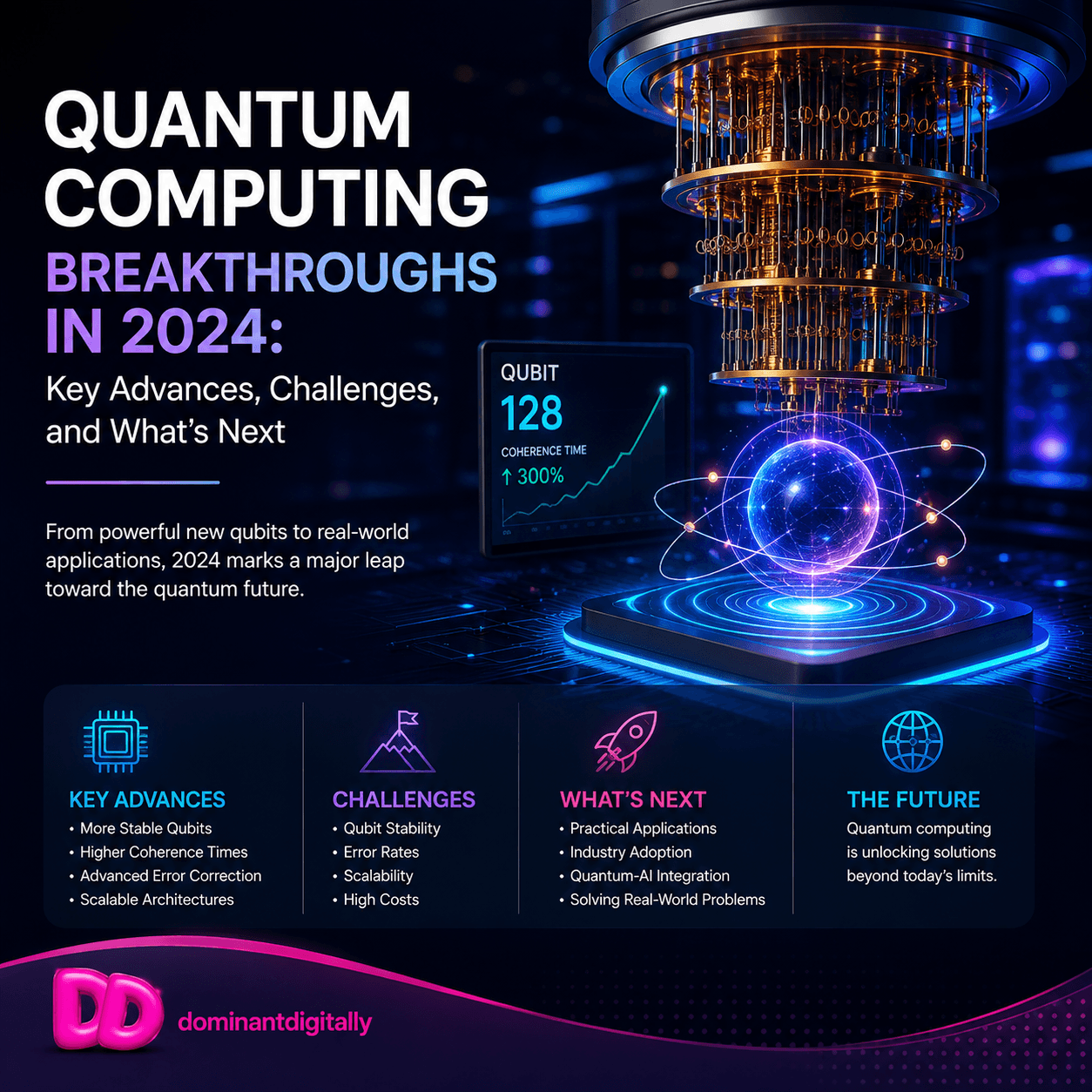
Quantum Computing Breakthroughs in 2024: Key Advances, Challenges and What’s Next
Quantum computing made major progress in 2024, particularly in quantum error correction, processor performance, and the development of more reliable qubits. Although practical, large-scale quantum computers are still under development, researchers achieved several milestones that could help turn theoretical possibilities into useful technology.
Major Quantum Computing Breakthroughs in 2024
1. Google’s Willow Quantum Chip
One of the biggest quantum computing (https://dominantdigitally.com/blog/latest-breakthroughs-in-quantum-computing-2024/) developments of 2024 was Google’s Willow processor. Announced in December, Willow contains 105 superconducting qubits and demonstrated an important improvement in quantum error correction.
Quantum systems are extremely sensitive to noise and environmental disturbances. As a result, errors can increase as more qubits are added. Google reported that with Willow, increasing the size of its error-correcting code actually reduced the logical error rate. This achievement is known as operating below the error-correction threshold, an important requirement for eventually building fault-tolerant quantum computers.
Google also reported that Willow completed a specific benchmark in less than five minutes, while estimating that a leading classical supercomputer would require an extremely long time to perform the same benchmark. However, this was a specialized benchmark rather than a practical everyday application, so it should not be interpreted as meaning quantum computers have replaced conventional computers.
2. Advances in Quantum Error Correction
Error correction remained one of the most important areas of research in 2024. Researchers increasingly focused not simply on adding more physical qubits, but on creating logical qubits that can protect quantum information from errors.
Google's Nature publication reported that its larger logical memory reduced errors as the error-correcting code increased in size. This was an important demonstration that scaling quantum error correction can potentially improve reliability rather than make the problem worse.
3. AI-Assisted Error Detection
Artificial intelligence also became part of quantum computing research. In November 2024, Google introduced AlphaQubit, an AI-based decoder designed to identify errors occurring during quantum computations.
The system uses neural-network techniques to recognize error patterns and improve the accuracy of quantum error correction. Combining AI with quantum computing could become increasingly important as future quantum systems generate enormous amounts of error-related information.
4. IBM’s Heron Processor
IBM also made significant progress in 2024 with its Heron quantum processor. IBM reported a 156-qubit version of Heron and continued improving gate error rates and processing speed. The company also worked on technologies designed to connect multiple quantum chips, an important step toward scaling quantum systems beyond a single processor.
IBM additionally released Qiskit 1.0, providing a more mature software foundation for researchers and developers working with quantum computers.
5. Microsoft and Quantinuum’s Error-Correction Work
Microsoft and Quantinuum reported another important 2024 milestone involving quantum error correction. Their approach used error-correction techniques to transform information from physical qubits into more reliable logical qubits. The companies reported significant improvements in reliability, demonstrating another possible path toward fault-tolerant quantum computing.
The Reality: Quantum Computing Is Not Yet Mainstream
Despite impressive breakthroughs, quantum computing still faces major challenges. Qubits are fragile and can lose their quantum information because of noise and environmental interactions. Building large numbers of high-quality qubits, maintaining them at extremely low temperatures, correcting errors in real time, and connecting processors efficiently are all difficult engineering problems.
Another important point is that quantum computers are not faster than classical computers for every task. Their potential advantage applies to particular categories of problems, such as quantum simulation, certain optimization problems, and some cryptographic applications.
Therefore, 2024 should be viewed as a year of important scientific and engineering progress rather than the arrival of fully practical quantum computers.
What Comes Next?
The next major goal is to develop fault-tolerant quantum computers containing enough reliable logical qubits to perform useful real-world calculations. Researchers will need to improve hardware quality, error correction, software, networking, and scalability simultaneously.
The progress made in 2024 especially in error correction suggests that the field is moving closer to this goal. However, the exact timeline for commercially useful large-scale quantum computing remains uncertain.
Conclusion
The latest breakthroughs in quantum computing during 2024 demonstrated that the technology is progressing beyond simple increases in qubit counts. Google’s Willow processor, IBM’s Heron improvements, AI-assisted error correction, and Microsoft-Quantinuum research all highlighted the same fundamental challenge: making quantum computers reliable enough to perform useful calculations.
Quantum computing is therefore neither a finished technology nor merely science fiction. It is an evolving field where important technical barriers are gradually being addressed. The biggest question is no longer whether quantum computers can demonstrate impressive laboratory results, but how efficiently researchers can scale those results into reliable, practical systems.
FAQs
What was the biggest quantum computing breakthrough in 2024?
Google’s Willow processor and its demonstration of below-threshold quantum error correction were among the most significant breakthroughs of 2024.
What is quantum error correction?
Quantum error correction is a collection of techniques used to protect fragile quantum information from errors caused by noise and other disturbances.
What is a logical qubit?
A logical qubit is a protected unit of quantum information created using multiple physical qubits and error-correction techniques.
Is quantum computing better than classical computing?
Not for every task. Quantum computers are designed to provide advantages for certain specialized problems, while classical computers remain more practical for most everyday computing.
Are quantum computers commercially useful yet?
Large-scale, fault-tolerant quantum computers are still being developed. Current systems are primarily used for research, experimentation, and specialized demonstrations.
Why is quantum computing difficult to build?
Qubits are highly sensitive to their environment. Maintaining their quantum states, reducing errors, performing error correction, and scaling the technology are major challenges.
Will quantum computers replace normal computers?
There is no indication that quantum computers will simply replace classical computers. The more likely future is a combination of classical and quantum computing, with each technology handling tasks suited to its strengths.
Appreciate the creator