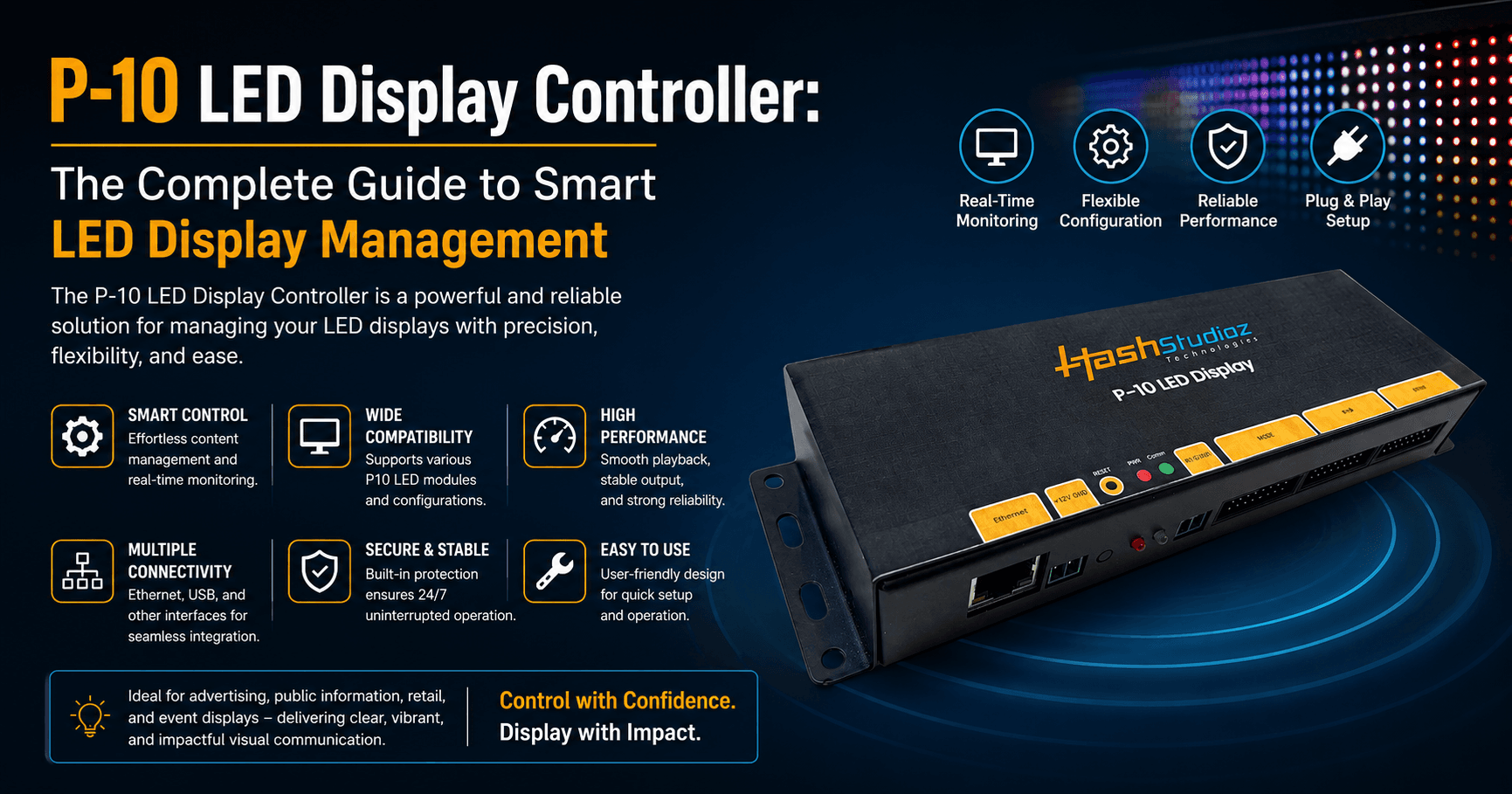
P-10 LED Display Controller: The Complete Guide to Smart LED Display Management
The world is rapidly shifting toward digital communication systems, and LED displays have become one of the most effective tools for real-time information sharing and visual advertising. From highways and shopping malls to factories and railway stations, LED display systems are now used almost everywhere because they provide bright, dynamic, and engaging visual communication.
At the center of every LED display system lies the P-10 LED Display Controller, which acts as the main control unit responsible for managing all display operations. Whether it is scrolling text, video playback, animations, or real-time alerts, the controller ensures that the content is displayed accurately and smoothly.
Without a reliable controller, LED panels cannot process or display content properly. This is why choosing the right controller is essential for achieving high display quality, stable operation, and long-term performance.
This complete guide explains every aspect of P-10 LED display controllers in detail, including their working process, components, features, benefits, applications, and future technological advancements.
What is a P-10 LED Display Controller?
A P-10 LED Display Controller is an electronic hardware device designed specifically to control and manage P10 LED display modules. It receives digital content from various sources such as computers, media players, cloud software, mobile applications, or industrial systems and converts that content into signals that the LED display panels can understand.
The controller works as the communication bridge between the user and the LED display hardware. It processes data, manages synchronization, and controls how information appears on the screen.
The term “P10” refers to the pixel pitch of the LED display module.
10 mm distance between adjacent pixels10\text{ mm distance between adjacent pixels}10 mm distance between adjacent pixels
This means the distance between one pixel and the next pixel is 10 millimeters. Because of this wider pixel spacing, P10 LED displays are highly suitable for outdoor viewing where audiences watch the screen from longer distances.
P10 LED controllers manage multiple functions, including:
Text display
Video playback
Image rendering
Animation effects
Brightness adjustment
Color management
Display synchronization
Remote communication
Real-time updates
In simple terms, the controller acts as the “brain” of the entire LED display system.
Understanding P10 LED Display Panels
To understand the controller properly, it is important to first understand P10 LED display panels.
P10 LED modules are one of the most commonly used LED display types in outdoor applications. These modules are built using LED pixels arranged in a matrix format that can display text, graphics, videos, and animations.
The reason P10 displays are widely used is because they offer an excellent balance between:
Cost
Brightness
Durability
Viewing distance
Energy efficiency
P10 LED panels are popular for outdoor environments because they provide high brightness levels that remain visible even in direct sunlight.
Types of P10 LED Displays
1. Single-Color Displays
These displays use only one color, usually:
Red
Green
Blue
White
Single-color displays are mainly used for:
Notice boards
Factory displays
Simple text communication
Token display systems
They are affordable and consume less power.
2. Dual-Color Displays
Dual-color displays combine two colors, commonly:
Red + Green
Red + Yellow
These displays improve visibility and allow more flexible communication compared to single-color displays.
They are commonly used in:
Public information systems
Traffic displays
Religious display boards
3. Full-Color RGB Displays
RGB displays use Red, Green, and Blue LEDs to generate millions of color combinations.
These displays support:
Videos
High-quality graphics
Animations
Advertising content
Full-color displays are commonly used for:
Outdoor billboards
Stadium screens
Shopping mall displays
Event stages
The controller ensures all these display modules operate together without flickering, delays, or synchronization problems.
How Does a P-10 LED Display Controller Work?
A P10 LED display controller performs several operations to ensure smooth display performance. It acts as an intelligent processing system that converts digital content into display signals.
Step 1: Content Creation
The first stage involves creating the display content.
The content can include:
Advertisements
Text messages
Live announcements
Videos
Images
Promotional graphics
Emergency notifications
Industrial production data
Content is generally created using:
LED display software
Mobile applications
Cloud management platforms
Industrial SCADA systems
Modern software platforms allow users to easily design visually attractive content with animations, effects, and scheduling options.
Step 2: Data Transmission
Once the content is prepared, it is transmitted to the controller.
Modern controllers support various communication technologies such as:
USB
Ethernet
Wi-Fi
RS232
RS485
4G LTE
Cloud servers
This allows users to update displays locally or remotely.
For example:
A shopping mall can update advertisements remotely
A traffic department can send emergency alerts instantly
A factory can display live production data automatically
Wireless communication greatly improves operational flexibility.
Step 3: Data Processing
After receiving the content, the controller processes the data before sending it to the LED modules.
This process includes:
Signal conversion
Pixel mapping
Refresh rate management
Color correction
Display synchronization
Timing control
The controller ensures that the display content appears:
Smooth
Bright
Flicker-free
Properly aligned
Advanced controllers use high-speed processors to handle complex graphics and video playback efficiently.
Step 4: Signal Distribution
Once processing is completed, the controller distributes display signals to the connected LED modules.
The controller ensures:
Proper communication between panels
Uniform brightness levels
Accurate color consistency
Synchronized animations
Without proper signal distribution, the display may suffer from:
Screen tearing
Flickering
Color mismatch
Delayed animations
Step 5: Real-Time Display Output
Finally, the LED panels display the processed content in real time.
Modern controllers can continuously update content without interrupting display operations. This is highly useful for applications requiring live information updates.
Examples include:
Stock market displays
Live sports scoreboards
Airport schedules
Traffic management systems
Major Components of a P-10 LED Display Controller
A P10 LED controller consists of several important hardware and software components.
Processor Unit
The processor is the most important part of the controller.
It handles:
Data calculations
Image rendering
Signal processing
Refresh management
Animation synchronization
A high-performance processor provides:
Faster response time
Better graphics quality
Smooth video playback
Stable operation
Industrial controllers often use powerful processors for heavy-duty applications.
Memory Storage
Controllers include memory systems to store content files.
The memory stores:
Videos
Images
Text data
Animation files
Scheduled playlists
Some controllers also support:
USB drives
SD cards
Cloud storage
Larger memory capacity allows longer video playback and more content storage.
Communication Interfaces
Communication ports connect the controller to external systems.
Common interfaces include:
Ethernet ports
USB ports
Wi-Fi modules
Serial ports
HDMI input
4G SIM support
These interfaces make the controller flexible and easy to integrate with modern communication systems.
Power Management Circuit
LED display systems require stable power management.
The power management circuit protects the controller from:
Voltage fluctuations
Overheating
Electrical surges
Power instability
This improves the lifespan of both the controller and the LED panels.
Display Output Ports
These ports transmit display signals to the LED modules.
The output ports ensure:
Fast signal transmission
Stable communication
Proper synchronization
Good-quality output ports reduce signal loss and improve display performance.
Key Features of P-10 LED Display Controllers
Modern controllers include advanced features that improve both functionality and user experience.
1. Real-Time Content Management
Real-time management allows users to instantly update display content.
This is extremely useful for:
Breaking news
Emergency alerts
Flash promotions
Live announcements
Dynamic advertisements
Businesses can quickly respond to changing situations without manually replacing physical signage.
2. Remote Access and Cloud Connectivity
Cloud-based controllers allow remote display management through internet connectivity.
Users can:
Update displays remotely
Monitor display health
Schedule content
Control multiple displays centrally
This reduces operational costs and improves management efficiency.
3. High Refresh Rate Support
A high refresh rate improves display quality significantly.
Benefits include:
Flicker-free visuals
Smooth animations
Better video quality
Improved camera recording
High refresh rates are especially important for live broadcasting and professional advertising displays.
4. Brightness Control
LED displays need different brightness levels during daytime and nighttime.
Modern controllers support:
Automatic brightness adjustment
Manual brightness control
Ambient light sensing
Energy-saving modes
This improves visibility while reducing unnecessary power consumption.
5. Multi-Display Synchronization
Controllers can manage multiple LED panels simultaneously.
This is useful for:
Video walls
Stadium displays
Large advertising boards
Concert screens
Synchronization ensures all screens display the same content perfectly.
6. Scheduling and Automation
Scheduling features allow automated display management.
Users can schedule:
Advertisements
Announcements
Event promotions
Time-based messages
Automation improves operational efficiency and reduces manual work.
Applications of P-10 LED Display Controllers
P10 LED display systems are used across many industries because of their versatility and visibility.
1. Outdoor Advertising
Outdoor advertising is one of the largest applications of P10 LED displays.
Businesses use them for:
Highway billboards
Shopping mall promotions
Retail advertising
Brand campaigns
Real estate marketing
LED displays attract more audience attention compared to traditional banners.
2. Traffic Management Systems
Traffic departments use LED displays for:
Traffic alerts
Speed warnings
Variable message signs
Parking information
Emergency announcements
Controllers provide real-time updates and reliable operation.
3. Industrial Automation
Factories use LED displays for:
Production monitoring
Machine status updates
Worker safety alerts
Shift schedules
Performance dashboards
Industrial-grade controllers are built to handle harsh environments.
4. Educational Institutions
Schools and colleges use LED displays for:
Digital notice boards
Exam updates
Event announcements
Campus communication
Emergency notifications
Remote management improves communication efficiency.
5. Sports and Event Management
LED displays are commonly used in:
Stadium scoreboards
Concert stages
Conferences
Live events
Exhibition halls
Controllers help manage dynamic and synchronized visual content.
6. Religious and Public Places
Public communication systems use LED displays in:
Temples
Mosques
Railway stations
Airports
Bus terminals
These displays provide important announcements and real-time information.
Advantages of Using a P-10 LED Display Controller
Using a high-quality controller provides many operational benefits.
1. Easy Content Updates
Users can instantly change content without replacing physical materials.
2. Better Audience Engagement
Dynamic content captures attention more effectively than static signage.
3. Energy Efficiency
Modern controllers optimize power consumption while maintaining brightness.
4. Scalability
Controllers support easy expansion by adding more LED panels.
5. Long-Term Cost Savings
Digital displays reduce printing and maintenance expenses over time.
6. Improved Reliability
Industrial controllers provide stable operation even in harsh weather conditions.
Future Trends in P-10 LED Display Controllers
LED display technology is continuously evolving.
Future controllers are expected to include:
AI-based content optimization
IoT integration
Cloud analytics
Smart automation
Wireless synchronization
Remote diagnostics
Audience behavior analysis
As smart city infrastructure expands, intelligent LED display systems will become increasingly important.
Conclusion
A P-10 LED Display Controller is the core component that powers modern LED display systems. It controls every aspect of display operation, including content processing, synchronization, communication, and real-time management.
From outdoor advertising and industrial automation to transportation and public communication, these controllers play a major role in delivering reliable and high-quality visual information.
Modern controllers provide advanced capabilities such as:
Remote access
Cloud connectivity
High refresh rates
Multi-display synchronization
Real-time updates
Smart scheduling
Choosing the right controller improves display quality, operational efficiency, scalability, and long-term reliability.
As digital communication technologies continue to advance, P10 LED display controllers will remain a critical part of smart display infrastructure and future connected systems.
Appreciate the creator