Overcoming Data Silos in Enterprise Government Contracting Strategies
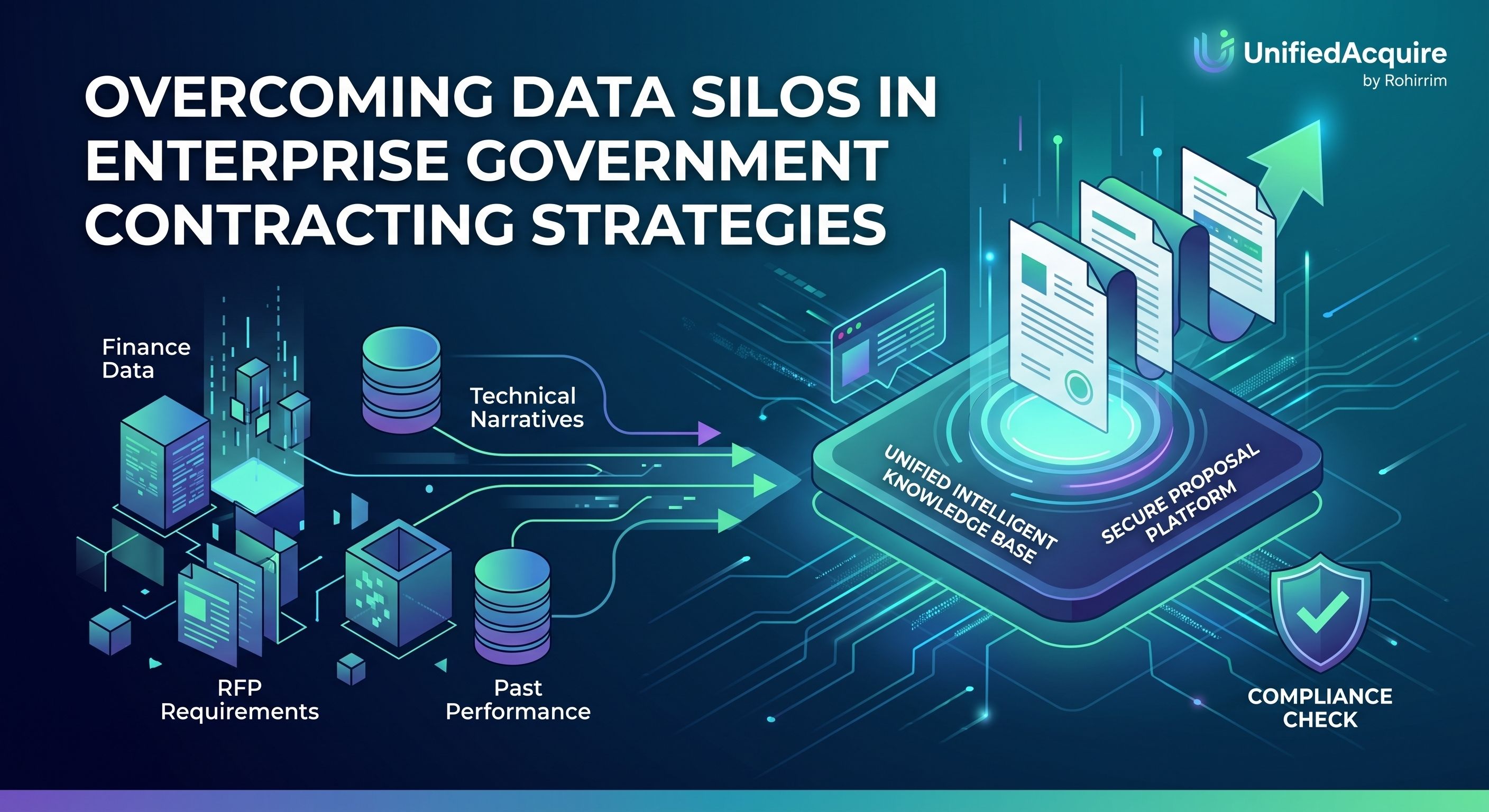
In the highly competitive arena of government contracting, an organization’s ability to win complex bids relies almost entirely on its capacity to leverage past performance, technical expertise, and institutional knowledge. However, as enterprises scale, the sheer volume of data they generate across various departments often becomes one of their greatest liabilities. Information vital to winning a Request for Proposal (RFP)—from specialized technical narratives to nuanced pricing models—frequently becomes trapped within disconnected digital environments.
These data silos create immense friction during the business development lifecycle. When an agency releases a massive solicitation with a strict 30-day turnaround, capture managers do not have the luxury of spending weeks hunting down subject matter experts (SMEs) or searching through fragmented shared drives to find a specific compliance matrix from three years ago. The inability to rapidly access and synthesize historical data inherently slows down the proposal process, increasing the risk of non-compliance and ultimately driving down win rates.
To dismantle these barriers, forward-thinking organizations are adopting advanced procurement automation tools (https://rohirrim.ai/unifiedacquire/) that centralize institutional knowledge and accelerate response times. By moving away from fragmented, manual workflows and embracing intelligent, interconnected architectures, federal contractors can transform their hidden, unstructured data into a decisive strategic advantage.
The Hidden Cost of Fragmented Proposal Knowledge
In a typical enterprise GovCon environment, data is naturally decentralized. Engineering teams manage technical specifications in dedicated project management software, finance teams track pricing history in distinct ERP systems, and proposal writers maintain past performance records across various cloud storage folders. While this separation makes sense for daily departmental operations, it creates catastrophic bottlenecks during the high-stakes proposal generation phase.
When a new RFP drops, proposal teams are forced into a reactive scavenger hunt. They must manually extract requirements from the government’s solicitation and then attempt to match those requirements with internal data scattered across the enterprise. This manual reconciliation is not only exhausting but deeply inefficient. Time that should be spent refining a compelling executive summary or optimizing a pricing strategy is instead wasted on administrative data retrieval. Furthermore, when writers are forced to recreate technical content from scratch because the original source files are lost in a silo, the organization risks submitting inconsistent messaging that misaligns with its established corporate capabilities.
Bridging the Gap Between Subject Matter Experts and Capture Teams
One of the most significant impacts of data silos is the strain they place on an organization’s most valuable resource: its subject matter experts. Capture teams rely heavily on SMEs to provide the highly technical, nuanced answers required by government evaluators. However, when historical data is inaccessible, SMEs are repeatedly asked to answer the same foundational questions for every new bid.
This repetitive strain can be alleviated by unifying enterprise data. When institutional knowledge is properly centralized and indexed, proposal managers face far fewer roadblocks. Breaking down these silos resolves several critical friction points in the capture process:
Eradicating Version Control Chaos: Eliminating the confusion of multiple draft documents circulating through email threads, ensuring teams always pull from the most recently approved, compliant corporate narratives.
Preserving Contextual History: Retaining the strategic reasoning behind past successful bids, rather than just keeping the final PDFs, allowing new writers to understand why specific technical approaches were chosen.
Accelerating Technical Drafting: Enabling writers to instantly surface approved boilerplates and past performance citations without pulling engineers away from active, billable government projects.
Unified AI Architectures vs. Traditional Workflows
The technological shift from siloed storage to unified, AI-driven environments represents a fundamental change in how government contractors operate. Modern systems do not just store data; they actively parse, analyze, and connect it to incoming government requirements.
Operational FunctionTraditional Siloed EnvironmentUnified Intelligent ArchitectureData RetrievalManual keyword searches across disconnected drives and folders.Semantic, natural language queries across a centralized knowledge base.RFP ShreddingHighlighting PDFs and manually pasting clauses into spreadsheets.Automated ingestion and structural categorization of all solicitation requirements.Compliance TrackingStatic tracking documents prone to human error and version conflicts.Dynamic compliance matrices automatically linked to specific source data.Content GenerationStarting from scratch or utilizing outdated, disjointed templates.Context-aware drafting backed by verified, highly relevant historical data.
Establishing a Single Source of Truth for Compliance
In the public sector, compliance is non-negotiable. Government agencies evaluate proposals against incredibly rigid criteria, and a failure to meet even a minor administrative requirement can result in immediate disqualification. When data lives in silos, ensuring absolute compliance becomes a logistical nightmare. A proposal manager might verify a technical specification with the engineering team, only to realize later that the compliance team updated that specific regulation in a separate, inaccessible database.
By centralizing data, enterprises create a single, immutable source of truth. Advanced workflow automation platforms can integrate directly with an organization's secure repositories, ensuring that every piece of information used in a proposal is verified, up-to-date, and compliant with current federal standards. This is particularly vital for navigating complex security frameworks like the Cybersecurity Maturity Model Certification (CMMC) or FedRAMP. When security protocols and technical standards are unified in one accessible location, proposal teams can confidently assert their compliance posture without second-guessing the accuracy of their underlying data.
Structuring Unstructured Past Performance Data
A major component of breaking down silos involves dealing with unstructured data. Enterprises possess terabytes of old proposals, technical whitepapers, and Contractor Performance Assessment Reporting System (CPARS) evaluations. In a siloed environment, this text is effectively dark data—it exists, but it cannot be easily utilized.
Modern document processing technologies utilize natural language processing to ingest this unstructured text, identify key themes, and tag the data with relevant metadata. A previously buried fifty-page technical volume from three years ago can be automatically analyzed and broken down into modular, searchable assets. When a new RFP demands a specific technical capability, the system can instantly surface the exact paragraph from that old volume, properly cited and ready for adaptation.
Transforming Knowledge Management into a Strategic Advantage
The ultimate goal of overcoming data silos is not simply to make files easier to find; it is to fundamentally accelerate the business development engine. Government contracting is a game of speed, precision, and scale. Enterprises that rely on fragmented systems will continually find themselves outpaced by competitors who can assemble complex, highly compliant bids in a fraction of the time.
By investing in interconnected platforms and centralizing their intellectual property, federal contractors can shift their posture from defensive to offensive. Proposal teams are liberated from the drudgery of data retrieval and administrative formatting. Instead, they can focus their energy on refining win themes, optimizing pricing, and crafting compelling narratives that resonate with government buyers. In an industry where the margin between winning and losing is razor-thin, the ability to seamlessly access and deploy enterprise-wide knowledge is the ultimate competitive differentiator.
Appreciate the creator