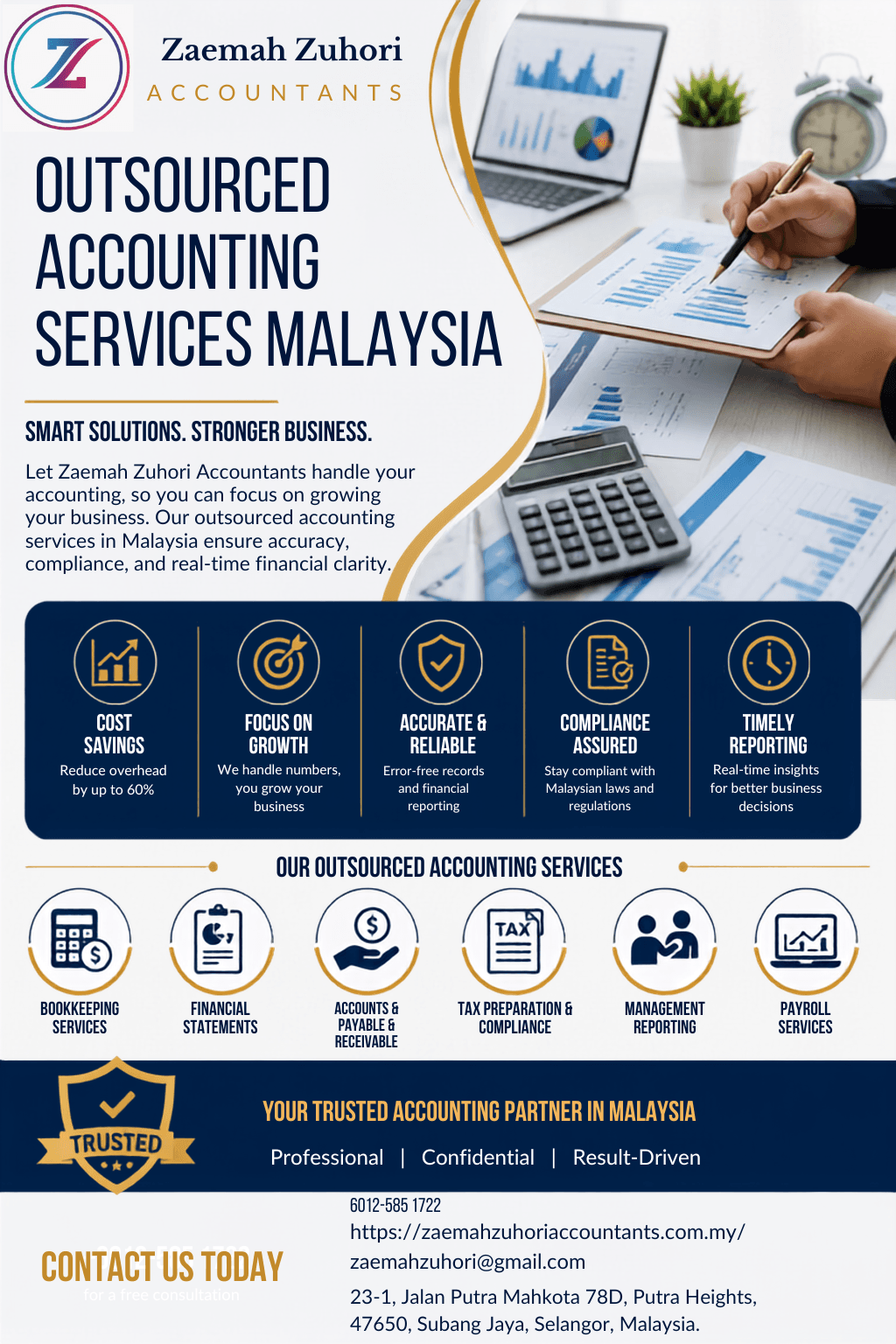
Outsourced Accounting Is Becoming the Default for Malaysian SMEs Heading Into 2026
Outsourced Accounting Is Becoming the Default for Malaysian SMEs Heading Into 2026
Something has shifted in how Malaysian business owners think about their books. It's no longer a debate between "hire someone" and "do it yourself." More and more, the real comparison is between building an in-house finance function and handing it to a firm that already has the systems, staff, and know-how in place.
Three things are pushing this shift: salaries keep climbing, LHDN's compliance expectations keep tightening, and tax rules keep getting more layered. Put those together and outsourcing stops being a cost-cutting shortcut — it becomes the more sensible operating model.
For business owners still weighing outsourced accounting services Malaysia (https://zaemahzuhoriaccountants.com.my/), the honest question by 2026 isn't "does this make sense for me?" It's "what's actually stopping me from doing this already?" Because on paper, the numbers rarely favour staying in-house.
What an In-House Hire Really Costs You
Ask most SME owners what their accountant costs, and they'll quote a monthly salary. That's only the visible slice.
In Kuala Lumpur, a mid-level accountant typically earns somewhere between RM3,500 and RM6,000 a month. Layer on EPF (12–13% employer contribution), SOCSO, EIS, paid leave, medical coverage, and whatever software licences they need to do the job properly — and the real annual cost climbs past RM70,000 before that person has closed a single set of books.
And that's the stable scenario. It doesn't account for recruitment agency fees, weeks of onboarding while they learn your business, or the very real possibility that they resign eight months in and take a working knowledge of your accounts with them. For a company turning over RM2–5 million a year, that's not a rounding error — it's a meaningful drag on margins.
Compare that to outsourced accounting, which for most SMEs lands somewhere between RM500 and RM2,500 a month, scaled to how many transactions you're actually processing. Work with an established firm, and you're often not even trading down on quality — you're trading up, because you're getting a whole team's worth of expertise instead of one person's.
What's Changed in 2026 That Makes Outsourcing More Urgent
SST Compliance Has Gotten More Complex
Malaysia's Sales and Service Tax (SST) framework continues to evolve. With expanded service categories and ongoing updates from the Royal Malaysian Customs Department (RMCD), staying compliant requires active monitoring — not just periodic filings. Many in-house bookkeepers at SME level simply don't have the specialist knowledge to handle SST edge cases, especially for businesses with mixed supply models.
e-Invoicing Mandates Are Rolling Out
The Inland Revenue Board of Malaysia (LHDN) is implementing mandatory e-invoicing in phases. Larger businesses were required to comply from August 2024, with SMEs following from 2025 onwards. This transition requires integration between accounting systems and the MyInvois platform — something many smaller businesses are unprepared to manage internally without external expertise.
Corporate Tax Obligations Are Under Closer Scrutiny
LHDN has increased audit activity targeting SMEs with inconsistent financial records. A compliance gap — whether from misclassified expenses, late filings, or incorrect capital allowance claims — can result in penalties, back taxes, and interest charges. Professional accountancy services provide a buffer of accuracy and documentation that protects business owners from these outcomes.
Outsourced vs. In-House: A Direct Comparison
Factor
In-House Accountant
Outsourced Accounting Firm
Monthly Cost
RM4,500–RM7,000+ (all-in)
RM500–RM2,500
Tax & SST Expertise
Varies by individual
Team-based, specialist knowledge
e-Invoicing Readiness
Requires training & setup
Already equipped and integrated
Scalability
Headcount-dependent
Scales with business volume
Continuity Risk
High (staff turnover)
Low (firm accountability)
Compliance Coverage
Dependent on one person
Multi-person review process
Who Benefits Most From Outsourcing Their Accounting?
Not every business has the same profile, but outsourcing tends to deliver the clearest advantage for:
Startups and early-stage SMEs that need financial structure but can't justify a full-time hire
Businesses in transition — expanding, restructuring, or bringing in investors — where clean, auditable records matter
Owner-managed businesses where the founder is currently doing the books themselves and losing hours that should be spent on business development
Companies with seasonal or irregular transaction volumes that don't require full-time accounting effort year-round
Businesses preparing for SST registration or navigating their first corporate tax submission
What Good Outsourced Accounting Actually Delivers
There's a common misconception that outsourcing means handing over a shoebox of receipts and getting back a spreadsheet. Quality accountancy services (https://zaemahzuhoriaccountants.com.my/) go well beyond basic bookkeeping. Here's what a credible outsourced firm typically provides:
Monthly management accounts with profit and loss, balance sheet, and cash flow statements
SST filing and advisory on taxable supplies
Corporate income tax computation and submission (Form C)
e-Invoicing compliance and MyInvois integration support
Payroll processing including EPF, SOCSO, and EIS contributions
Financial analysis and commentary to support business decisions
This is a materially different value proposition from a single in-house bookkeeper managing transactions reactively.
Common Concerns — Addressed Directly
"Will an external firm really understand my business?"
This is the most common hesitation, and it's fair. The answer lies in onboarding quality. A professional firm will document your chart of accounts, business model, and industry-specific treatments in the first month. After that, context builds quickly. Many outsourced clients report that their external accountants, precisely because they work across multiple industries, bring benchmarking insights that an in-house hire never could.
"What about data security?"
Reputable accounting firms in Malaysia operate under professional confidentiality obligations governed by the Malaysian Institute of Accountants (MIA) and contractual non-disclosure agreements. Cloud-based accounting platforms like Xero and QuickBooks Online also provide audit trails and user-access controls that are often more rigorous than internal setups.
"Is this only for larger SMEs?"
No. In fact, micro and small businesses often benefit the most. A sole proprietor billing RM30,000 per month has the same GST/SST obligations and tax filing requirements as a larger company — but has far less capacity to manage them internally.
Making the Switch: What to Look For in a Provider
Before engaging any outsourced accounting firm, run through this checklist:
Is the firm registered with or staffed by members of the Malaysian Institute of Accountants (MIA)?
Do they have documented experience with your industry or business model?
Can they demonstrate e-invoicing capability and MyInvois familiarity?
Is the engagement scope clearly defined — what's included, what's billed separately?
What's the turnaround time for monthly accounts and tax filings?
How do they communicate — email only, or do they offer regular advisory calls?
These questions separate transactional bookkeeping vendors from genuine accounting partners.
The Compliance Risk Angle — Why This Matters Now More Than Ever
According to LHDN's enforcement trend data, SME audits have increased in frequency as digital reporting infrastructure improves. When your financial records are inconsistent or your tax positions are poorly documented, you're not just at risk of a fine — you're at risk of a full audit that consumes months of management time.
Professional outsourced accounting creates a compliance trail: every transaction categorised, every filing timestamped, every decision documented. That paper trail is your first line of defence if LHDN ever comes knocking.
For SME owners in Malaysia looking to reduce overhead, stay ahead of compliance obligations, and get reliable financial intelligence — the shift to outsourced accounting isn't a compromise. It's an upgrade. Firms like Zaemah Zuhori Accountants (https://zaemahzuhoriaccountants.com.my/) are built precisely for this: providing Malaysian businesses with professional-grade accounting support without the cost and operational risk of building it in-house. If 2026 is the year you stop managing your books reactively, this is where to start.
Frequently Asked Questions
What exactly do outsourced accounting services in Malaysia cover?
Rather than putting an accountant on your payroll, you hand your financial function over to an external firm. They take care of bookkeeping, tax filings, payroll processing, and staying on top of compliance deadlines. In practice, this means monthly management accounts, SST return submissions, corporate tax filings, and financial reports — all delivered under a scope and fee structure you agree on upfront.
What's the realistic monthly cost for outsourced accounting in Malaysia?
Most SMEs pay somewhere between RM500 and RM2,500 a month, with the exact figure depending on how many transactions you're generating, how complex your business is, and how much you actually need done. Set that against a full-time in-house accountant — where salary, EPF, and benefits together often push past RM5,000 to RM7,000 monthly
— and the gap speaks for itself.
Does outsourcing make sense for a small business, or is it more of a mid-market thing?
It's arguably where small businesses benefit the most. A sole proprietor or small outfit still has to meet the same SST, income tax, and e-invoicing requirements as a much larger company, but rarely has the internal bandwidth to handle them properly. Outsourcing gives them professional-level support scaled to their size, without the overhead of bringing someone on full-time.
Bookkeeping and accountancy services aren't the same thing — what's the actual difference?
Bookkeeping is essentially the record-keeping layer — logging transactions as they happen, day to day. Accountancy sits above that: it's tax planning, statutory compliance, management reporting, financial analysis, and advisory input. If you're only getting bookkeeping, you're covered for filings. If you want your numbers to actually inform decisions, you need a firm offering the fuller accountancy service.
How is e-invoicing going to affect Malaysian SMEs through 2026?
LHDN's e-invoicing mandate means invoices now need to be issued and received through the MyInvois platform. Businesses that were brought into the compliance timeline starting in 2025 need their systems properly integrated and their internal processes adjusted to match. A firm that already understands e-invoicing can manage that transition for you, which cuts down significantly on the risk of falling foul of penalties.
What should actually guide the choice of an outsourced accounting firm?
A few things matter more than the sales pitch: MIA-registered practitioners, real experience handling businesses like yours, a clearly written service scope so there's no ambiguity later, and solid working knowledge of Malaysian tax rules — SST and e-invoicing included. Beyond that, how responsive they are and whether they give you insight you can act on, rather than just data entry, is usually what separates a genuine accounting partner from a basic bookkeeping vendor.
Appreciate the creator