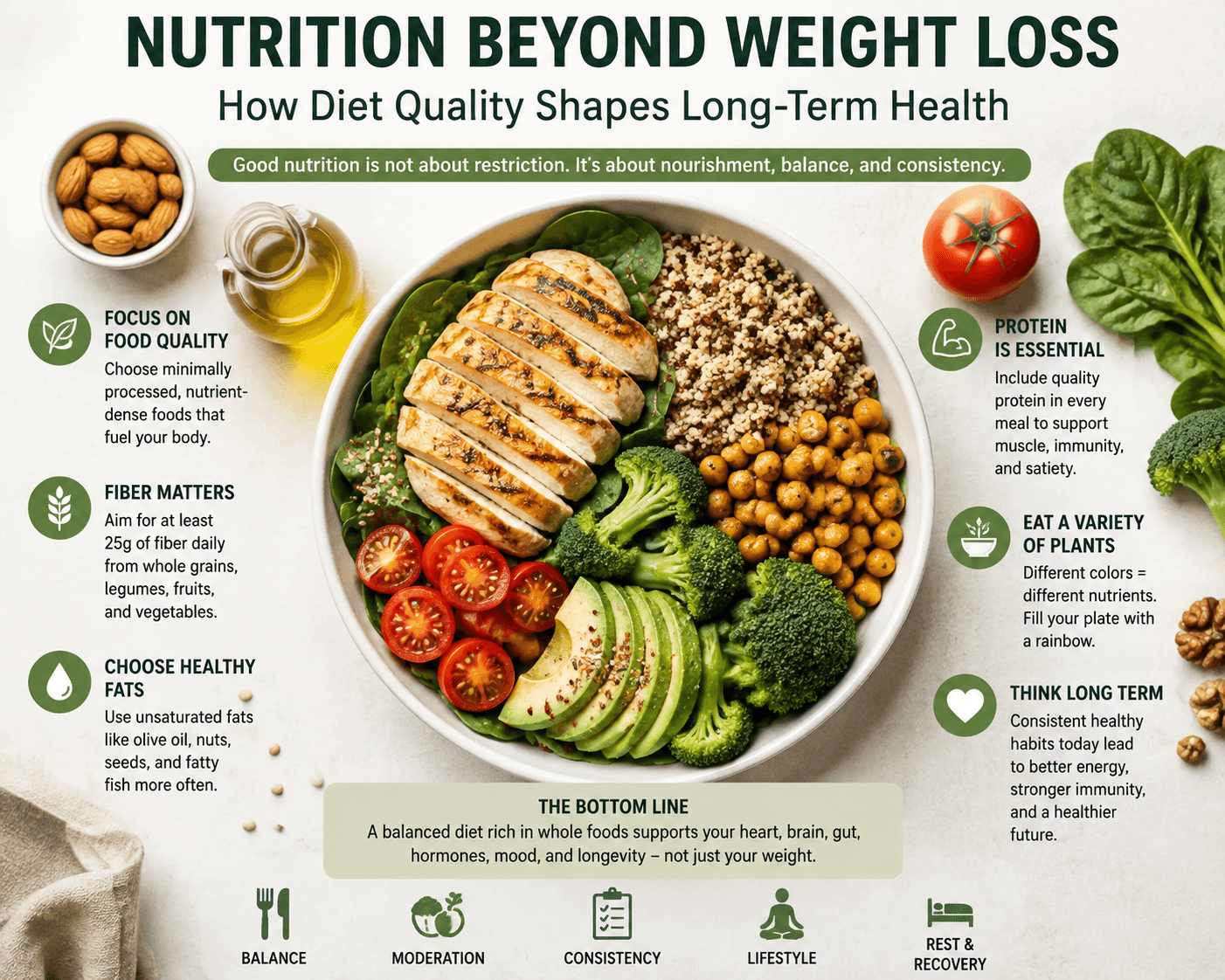
Nutrition Beyond Weight Loss: How Diet Quality Shapes Long-Term Health
Nutrition is often discussed through the language of weight.
Lose weight. Maintain weight. Reduce calories. Burn more energy than you consume.
These are legitimate concerns, but they can make nutrition appear narrower than it really is.
A person's diet influences far more than body mass. It contributes to blood pressure regulation, glucose metabolism, cardiovascular health, gastrointestinal function, muscle maintenance, micronutrient status and, over the long term, the risk of several chronic diseases.
This broader perspective is increasingly important because a person can maintain a stable weight while eating a nutritionally poor diet. Conversely, someone may experience changes in body weight without necessarily improving the overall quality of their food choices.
The more meaningful question is therefore not simply whether a diet changes the number on the scale.
It is whether the diet provides the biological materials and dietary environment required to support health over many years.
Current World Health Organization guidance frames healthy eating around four principles: adequacy, balance, moderation and diversity. It also emphasizes that the precise composition of a healthy diet should vary according to individual characteristics, culture, food availability and lifestyle.
That framework provides a useful starting point for understanding what diet quality really means.
Weight Is One Health Metric, Not the Whole Picture
Body weight is easy to measure, which partly explains its dominance in nutrition conversations.
But weight alone cannot tell us whether someone is meeting their nutritional requirements.
It does not reveal fiber intake.
It does not indicate whether someone is consuming enough iron, calcium, vitamin B12 or folate.
It does not tell us whether dietary fats are predominantly unsaturated or saturated.
It cannot show whether a person regularly consumes vegetables, legumes and whole grains.
Two individuals with identical body weights can therefore have substantially different nutritional profiles.
This is not an argument against monitoring weight when it is relevant.
It is an argument for putting weight in its proper context.
Health assessment becomes more informative when several dimensions are considered together.
Diet Quality Is About Patterns
There is a tendency to search for the one food that is healthiest or the one ingredient that should be eliminated.
Human nutrition does not generally work that way.
Dietary patterns are more informative.
A dietary pattern describes the combination of foods consumed repeatedly over time, including their relative proportions and frequency.
This approach is supported by both public-health guidance and epidemiological research.
WHO emphasizes diets containing a broad variety of minimally processed and unprocessed foods, particularly vegetables, fruits, pulses, whole grains, nuts and appropriate protein sources, while limiting excessive sodium, free sugars and unhealthy fats.
The important point is that these foods work together.
A bowl of oats is not a complete diet.
Neither is a serving of spinach, a protein shake or a handful of almonds.
Health emerges from the cumulative pattern.
Fiber May Be One of the Most Underappreciated Nutritional Variables
Fiber rarely receives the same attention as protein or calories, yet it is central to dietary quality.
Fiber affects intestinal function and contributes to the physical and metabolic environment of the gastrointestinal tract.
Different fibers behave differently. Some increase stool bulk, while others are fermented by gut microorganisms.
This diversity is nutritionally important because fiber is not a single compound with a single biological effect.
WHO's current guidance recommends that people over 10 years of age obtain at least 25 grams of naturally occurring dietary fiber per day.
That recommendation is not simply about preventing constipation.
A large 2024 systematic review and meta-analysis covering more than 3.5 million participants found that higher dietary fiber intake was associated with lower risks of all-cause, cardiovascular and cancer mortality. These were observational data, so they demonstrate association rather than proving that fiber alone caused the differences in mortality.
That distinction is important.
Good nutritional research should tell us not only what appears beneficial, but also how confident we can be about why the association exists.
The Source of Fiber Matters Too
It is tempting to think of fiber as a number on a nutrition label.
But 25 grams of fiber obtained from a varied diet is not necessarily nutritionally equivalent to 25 grams isolated into a supplement.
Whole foods provide fiber alongside other components.
A serving of lentils provides protein, folate, minerals and other compounds.
Whole grains provide fiber along with carbohydrates, minerals and phytochemicals.
Fruit contributes fiber together with vitamins and numerous plant compounds.
Vegetables provide different combinations depending on the species and preparation.
This is one reason dietary diversity remains so important.
The nutritional value of a food is rarely represented adequately by a single nutrient.
Carbohydrates Need Better Categorization
Carbohydrates have been treated as either beneficial or harmful in many popular diet discussions.
That distinction is too crude.
Whole grains, legumes, fruits and vegetables all contain carbohydrates, but their nutritional profiles are substantially different from refined sugars and many highly processed carbohydrate-rich foods.
WHO's 2026 healthy-diet guidance recommends that carbohydrates come primarily from whole grains, vegetables, fruits and pulses for most people.
This does not require eliminating refined carbohydrates.
Rather, it suggests that the majority of the carbohydrate environment should be built around foods that contribute meaningful nutritional value.
The distinction is between carbohydrate as a chemical category and carbohydrate-containing foods as part of a dietary pattern.
Fat Quality Matters More Than the Word “Fat”
The same principle applies to dietary fat.
For decades, fat was often treated as something to minimize.
Modern nutrition is more interested in which fats are being consumed and what they are replacing.
Unsaturated fats found in foods such as nuts, seeds, fish, avocado and several plant oils can fit into a healthy dietary pattern.
Saturated fats are more limited in current recommendations, while industrial trans fats should be avoided.
WHO's 2026 guidance recommends replacing saturated and trans fats with unsaturated fats or, in appropriate contexts, carbohydrates from naturally fiber-rich foods.
This concept of replacement is crucial.
Reducing one nutrient has little meaning unless we know what replaces it.
Replacing saturated fat with unsaturated fat is nutritionally different from replacing it with refined carbohydrate.
Micronutrients Reveal the Limits of Calorie Counting
A calorie tells us how much energy food provides.
It does not tell us whether the diet is rich in micronutrients.
Vitamins and minerals are required in relatively small quantities, but their physiological importance is substantial.
Iron participates in oxygen transport.
Calcium contributes to bone and muscle physiology.
Iodine is essential for thyroid hormone production.
Folate is important for DNA synthesis and cell division.
Vitamin B12 is necessary for neurological function and blood formation.
Magnesium participates in numerous enzymatic reactions.
A person can therefore meet their energy needs while failing to meet some micronutrient requirements.
This is one reason nutrient density matters.
A diet built around a diverse range of nutrient-rich foods creates more opportunities to meet physiological requirements without relying exclusively on supplements.
WHO specifically emphasizes dietary diversity as a way of improving the likelihood of meeting vitamin and mineral requirements.
Why Highly Processed Foods Require Context
The discussion around processed food has become increasingly polarized.
One side treats processing as inherently harmful.
The other dismisses the category altogether.
Neither position is particularly useful.
Processing is not a single phenomenon.
Freezing, pasteurization, fermentation, drying, milling and cooking are all forms of processing, but they have very different nutritional consequences.
The more relevant question is what a particular food contributes to the diet.
Some highly processed foods are rich in sodium, free sugars or unhealthy fats and provide relatively little fiber or micronutrient density.
Others can be useful sources of nutrients and may make healthy eating more practical.
WHO's current guidance nevertheless notes that diets containing substantial amounts of highly processed foods are associated with negative health outcomes and recommends that minimally processed and unprocessed foods form the foundation of healthy dietary patterns.
The goal should not be nutritional purity.
It should be a better overall pattern.
Mediterranean-Style Eating Is Interesting for a Reason
The Mediterranean dietary pattern has received sustained scientific attention, not because it represents one magical cuisine, but because it embodies several principles repeatedly associated with better dietary quality.
It typically emphasizes vegetables, fruits, legumes, whole grains, nuts, seeds, olive oil and other plant foods, while incorporating fish and moderate amounts of other animal foods.
It also tends to minimize excessive intake of highly processed foods and added sugars.
Recent research continues to examine its relationship with cardiovascular health, chronic disease and quality of life. A 2025 systematic review found evidence suggesting associations between Mediterranean-diet adherence and aspects of physical and mental health-related quality of life, although the evidence base contains differences in study design and populations.
Again, the lesson is not that everyone must eat a Mediterranean diet.
The more general lesson is that several healthy dietary patterns can share common structural characteristics.
Healthy Diets Do Not Need to Look Identical
A nutritious diet in Japan does not need to look like one in Greece.
A South Asian dietary pattern can be healthy.
A Latin American dietary pattern can be healthy.
A vegetarian diet can be healthy.
An omnivorous diet can be healthy.
The common denominator is not a particular cuisine.
It is the nutritional structure.
Adequate protein.
Sufficient fiber.
A broad range of plant foods.
Appropriate sources of healthy fats.
Adequate vitamins and minerals.
Moderation of sodium and free sugars.
Reasonable energy balance.
Food safety.
This flexibility is important because dietary recommendations that ignore culture tend to become difficult to sustain.
Affordability Is Part of Nutrition
There is also a practical issue that deserves considerably more attention.
A healthy diet must be accessible.
People do not make food choices in a vacuum. Food prices, work schedules, transportation, cooking facilities, local availability and household responsibilities all influence what ends up on the plate.
The latest State of Food Security and Nutrition in the World 2026 report focuses specifically on the rising cost of healthy diets and the structural factors affecting affordability and access.
This is important because nutrition advice can become disconnected from reality when it assumes that everyone has the same resources.
Frozen vegetables can be nutritious.
Canned beans can be useful.
Whole grains do not have to be expensive specialty products.
Seasonal produce can sometimes provide excellent value.
Good nutrition is not synonymous with expensive food.
Sustainability and Health Can Overlap
Dietary quality also intersects with environmental considerations.
WHO notes that healthy diets can also be more environmentally sustainable when they emphasize a greater variety of plant foods and appropriate dietary patterns.
This does not mean nutritional decisions should be reduced to environmental calculations.
Human nutritional requirements come first.
But there can be considerable overlap between diets rich in legumes, whole grains, vegetables, fruits, nuts and seeds and dietary patterns with lower environmental burdens.
This is another reason dietary diversity is valuable.
Health Metrics Should Follow the Dietary Pattern
One of the most useful developments in personal nutrition is the ability to look beyond weight.
Blood pressure can provide information about cardiovascular risk.
Waist circumference can provide information about central adiposity.
Blood glucose and HbA1c can provide information about glycemic regulation when clinically appropriate.
Blood lipids can help assess cardiovascular risk.
Resting heart rate and physical performance can provide additional context.
Body mass index can be useful at a population level and as one screening measure, although it cannot distinguish fat mass from lean mass and should not be interpreted in isolation.
None of these metrics provides a complete picture.
Together, however, they can create a more informative view of health than body weight alone.
Nutrition Should Be Evaluated Over Time
Perhaps the biggest mistake in dietary thinking is judging nutrition from a single meal.
A person can eat dessert and have an excellent diet.
Someone can eat a salad and have a poor diet.
One meal tells us very little.
Patterns tell us much more.
If vegetables appear occasionally, that is different from eating them regularly.
If legumes are eaten once a month, that is different from incorporating them several times per week.
If sugary drinks are occasional, that is different from consuming them throughout the day.
Nutrition is cumulative.
The body responds to repeated exposure, not to the moral character of individual meals.
Personalization Is Becoming More Practical
General dietary guidance provides a foundation, but people differ in their requirements and circumstances.
Age changes nutritional priorities.
Physical activity changes energy and protein requirements.
Pregnancy changes nutrient needs.
Medical conditions can require dietary modification.
Food allergies and intolerances affect what is practical.
Cultural preferences influence adherence.
Work schedules affect meal timing and preparation.
A useful nutrition plan therefore needs to translate broad scientific principles into a person's actual life.
This is where tools such as Macrition (https://macrition.com/ (https://macrition.com/)) can provide a practical layer of organization, helping users structure personalized meal plans and track nutrition goals rather than relying solely on generic diet templates.
Technology should support informed decision-making, however, rather than create the impression that an algorithm can replace clinical assessment when medical care is required.
A More Mature Definition of Healthy Eating
Perhaps the most useful definition of healthy eating is not a list of forbidden foods.
It is a pattern that consistently provides what the body needs while limiting excessive exposure to factors associated with disease.
That means:
Adequacy, so nutritional requirements are met.
Balance, so energy and macronutrients are appropriately distributed.
Moderation, so foods and nutrients that can become harmful in excess remain limited.
Diversity, so the diet provides a broad nutritional foundation.
These principles are reflected directly in current WHO guidance.
They are also flexible enough to accommodate different cultures, budgets and lifestyles.
The Emerging Evidence on Long-Term Dietary Patterns
Research increasingly supports the idea that diet quality is associated with long-term health outcomes.
A recent prospective cohort study involving more than 100,000 UK Biobank participants found that several established healthy dietary patterns, including Mediterranean, DASH and healthful plant-based patterns, were associated with lower all-cause mortality and longer estimated life expectancy. The authors reported associations with several years of difference in estimated life expectancy between the highest and lowest diet-quality groups.
This type of evidence should be interpreted carefully.
It does not prove that a particular dietary score will add a specific number of years to an individual's life.
People who eat healthier diets may also differ in physical activity, socioeconomic circumstances, healthcare access, smoking behavior and other factors.
But when different healthy dietary patterns repeatedly show similar associations, the broader signal becomes difficult to ignore.
The details vary.
The underlying principles appear remarkably consistent.
What This Means in Practice
A sensible nutrition strategy does not need to begin with eliminating foods.
It can begin with adding nutritional value.
Add another serving of vegetables.
Include legumes more often.
Choose whole grains regularly.
Keep fruit available.
Use nuts and seeds where appropriate.
Select healthier sources of fat.
Make sure meals contain adequate protein.
Choose water as the default beverage.
Reduce frequent consumption of foods high in free sugars, sodium and unhealthy fats.
Then observe what happens over time.
This approach is often more sustainable than beginning with a long list of restrictions.
Conclusion
Nutrition is much larger than weight management.
Body weight matters, but it is only one measurable feature of a much broader biological system.
A high-quality diet supplies adequate energy and nutrients, supports physiological function, encourages dietary diversity and moderates components that become problematic when consumed excessively.
The strongest evidence does not point toward one perfect food or one universal diet.
Instead, it repeatedly returns to a set of remarkably consistent principles: variety, adequacy, balance, moderation, dietary fiber, nutrient density and predominantly minimally processed foods.
The most useful dietary plan is therefore not necessarily the most restrictive or technologically sophisticated.
It is the one that can provide nutritional adequacy while fitting the realities of someone's life.
And perhaps that is the most important shift in modern nutrition: moving away from asking “Which diet should I follow?” and toward asking “What dietary pattern can consistently support the health I want to maintain for decades?”
That question is harder.
It is also much more meaningful.
Appreciate the creator