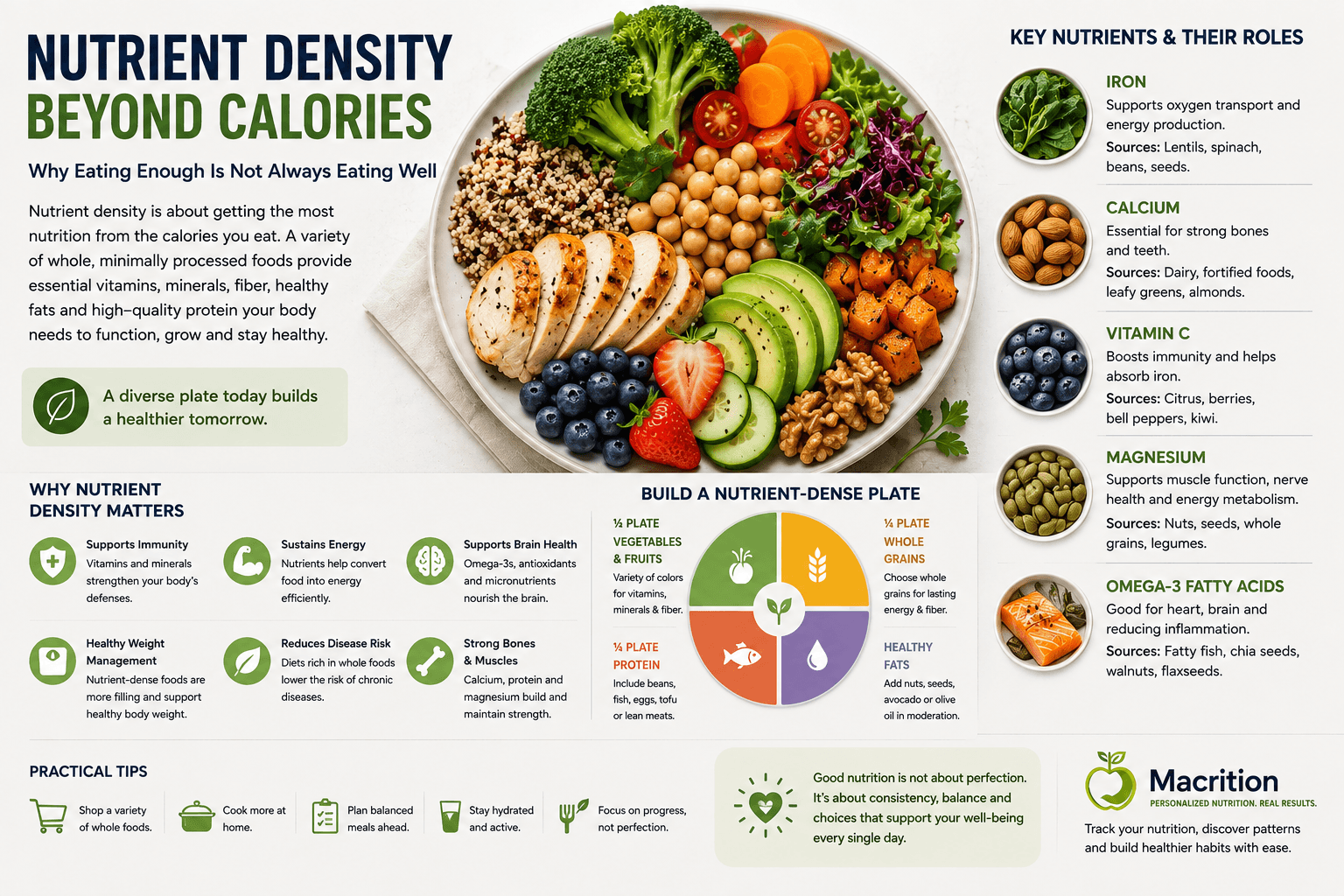
Nutrient Density and Hidden Nutritional Gaps: Why Eating Enough Is Not Always Eating Well
One of the more persistent misunderstandings in nutrition is the assumption that adequate food intake automatically means adequate nutrition.
A person can consume enough calories to maintain body weight and still have an inadequate intake of several essential nutrients.
This distinction becomes increasingly important in modern dietary environments, where energy-dense foods are widely available but nutrient density can vary enormously from one meal to another.
A meal can provide substantial energy while contributing relatively little fiber, vitamins, minerals or other biologically important compounds. Conversely, a comparatively modest amount of food can provide a remarkably broad range of nutrients.
This is where the concept of nutrient density becomes useful.
Nutrient density asks a simple but important question:
How much nutritional value does a food provide relative to the energy it contains?
It is not a perfect measurement, and no single index captures every aspect of food quality. Nevertheless, it provides a useful framework for thinking beyond calories and understanding why the composition of a diet matters so much.
Calories and Nutrients Are Not the Same Thing
Calories describe energy.
They do not describe nutritional completeness.
Consider two hypothetical meals with approximately the same energy content.
One might consist of vegetables, lentils, whole grains, yogurt, nuts and fruit.
The other might consist primarily of refined carbohydrates, sugary beverages and highly processed snacks.
Both meals may satisfy an energy requirement.
But they can differ considerably in protein quality, fiber, potassium, magnesium, folate, vitamin C, calcium, essential fatty acids and numerous other compounds.
This is one reason nutritional assessment cannot stop at energy intake.
Energy balance is important for body-weight regulation, but health also depends on what accompanies that energy.
The Problem of Hidden Nutritional Gaps
Nutrient deficiencies are not always dramatic.
Severe deficiency can produce recognizable clinical symptoms, but inadequate intake may also exist at a less obvious level.
Someone may not have an obvious deficiency disease while still consistently consuming less of a particular nutrient than is desirable.
This makes nutritional adequacy difficult to judge from appearance alone.
A person can look healthy, maintain a stable weight and eat three meals a day while having a dietary pattern that is relatively poor in particular micronutrients.
The reverse can also occur.
Someone with a higher body weight can still have inadequate intake of essential vitamins and minerals.
Body size and nutritional adequacy are related concepts, but they are not interchangeable.
Why Dietary Variety Matters
One of the simplest ways to improve nutritional coverage is to increase dietary variety.
Different foods contain different combinations of nutrients.
Leafy green vegetables can contribute folate, vitamin K and several minerals.
Citrus fruits and other fruits can contribute vitamin C and various plant compounds.
Legumes provide protein, fiber, folate, iron and other micronutrients.
Nuts and seeds provide unsaturated fats, magnesium and other minerals.
Whole grains contribute fiber and a range of micronutrients.
Dairy products and fortified alternatives can contribute calcium, protein and other nutrients.
Fish can provide protein and, depending on the species, long-chain omega-3 fatty acids.
The nutritional advantage comes partly from the combination.
No single food needs to provide everything.
A varied diet allows different foods to fill different nutritional roles.
Micronutrients Work Together
Another reason nutrition is more complicated than a list of isolated vitamins is that nutrients interact.
Iron metabolism is influenced by the overall meal composition.
Vitamin D and calcium are closely connected to bone physiology.
Folate and vitamin B12 participate in related metabolic pathways.
Vitamin C can influence the absorption of non-heme iron from plant foods.
Magnesium participates in hundreds of enzymatic reactions.
These relationships demonstrate why taking a single nutrient out of context can produce an incomplete picture.
Human physiology is an interconnected system.
Nutrition is therefore better understood as a network of relationships rather than a checklist.
Bioavailability Changes the Equation
Even when a food contains a particular nutrient, the amount listed in a nutritional database does not necessarily equal the amount absorbed and utilized by the body.
This is known as bioavailability.
The form of the nutrient matters.
The food matrix matters.
Other foods consumed during the same meal can matter.
Individual physiology matters.
For example, plant foods contain non-heme iron, which is absorbed differently from the heme iron found in animal foods. Compounds such as phytates can influence mineral absorption, while vitamin C can enhance non-heme iron absorption.
This does not make plant foods nutritionally inferior.
It demonstrates why dietary patterns and food combinations matter.
A varied diet can provide both nutrients and the conditions that help the body use them.
Food Preparation Can Change Nutritional Value
Cooking is another factor that deserves attention.
Heat can reduce some heat-sensitive vitamins while increasing the availability of certain nutrients and making foods easier to digest.
Chopping, soaking, fermenting, sprouting and other preparation techniques can also alter the nutritional characteristics of foods.
This means there is no universal rule that raw food is always superior to cooked food.
A lightly cooked vegetable can still be highly nutritious.
A cooked legume can be considerably more practical and digestible than an uncooked one.
Food preparation is not inherently a nutritional problem.
The method and context matter.
Nutrient Density Is Particularly Important During Energy Restriction
This concept becomes especially important when someone is intentionally reducing calorie intake.
When total energy intake falls, there are fewer opportunities to obtain essential nutrients.
A person consuming 1,800 calories from a varied diet has a different nutritional challenge from someone consuming 1,800 calories predominantly from highly refined foods.
This is one reason restrictive diets can become nutritionally problematic.
The lower the energy intake, the more important it becomes that the available calories carry substantial nutritional value.
Weight management should therefore not be framed simply as eating less.
A more sophisticated approach is:
Reduce unnecessary energy while protecting nutritional adequacy.
That distinction can make a substantial difference to the quality of a diet.
Protein Is Part of Nutrient Density Too
Nutrient density is not limited to vitamins and minerals.
Protein quality and quantity also matter.
A food that provides protein alongside fiber and micronutrients may have a different nutritional role from a product that provides isolated protein with little else.
This is one reason whole foods often have an advantage in everyday nutrition planning.
A meal built around beans, vegetables, whole grains and healthy fats provides a much broader nutritional package than an isolated nutrient supplement.
Supplements can be useful in appropriate circumstances.
But they should generally complement a good diet rather than become a substitute for dietary diversity.
The Rise of Fortified Foods
Fortification has made an important contribution to public health.
Adding selected vitamins and minerals to commonly consumed foods can help prevent deficiencies at the population level.
Iodized salt is one of the most well-known examples.
Fortified cereals and other foods can also contribute important micronutrients in some populations.
This demonstrates something important about food policy.
Nutrition does not always have to depend entirely on individual behavior.
Food fortification, public-health interventions and improved food environments can help address nutritional problems at scale.
At the individual level, however, fortified products should still be considered within the context of the entire diet.
Why “Healthy Food” Is Too Broad a Category
The word “healthy” is often used as if it were a scientific classification.
It is not.
A food can be beneficial in one context and less useful in another.
Nuts are nutrient-dense, but they are also energy-dense.
Fruit contains naturally occurring sugars, but it also provides fiber, vitamins and plant compounds.
Whole grains provide valuable nutrients, but an individual with a specific medical condition may need personalized dietary adjustments.
Even highly nutritious foods can become problematic if they displace other essential foods or are consumed in inappropriate quantities.
The better question is not whether a food is universally healthy.
It is:
What role does this food play in the overall diet?
Nutrient Density and Food Accessibility
There is also an economic dimension to this discussion.
Nutrition recommendations sometimes assume that everyone has equal access to fresh produce, diverse protein sources, refrigeration, cooking facilities and sufficient time to prepare meals.
Real life is not that simple.
Food prices, availability, work schedules, transportation, geography and cultural preferences influence what people eat.
A nutritionally sound dietary pattern must therefore be realistic.
Frozen vegetables can be useful.
Canned beans can be useful.
Frozen fish can be useful.
Fortified foods can be useful.
Convenient foods should not automatically be dismissed simply because they are packaged.
The objective is to identify practical ways of improving nutritional density within the resources available.
How to Build More Nutrient-Dense Meals
A useful approach is to think about meals in terms of components rather than rigid menus.
Start with a source of protein.
Add vegetables or fruit.
Include a high-quality carbohydrate source where appropriate.
Add a source of unsaturated fat.
Then consider whether the meal contributes meaningful fiber and micronutrients.
For example, a meal containing lentils, vegetables, brown rice, yogurt and a small amount of nuts provides several complementary nutritional components.
It is not necessary to calculate every vitamin and mineral in every meal.
The purpose is to create a pattern in which nutritional adequacy becomes the natural result of varied food choices.
Color Can Be a Practical Clue
The advice to “eat a variety of colors” is not a complete nutritional strategy, but it can be surprisingly useful.
Different plant foods contain different pigments and phytochemicals.
Deep green vegetables, orange and red vegetables, berries, citrus fruits, legumes, herbs and other plant foods contribute different combinations of bioactive compounds.
Color variety can therefore serve as a simple reminder to diversify plant intake.
It is not necessary to turn this into another nutritional rule.
It is simply an easy visual cue.
A plate containing several naturally colorful foods is often more diverse than one dominated by a single refined carbohydrate.
The Role of Meal Planning
Nutritional adequacy often fails not because people do not know what healthy foods are, but because those foods are not consistently available when meals are prepared.
Meal planning can solve part of this problem.
Planning a few protein sources for the week, purchasing several types of vegetables and fruit, keeping legumes and whole grains available, and preparing some components in advance can make nutrient-dense eating considerably easier.
This is also where personalized planning tools can have practical value. Macrition (https://macrition.com) can help organize individualized meal plans and nutrition goals around a person's routine, making it easier to translate general principles of dietary adequacy into realistic daily meals.
The important point is that planning should reduce friction, not create another source of stress.
When Supplements Make Sense
Supplements have a legitimate place in nutrition.
They can be useful when dietary intake is insufficient, when a physiological condition increases requirements, when food access is limited, or when a healthcare professional identifies a specific need.
But supplementation should not automatically be interpreted as evidence of better nutrition.
Taking numerous supplements while maintaining a narrow, highly processed diet does not recreate the nutritional complexity of whole foods.
Whole foods contain combinations of nutrients, fiber and bioactive compounds that supplements generally cannot reproduce completely.
The strongest strategy remains food first, with supplementation where there is a clear reason for it.
Nutrition Changes Across the Life Course
Nutrient needs are not static.
Children require nutrients for growth.
Adolescents experience substantial physiological changes.
Pregnancy increases requirements for several nutrients.
Adults have different nutritional priorities depending on activity and lifestyle.
Older adults may face increased concerns about muscle preservation, bone health, appetite and nutrient absorption.
This means that a dietary pattern that is appropriate for one stage of life may not be ideal for another.
Personalization is therefore not simply a technological trend.
It is a biological necessity.
A More Useful Way to Judge a Diet
Instead of asking whether a diet contains a particular number of calories, it can be helpful to ask a broader set of questions:
Does it provide enough energy for the individual's needs?
Does it provide adequate protein?
Is there sufficient dietary fiber?
Are vegetables, fruits, legumes and whole grains represented regularly?
Are important micronutrients likely to be covered?
Is there reasonable dietary variety?
Is the diet practical and affordable?
Can the person realistically maintain it?
These questions provide a much more complete assessment than calorie counting alone.
The Real Goal Is Nutritional Adequacy
Nutrition does not need to be perfect.
It needs to be sufficient, balanced and sustainable.
A person does not need to consume every vitamin and mineral in exactly the same quantity every day. Nutritional adequacy develops over time through the cumulative effect of dietary choices.
One meal will not determine nutritional status.
Neither will one imperfect day.
What matters is the pattern that emerges over weeks, months and years.
This is perhaps the most useful way to think about nutrient density.
It is not about making every meal nutritionally flawless.
It is about making nutrient-rich foods a dependable part of everyday eating.
Conclusion
Modern nutrition is often presented as a battle between calories, carbohydrates, fats and protein.
But beneath those debates lies a more fundamental question:
Is the diet actually providing what the body needs?
Nutrient density helps answer that question.
It reminds us that energy and nutrition are not interchangeable concepts. A person can consume enough calories while still having a diet that lacks variety, fiber or important micronutrients.
The solution is not to obsess over every nutrient.
It is to build dietary patterns around diverse, nutrient-dense foods and use planning to make those choices practical.
Vegetables, fruits, legumes, whole grains, nuts, seeds, appropriate protein sources and healthy fats can collectively provide a remarkably broad nutritional foundation.
The objective is not nutritional perfection.
It is adequacy over time.
A well-designed diet should provide enough energy, enough essential nutrients and enough variety to support the body's changing needs, while remaining realistic enough to live with.
That is ultimately what good nutrition planning should accomplish: not simply fewer calories or more protein, but more nutritional value from the food we eat every day.
Appreciate the creator