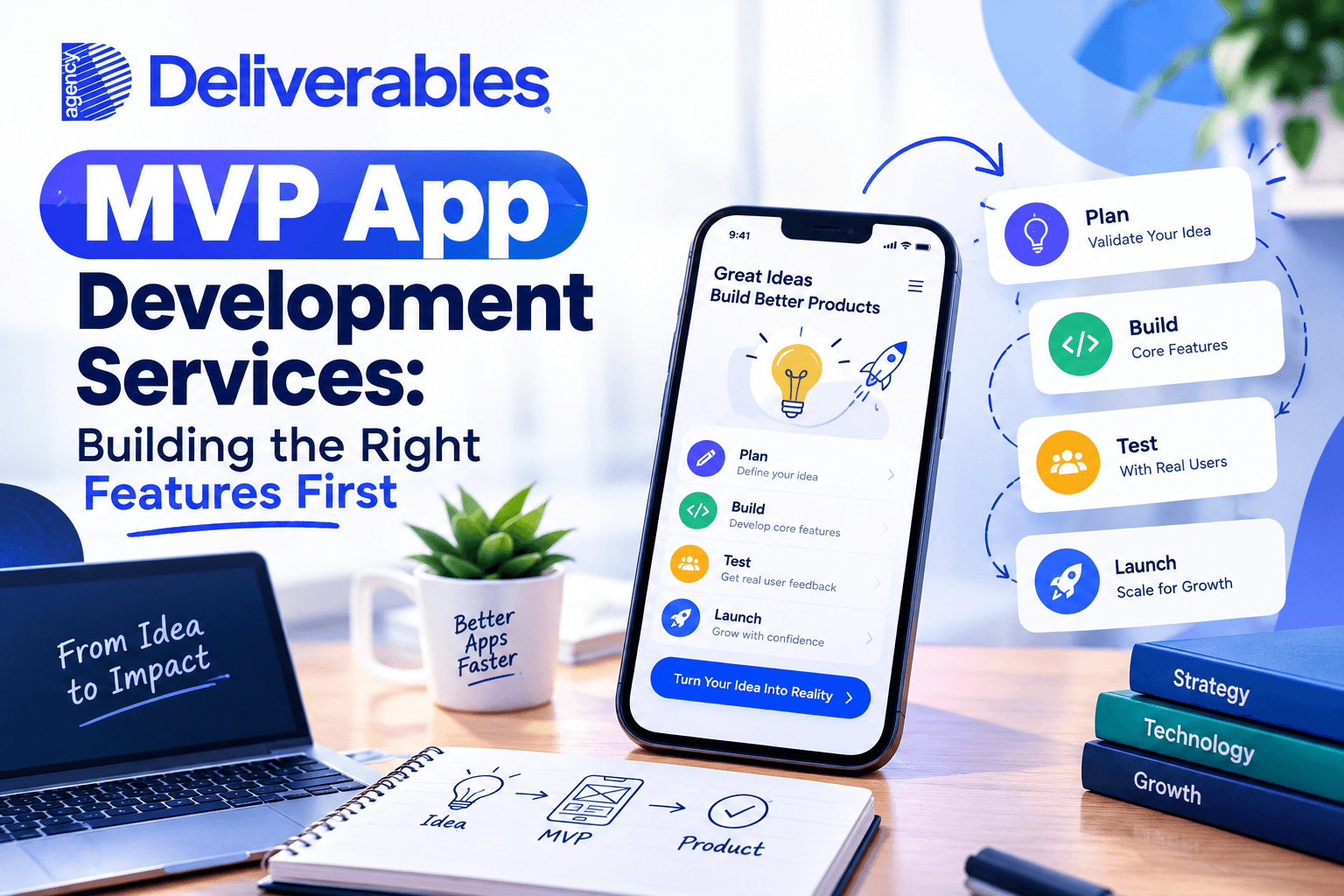
MVP App Development Services: Building the Right Features First
A new app usually starts with a simple idea. As the idea develops, more features are added, the product becomes more complex, and the original launch plan can quickly turn into a much bigger project. For startups and businesses, this can mean higher development costs and a longer wait before real users can try the product.
MVP App Development Services (https://deliverable.agency/services/mvp-development) offer a practical way to avoid this problem. Instead of building every planned feature at the beginning, the development process focuses on the functions that are most important to the product's purpose. The first version can then be launched, tested with users, and improved based on real feedback.
Building the right features first does not mean creating a low-quality app. It means understanding what the product actually needs at its initial stage and using resources where they can provide the most value.
What Is an MVP App?
An MVP, or Minimum Viable Product, is an initial version of an application that includes the core functionality required to solve a specific user problem.
The idea is straightforward: build enough of the product to make it useful, release it to a suitable audience, and learn from the experience.
For example, consider a startup planning a grocery delivery application. A complete application might eventually include personalized recommendations, loyalty rewards, advanced analytics, multiple delivery options, subscriptions, and promotional tools.
The first version may only need customer registration, product browsing, cart management, checkout, payment, and order tracking.
Those core functions allow the business to test whether customers actually want the service before investing in additional features.
Why Features Should Be Prioritized
Feature prioritization is one of the most important parts of MVP development.
Businesses often have a long list of ideas for their applications. Some features may be useful in the future, while others may be essential from the beginning.
Trying to develop everything at once can create unnecessary complexity. It can also make it harder to understand which parts of the product are actually responsible for user value.
A focused MVP keeps attention on the main problem the application is designed to solve.
Before development starts, the team should ask:
What problem does the app solve?
Who is the target user?
What action should users be able to complete?
Which features are required for that action?
Which features can be introduced later?
What does the business need to learn from the first release?
The answers help create a realistic feature roadmap.
Start With the User Problem
The best MVPs are built around a clear user problem rather than a long feature list.
Suppose a business wants to create an appointment booking app. The main purpose may be allowing users to find available services and reserve a time slot.
The essential features could include:
Account creation
Service listings
Availability
Appointment booking
Notifications
Basic payment functionality
Features such as advanced loyalty programs or AI recommendations might be useful later, but they may not be necessary to test the core concept.
An experienced MVP App Development Company can help businesses separate essential functionality from features that can wait for later releases.
Define the Core User Journey
Once the main problem is clear, the next step is to map the user journey.
Think about what a user needs to do from the moment they open the application until they complete the main task.
For a food ordering app, the journey could look like:
Open app → create account → browse restaurants → select food → add to cart → pay → receive order updates.
Every screen and function in the MVP should support this journey.
This approach helps remove unnecessary steps and keeps the product easy to understand.
It also gives developers and designers a clear structure to work with.
Separate Essential and Future Features
A useful way to prioritize features is to divide them into different groups.
Essential features are required for the product to work.
Important features can improve the experience but may not be necessary for the first release.
Future features can be considered after the MVP has been tested.
For example, an e-commerce MVP may require product listings, search, cart, checkout, and order management. Advanced product recommendations, customer loyalty programs, and detailed analytics could be added later.
This does not mean future features should be ignored. They can be included in the product roadmap while keeping the first release focused.
Design a Simple User Experience
Good design is important even when the product is an MVP.
Users should be able to understand the application's purpose without spending time figuring out how it works.
During the design stage, the team can create wireframes, user flows, prototypes, and final UI designs.
The focus should be on:
Clear navigation
Simple layouts
Consistent design elements
Easy-to-understand actions
Mobile-friendly interactions
Smooth movement between screens
A simple interface can also make user feedback easier to interpret because users are interacting with a focused product.
Select Technology Based on the Product
Technology choices should support the product rather than drive the product.
Depending on the requirements, an application may be developed using native technologies or cross-platform frameworks. The backend may use different programming languages, databases, APIs, and cloud services.
The right approach depends on factors such as:
Application complexity
Performance requirements
Target platforms
Development budget
Expected user volume
Security requirements
Future expansion
Professional MVP App Development Services should include technology planning as part of the overall development strategy.
The development team should be able to explain the reasons behind its technology recommendations instead of simply selecting tools because they are currently popular.
Build in Small, Manageable Stages
MVP development does not have to happen as one large process.
Breaking development into smaller stages can make the project easier to manage.
The team can complete the basic structure first, add core functionality, integrate required services, and then test individual components.
Regular reviews can help identify changes before they affect larger parts of the application.
This approach also gives business owners a better understanding of how the product is progressing.
Test the Core Features
An MVP may contain fewer features than a full product, but the features it does contain should work properly.
Testing should cover important user actions and common usage scenarios.
Developers and testers can check:
Registration and login
Navigation
Forms
Payments
Notifications
API integrations
Data handling
Application performance
Different devices and screen sizes
Finding issues before launch can prevent avoidable problems for early users.
The purpose of testing is not only to remove bugs. It is also to make sure that the main user journey works as expected.
Launch and Collect Feedback
Once the core product is ready, the MVP can be introduced to a selected audience.
The first launch should be treated as a learning stage.
Businesses can monitor user behavior, collect feedback, review support requests, and identify areas where users face difficulties.
For example, users may repeatedly ask for a particular feature, stop using the app at a specific step, or prefer a different way of completing an action.
These observations can help the business decide what should be improved next.
Use Feedback to Plan the Next Version
The development process does not end when the MVP is launched.
The information collected from users can be used to create the next development roadmap.
Some features may become higher priorities, while others may be removed from the plan.
This is one of the main advantages of an MVP approach. Product decisions can be based on actual user experiences instead of assumptions alone.
Over time, the MVP can develop into a more complete application with additional features, integrations, automation, and improved functionality.
Benefits of MVP App Development Services
Businesses use MVP App Development Services for several practical reasons.
A focused MVP can help reduce unnecessary initial development, provide an opportunity to test a business idea, and create a working product for early users.
It can also help teams identify technical and usability challenges earlier.
For startups, an MVP can provide a tangible product that can be demonstrated to potential customers, partners, or investors.
However, the exact benefits depend on the product, market, and development strategy. An MVP should be planned around a specific goal rather than treated as a standard template for every application.
Working With Deliverables Agency
Deliverables Agency (https://deliverable.agency/) is a software and AI development company offering digital product development services for startups, SMEs, and enterprises.
Its services include MVP development, app development, AI development, AI chatbot development, generative AI, no-code development, and UI/UX design.
For businesses with a new app idea, the MVP development process can cover important stages such as requirement analysis, feature planning, UI/UX design, development, testing, deployment, and future improvements.
A focused approach allows businesses to start with the most important product functions and use feedback to guide later development.
When evaluating an MVP Development Company, businesses can consider factors such as technical expertise, development experience, communication, design capabilities, testing practices, and post-launch support.
How to Build the Right MVP Feature Set
Before starting development, create a simple feature plan.
Start by identifying the primary user problem. Then define the main action users need to complete. List the features required to support that action and remove anything that is not necessary for the first release.
Next, organize the remaining features into the first version and future roadmap.
This process can prevent scope from expanding unnecessarily during development.
It also gives the development team a clear understanding of what needs to be built first.
Final Thoughts
Building an MVP is not about creating the smallest possible application. It is about creating the right first version of a product.
MVP App Development Services help businesses focus on essential functionality, create a usable product, launch it to real users, and learn from their experiences.
The most effective approach starts with a clear problem, prioritizes essential features, creates a simple user experience, selects suitable technology, and leaves room for future improvements.
Whether you are a startup testing a new concept or an established business exploring a new digital product, a focused MVP can provide a practical starting point for turning an idea into a real application.
Appreciate the creator