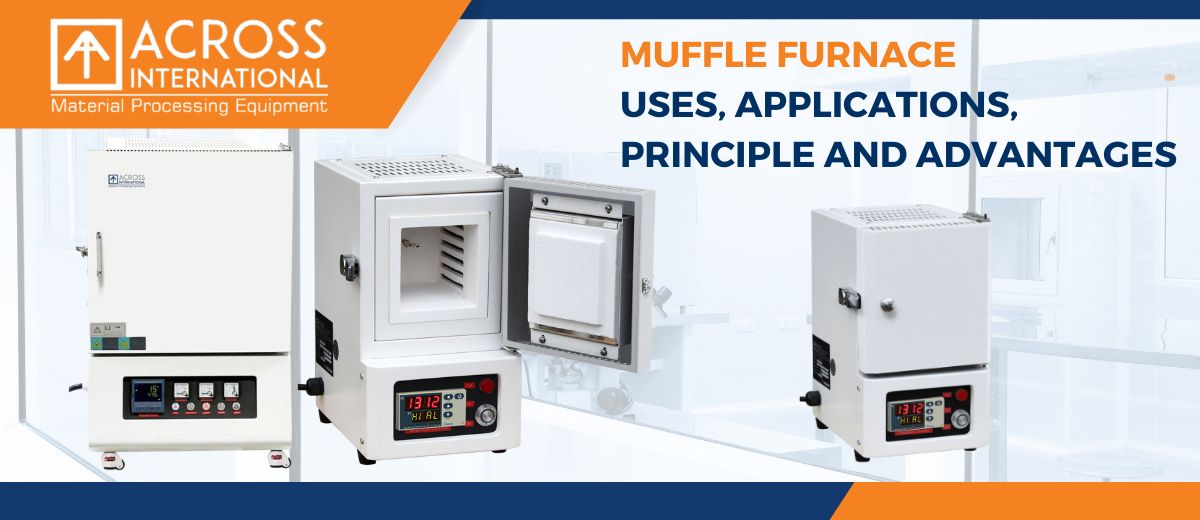
Muffle Furnace Uses, Applications, Principle and Advantages
What is a Muffle Furnace?
Muffle furnaces are a box type of heat treatment laboratory furnaces designed to change the physical and chemical properties of samples at very high temperatures. They are designed to isolate the material being processed from direct contact with heating elements providing uniform heating. The word “muffle” is defined as an insulated chamber which encloses the sample, and keeps it separate from the heating element.
Muffles are made from high-quality ceramic materials such as alumina or silicon carbide, which are capable of withstanding extreme temperatures and chemical reactions. Based on the process of producing heat, furnaces are divided into two categories such as combustion and electric types. In combustion types of furnaces, heat energy is directly produced by the burning of fuel whereas heat is produced by electrical power in electric types of furnaces. Recent years, electric muffle furnaces have been widely used over combustion type muffle furnaces due to safety, performance, and environmental concern. Muffle furnaces are widely used in research laboratories and small industries, from metallurgy to ceramic applications.
Electric Muffle Furnaces
Electric muffle furnaces are laboratory heating devices designed to achieve high temperatures and isolate the sample from direct contact with the heating element. This isolation assures a clean and controlled environment, making muffle furnaces crucial for such an application where a precise thermal condition is needed. Modern electrical muffle furnaces heat by convection, conduction or blackbody radiation process.
What are the Types of Electric Muffle Furnaces?
Electric muffle furnaces are categorized into various types such as tube furnaces, box furnaces, etc.,
Box Furnaces: Box Furnaces are the most commonly used furnaces due to their versatility and ease of use. The box furnaces are primarily used in small to medium sized industries and research laboratories. The common purposes of the electric box furnaces are annealing, sintering, and ashing.
Tube furnaces: Tube furnaces are designed for continuous processing in situations where a high temperature environment is needed. Such furnaces are particularly famous in the material science and chemical industries. The common purposes for tube furnaces are calcination, thermal desorption, and catalyst research.
Significant Characteristics/Features of Electric Muffle Furnaces
Muffle chamber: The chamber is well insulated and designed to isolate the sample and the heating element. This ensures the controlled heat transfer via radiation and convection and prevents direct contact between the sample and the heating element.
Heating elements: Uses resistance-based heaters such as Kanthal (≤1,200 °C), silicon carbide and molybdenum di-silicide (1400–1800 °C) ensures uniform heating.
Read here more about Muffle Furnace Uses, Applications, Principle and Advantages
Appreciate the creator