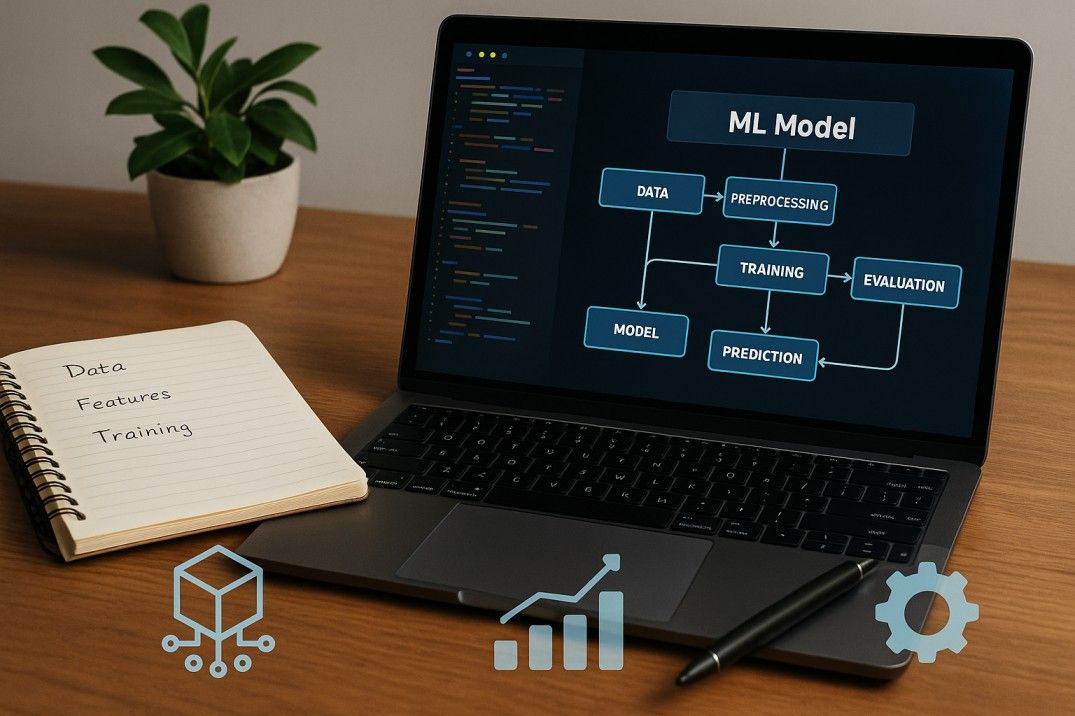
ML Model Engineering Services: What to Expect & How It Works
Modern AI systems don’t succeed because of clever algorithms alone—they succeed because of disciplined ML Model Engineering. As organizations scale their AI initiatives, the challenge is no longer building models; it’s operationalising them with predictable accuracy, reliability, and cost-efficiency. The days of “train a model and ship it” are over. Today, enterprises need structured processes, cross-functional collaboration, and engineering rigor to make machine learning reproducible.
This article explores ML Model Engineering in a practical, deeply technical, yet accessible way. It explains how professional Machine Learning Development, MLOps Consulting, and Generative AI Development services transform a collection of data experiments into enterprise-ready AI systems.
What Is ML Model Engineering? A Practical Understanding
ML Model Engineering is the disciplined process of designing, training, optimizing, validating, deploying, and maintaining machine learning models for real-world production environments. It ensures models deliver measurable value rather than staying stuck in Jupyter notebooks.
Instead of focusing only on algorithms, model engineering emphasizes reproducibility, lifecycle management, risk mitigation, and continuous performance improvement. It bridges the gap between data science experiments and software engineering principles.
In most organizations, this function sits between data scientists, application developers, and DevOps teams, ensuring that ML workflows obey the same engineering rigor as any modern CI/CD pipeline.
Why ML Model Engineering Matters More Than Ever
Enterprises now use ML across critical domains—fraud detection, supply chain predictions, pricing optimization, healthcare diagnosis, and customer behavior forecasting. This creates two major challenges: complexity and scale.
A model trained in an experiment may perform well on a dataset but degrade dramatically in production due to data drift, user behavior changes, or integration issues. A 2024 Gartner survey showed that over 50% of ML models fail to reach production, and those that do often lack monitoring or governance.
ML Model Engineering solves this by implementing:
Standardized workflows
Continuous monitoring
Automated retraining
Versioning controls
Deployment reliability
Governance and compliance
Organizations that adopt structured ML engineering reduce deployment time by up to 40% and improve model reliability by 30–50%, according to McKinsey research.
How ML Model Engineering Differs From Data Science
Many companies confuse data science with ML engineering. They overlap but serve different purposes.
Data scientists explore data, build hypotheses, and experiment with models. ML engineers take those outputs and make them work at scale efficiently, safely, and repeatedly.
A data scientist may evaluate algorithms; an ML engineer ensures that the chosen algorithm integrates with real business workflows and can be deployed with a predictable performance.
In enterprise AI teams, data scientists answer:
“What model works best?”
ML engineers answer:
“How do we make it work consistently in production?”
Without ML engineering, even the best model risks failure.
What You Can Expect from ML Model Engineering Services
When you work with a team offering ML Model Engineering Services, you’re not just getting model optimization; you’re getting end-to-end lifecycle management. The process is systematic, predictable, and rooted in engineering excellence.
Below is a comprehensive, narrative walkthrough of what a typical engagement includes.
Step-by-Step Breakdown: How ML Model Engineering Works
Requirements, Objectives, and Feasibility Assessment
The process begins with an in-depth evaluation of the business goal. A successful ML system must connect data sources, model capabilities, product requirements, and accuracy expectations. This stage clarifies what success looks like in measurable terms—accuracy thresholds, latency limits, fairness guidelines, and system constraints.
Teams also assess feasibility. Some ideas fail because the required data does not exist or is too noisy. Others require hybrid machine learning and generative AI capabilities. A good assessment prevents resource waste and sets realistic expectations.
Data Audit and Collection Strategy
ML models rely heavily on the quality and diversity of the underlying data. Model engineering teams analyze your existing datasets for completeness, representativeness, bias, and historical range. They also determine whether additional data collection is required.
Instead of dumping data into a pipeline, engineers design a systematic data strategy—deciding what needs to be collected, how frequently, at what granularity, and under what governance controls. This ensures long-term reliability of the ML system.
Data Engineering, Transformation & Feature Pipelines
Raw data is rarely production-ready. ML engineers design robust data pipelines that clean, normalize, validate, and transform data into usable features. Automated feature pipelines ensure consistency: the same logic used during training is reproduced exactly in production.
This includes handling missing values, building feature stores, encoding variables, managing time-based windows, and applying normalization strategies. For large enterprises, feature stores ensure teams don’t rebuild identical features repeatedly they reuse them efficiently.
Model Design, Architecture & Optimisation
Once data is ready, the engineering team works with data scientists to identify the right modeling approach. This can include classical machine learning, deep learning, reinforcement learning, or even hybrid generative AI systems.
Unlike data science experiments, ML engineers architect models for:
latency
scalability
memory efficiency
deployment constraints
inference cost optimization
For example, a fraud detection model operating at 200 ms latency cannot afford computationally expensive layers. ML engineers focus on pruning, quantization, distillation, and hyperparameter optimization to make models production-ready without sacrificing critical accuracy.
Model Validation, Bias Detection & Stress Testing
Before any deployment, validation is essential. ML engineers test models under a variety of real and synthetic conditions to ensure they behave reliably. This includes:
testing on unseen data distributions
adversarial scenarios
fairness evaluations
domain-specific sensitivity tests
calibration assessments
Stress testing often reveals edge cases such as seasonal anomalies, missing values, API delays, or sudden behavior shifts. Reliable ML systems are built by removing failure points before real deployment.
Deployment Architecture, CI/CD & Integration
Model deployment is not simply “pushing the model to production.” ML engineers design inference architecture, containerize models, and integrate them with existing business systems. They collaborate with DevOps teams to build automated CI/CD workflows, ensuring new versions are deployed safely.
Deployment strategies vary based on business requirements:
batch inference for large datasets
real-time APIs for customer-facing systems
streaming analytics for IoT devices
edge deployments for low-latency environments
Reliable deployment is essential for ML systems to support real users.
Monitoring, Drift Detection & Performance Management
Once the model is running, the real work begins. Data drift, concept drift, and user behavior changes can degrade model accuracy significantly. Without monitoring, enterprises risk financial losses, incorrect decisions, or damaged customer trust.
ML Model Engineering includes building monitoring dashboards for:
model accuracy
data distribution
latency and throughput
anomalous inputs
fairness metrics
model explainability
Alerting systems notify teams when performance thresholds are violated. Automated retraining pipelines may trigger re-learning to restore accuracy. These mechanisms transform ML systems from static assets into continuously improving intelligence layers.
Governance, Compliance & Security
Modern machine learning must obey strict governance. Depending on your industry, you may need to ensure GDPR compliance, audit trails, lineage tracking, reproducibility, and explainability.
ML engineers build governance processes such as access controls, encryption standards, versioning frameworks, and audit logs.
This ensures that the ML system is not only accurate but also safe, compliant, and accountable—critical for regulated industries like banking, healthcare, and insurance.
How MLOps Consulting Strengthens ML Model Engineering
MLOps Consulting acts as the backbone of professional ML Model Engineering. It brings DevOps-style automation and reliability to ML lifecycle management. Without MLOps, models remain experimental; with it, they become operational assets.
MLOps improves:
deployment reliability
release cycle frequency
automated testing and model validation
data versioning and pipeline consistency
system observability
Modern ML systems require automated pipelines to scale. MLOps ensures that models evolve safely and efficiently.
The Role of Generative AI in Modern ML Engineering
Generative AI is transforming how ML models are engineered. Instead of building models from scratch, organizations increasingly integrate generative components—language models, vision transformers, recommendation models—into their ecosystems.
ML Model Engineering teams ensure generative models are:
fine-tuned
governed
customized for domain-specific performance
optimized for inference cost
The introduction of large language models (LLMs) also expands use cases in documentation generation, data augmentation, synthetic data generation, and interactive pipelines.
Real-World Use Cases That Rely on ML Model Engineering
ML Model Engineering powers mission-critical applications across industries, including:
real-time fraud detection engines
demand-supply forecasting
predictive maintenance for manufacturing
credit scoring models
personalized content recommendations
healthcare diagnosis prediction
pricing optimization engines
In all these cases, the value comes from reliable deployment, not experimentation. Well-engineered ML models help businesses reduce operational costs, improve accuracy, and gain a competitive edge based on predictive intelligence.
Challenges ML Model Engineering Helps Organizations Solve
Enterprises adopting ML face common bottlenecks:
inconsistent training workflows
fragmented data pipelines
slow deployment cycles
model decay and accuracy degradation
unpredictable inference costs
compliance and governance gaps
ML Model Engineering systematically removes these barriers, enabling stable, scalable, and auditable ML systems.
Choosing the Right ML Model Engineering Partner
Selecting an ML engineering partner is often the difference between success and costly failure. The right team should have expertise in Machine Learning Development, MLOps, model optimization, cloud infrastructure, and Generative AI Development. They must understand business context as much as technical architecture.
An ideal partner brings:
cross-functional engineering expertise
proven production deployment experience
strong documentation practices
post-deployment monitoring and support
security and compliance proficiency
A partner that understands both experimentation and engineering helps organizations accelerate AI adoption safely.
Conclusion: ML Model Engineering Is the Future of Scalable AI
ML Model Engineering is no longer optional. As AI becomes embedded in the core of business operations, the systems powering it must be stable, explainable, continuously improving, and secure. Enterprises that invest in structured machine learning engineering combined with strong MLOps Consulting and Generative AI Development are positioned to scale efficiently and innovate faster.
In the rapidly evolving AI ecosystem, model engineering bridges the gap between experimentation and real-world value, ensuring that machine learning doesn’t stay in the lab but becomes a reliable engine for business growth.
Appreciate the creator