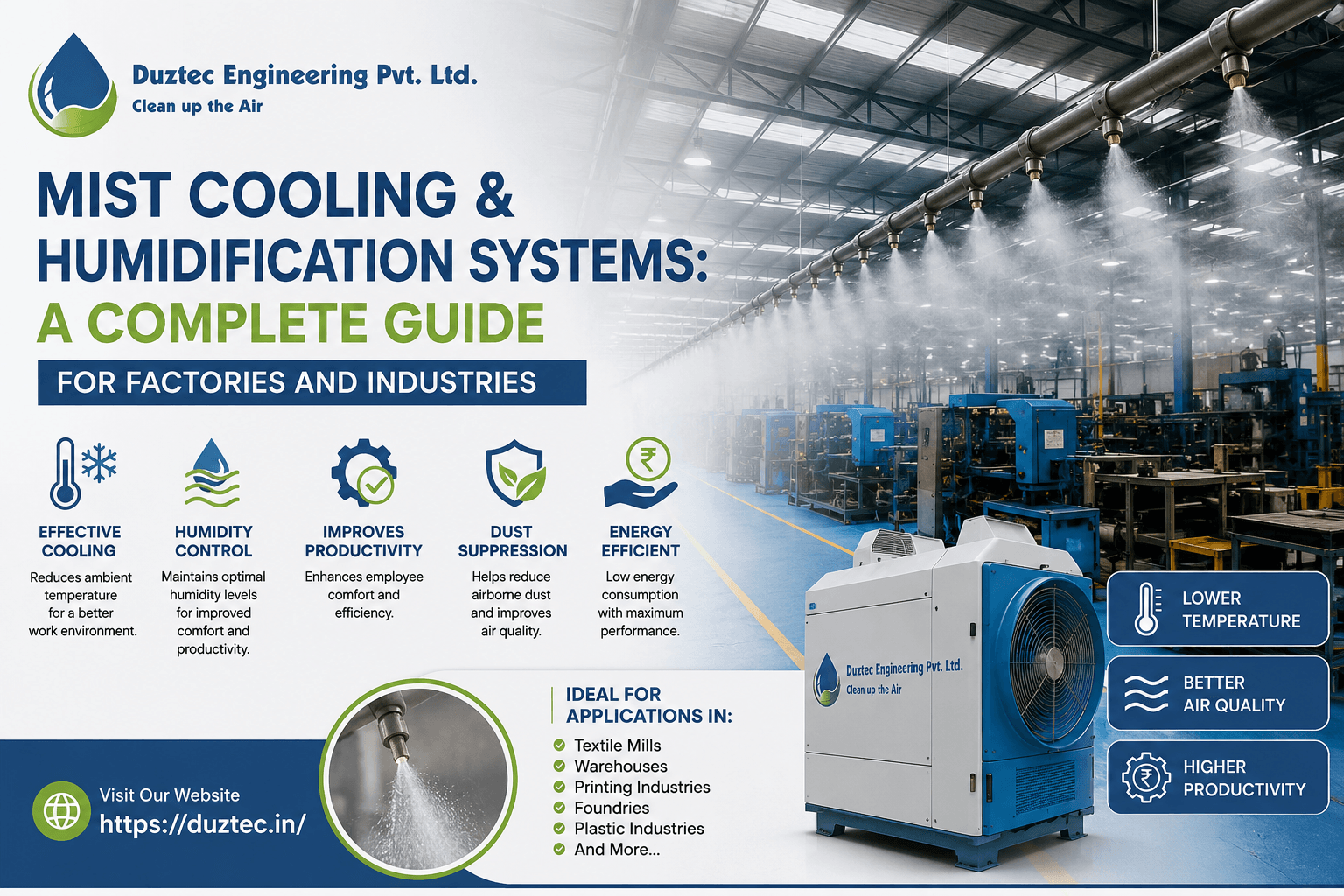
Mist Cooling & Humidification Systems: A Complete Guide for Factories and Industries
Factories and industrial facilities often face two closely connected environmental challenges: excessive heat and uncontrolled humidity. High temperatures can make workspaces uncomfortable, affect equipment performance, and create difficult operating conditions. At the same time, excessively dry air can impact sensitive processes, materials, and indoor environmental conditions.
This is where mist cooling and humidification systems (https://duztec.in/product-detail/cooling-and-humidification) can play an important role.
By using finely atomized water droplets, modern mist cooling systems (https://duztec.in/product-detail/cooling-and-humidification) can help reduce ambient temperatures while adding controlled moisture to the air where required. Depending on the application, these systems can be used across manufacturing plants, warehouses, production areas, outdoor industrial zones, and other commercial environments.
In this guide, we explore how mist cooling and humidification systems work, their benefits, applications, and how businesses can choose the right solution for their facility.
What Is a Mist Cooling System?
A mist cooling system uses water that is broken into very fine droplets and dispersed through specialized nozzles. When these droplets come into contact with warm air, they absorb heat as they evaporate, creating an evaporative cooling effect.
Unlike conventional cooling approaches that rely primarily on refrigerants or large mechanical systems, mist cooling focuses on cooling the surrounding air through controlled water evaporation.
Depending on the system design, misting can be used for:
Factory and production areas
Industrial yards
Warehouses
Manufacturing facilities
Worker comfort zones
Outdoor process areas
Heat-intensive industrial environments
A well-designed industrial misting system (https://duztec.in/product-detail/fog-cannon) can help create more manageable thermal conditions while using water efficiently.
How Does Mist Cooling Work?
The basic principle behind mist cooling is relatively simple.
Water is supplied to the system and delivered through fine mist nozzles. These nozzles atomize the water into extremely small droplets. When the droplets enter warm air, they begin to evaporate.
The evaporation process consumes heat from the surrounding air, which can lower the perceived or ambient temperature in the treated area.
The effectiveness of a water mist cooling system depends on several factors, including:
Ambient temperature
Relative humidity
Droplet size
Air movement
Water quality
Nozzle pressure
System design
Application area
This is why industrial applications require more than simply installing a set of misting nozzles. The system needs to be designed around the facility's environmental and operational requirements.
What Is an Industrial Humidification System?
An industrial humidification system (https://duztec.in/blog-details/understanding-the-need-for-cooling-and-humidification-systems) is designed to introduce controlled moisture into the air to maintain an appropriate level of relative humidity.
In industrial environments, humidity control can be important for process stability, material handling, product quality, and overall environmental conditions.
An industrial humidification solution may be used where dry air creates operational challenges, particularly in facilities dealing with sensitive materials or processes.
Depending on the application, humidification may be relevant in:
Manufacturing facilities
Warehouses
Pharmaceutical environments
Laboratories
Textile facilities
Food processing areas
Clean and controlled environments
The objective is not simply to increase humidity, but to maintain humidity within a suitable operating range.
Mist Cooling vs. Humidification: What's the Difference?
Although mist cooling and humidification (https://duztec.in/blog-details/understanding-the-need-for-cooling-and-humidification-systems) may use similar technologies, their primary objectives can be different.
Mist Cooling
Humidification
Primarily focused on reducing heat
Primarily focused on managing humidity
Uses evaporative cooling
Adds controlled moisture to the air
Useful in hot environments
Useful in dry environments
Helps improve thermal comfort
Helps maintain environmental conditions
Common in factories and industrial yards
Common in process-sensitive environments
Some advanced systems can address both temperature and humidity requirements, making them suitable for facilities where environmental control needs to be managed more precisely.
Why Do Factories Need Cooling and Humidity Control?
Industrial facilities can experience significant heat gains from machinery, production processes, boilers, furnaces, roofs, and outdoor exposure.
A poor thermal environment may contribute to:
1. Worker Discomfort
Excessive heat can make industrial work areas uncomfortable. Cooling solutions can help improve the working environment, particularly around heat-intensive operations.
2. Heat Stress Management
In hot industrial environments, controlling surrounding conditions can be an important component of a broader workplace heat-management strategy.
3. Process Requirements
Some manufacturing processes require relatively stable environmental conditions. Uncontrolled temperature or humidity may affect process consistency.
4. Material Handling
Certain materials can respond differently to changes in humidity. Controlled humidification can help maintain more suitable environmental conditions where required.
5. Equipment Environment
Industrial equipment operates within specific environmental conditions. Proper environmental management can support more suitable operating surroundings.
Key Benefits of Industrial Mist Cooling Systems
Efficient Cooling
Fine mist cooling uses the principle of evaporative cooling to reduce heat in suitable environments.
Large-Area Cooling
Misting technology can be designed to cover large production areas, factory yards, and industrial spaces without requiring conventional room-by-room cooling.
Water-Efficient Operation
Properly engineered misting systems can deliver controlled quantities of water through specialized nozzles, helping optimize water usage.
Flexible Installation
Depending on the application, systems can be installed as fixed installations or integrated into purpose-built industrial cooling arrangements.
Improved Thermal Comfort
By reducing surrounding heat in appropriate environments, mist cooling can help create a more comfortable workspace.
Applications of Mist Cooling and Humidification Systems
Different industries have different environmental requirements. Some of the common applications include:
Manufacturing Plants
Manufacturing facilities can experience substantial heat from equipment and production processes. An industrial cooling system can be used to address localized or large-area heat buildup.
Factory Yards and Outdoor Areas
Outdoor working zones can be difficult to cool using conventional air-conditioning systems. A factory cooling system based on misting can provide targeted evaporative cooling.
Warehouses
Large warehouses can experience heat accumulation, particularly in summer. Depending on the operating conditions, mist cooling may support temperature management in selected areas.
Textile Industry
Humidity can be an important environmental factor in textile-related processes. An industrial humidification system can help maintain more consistent humidity where process requirements call for it.
Pharmaceutical Facilities
Pharmaceutical environments may require controlled temperature and humidity conditions depending on the process and area. Humidification can form part of a broader environmental control strategy.
Laboratories and Controlled Environments
Laboratories may require carefully managed environmental conditions. The right humidification solution can support those requirements when specified appropriately.
Heat-Intensive Industrial Areas
Facilities involving high-temperature machinery or processes can use industrial cooling systems to help manage surrounding heat.
What Is an Industrial Misting System?
An industrial misting system (https://duztec.in/product-detail/cooling-and-humidification) is a purpose-designed misting solution developed for demanding industrial environments.
Unlike basic consumer misting solutions, industrial systems need to account for factors such as:
Operating area
Water pressure
Nozzle configuration
Droplet characteristics
Pump requirements
Automation
Environmental conditions
Maintenance requirements
The system should therefore be engineered around the facility rather than selected solely on equipment specifications.
High-Pressure Misting vs. Conventional Misting
A high-pressure misting system (https://duztec.in/product-detail/high-pressure-dust-suppression-hpds) uses higher water pressure to produce finer droplets through specialized misting nozzles.
Smaller droplets can evaporate more readily under suitable environmental conditions, making high-pressure misting useful in applications where effective evaporative cooling is required.
However, system performance depends on more than pressure alone. Proper nozzle selection, water quality, layout, airflow, and climatic conditions all influence results.
Factors to Consider Before Choosing a Mist Cooling System
Choosing the right system starts with understanding the site.
Area to Be Cooled
Determine whether you need localized cooling, production-area cooling, or coverage across a larger industrial zone.
Ambient Conditions
Temperature and relative humidity directly affect evaporative cooling performance.
Water Quality
Water quality can influence nozzle performance, maintenance requirements, and system longevity.
Required Cooling Level
The expected temperature reduction and operational objective should be clearly defined before system selection.
Installation Environment
Indoor, semi-open, and outdoor environments may require different configurations.
Automation Requirements
Automated controls can help regulate misting based on operating conditions and predefined parameters.
Maintenance
Nozzles, pumps, filters, pipelines, and other components should be accessible for regular inspection and maintenance.
Mist Cooling and Humidification: Is One System Enough?
Not every facility has the same requirements.
Some environments primarily need mist cooling, while others need humidity control. Certain industrial applications may require both.
For example, a hot manufacturing area may prioritize cooling, while a process-sensitive environment may prioritize maintaining a specific humidity range.
The right approach is to assess:
Temperature + Relative Humidity + Process Requirements + Space + Application
before deciding on the system configuration.
Mist Cooling vs. Air Conditioning for Industrial Facilities
Traditional air-conditioning can be highly effective in enclosed spaces, but cooling very large or semi-open industrial areas through conventional AC systems may be challenging and energy-intensive.
Mist cooling can be considered where:
The area is large
The space is semi-open or open
Localized cooling is required
Evaporative cooling conditions are favorable
Conventional air conditioning is impractical
This does not mean mist cooling universally replaces air conditioning. Instead, it can serve as an alternative or complementary industrial cooling solution, depending on site conditions.
Why Proper System Design Matters
Installing a misting system without evaluating the site can lead to inconsistent performance.
A professional system design should consider:
Water source → Filtration → Pumping → Pressure → Nozzles → Droplet size → Layout → Airflow → Control
Every stage affects the overall performance of the solution.
A well-designed industrial humidification system similarly needs to account for the desired humidity range, application area, air movement, control strategy, and process requirements.
Duztec Cooling & Humidification Solutions
Duztec's Precision Cooling & Humidification solutions are designed for industrial and commercial environments where temperature and humidity need to be managed through controlled misting technology.
The solution can be considered across applications where industrial cooling, humidity control, and environmental management are important.
By combining appropriate misting technology with application-specific system design, Duztec aims to provide practical solutions for challenging industrial environments.
Final Thoughts
Industrial facilities increasingly need solutions that can address heat, humidity, worker comfort, and environmental control without relying solely on conventional cooling methods.
A properly designed mist cooling system can help manage heat through evaporative cooling, while an industrial humidification system can help maintain suitable humidity conditions where dry air creates operational challenges.
The key is choosing a solution based on the facility's actual requirements rather than simply selecting a standard misting product.
For factories, manufacturing plants, warehouses, and other industrial environments, the right combination of mist cooling, humidification, and environmental control can contribute to a more suitable and manageable working environment.
Frequently Asked Questions
What is a mist cooling system?
A mist cooling system atomizes water into fine droplets that evaporate in warm air, helping reduce surrounding heat through evaporative cooling.
What is an industrial humidification system?
It is a system designed to add controlled moisture to industrial air environments to maintain a suitable relative humidity level.
Where can industrial misting systems be used?
Industrial misting systems can be used in factories, production areas, warehouses, outdoor yards, and other environments where cooling or humidity control is required.
Does mist cooling work in every climate?
Mist cooling performance depends significantly on ambient temperature and relative humidity. It is generally more effective when the surrounding air has sufficient capacity to absorb additional moisture.
Can mist cooling and humidification be used together?
Yes. Depending on the application, a system can be designed to address both cooling and humidity requirements, provided the desired environmental conditions are properly defined.
Appreciate the creator