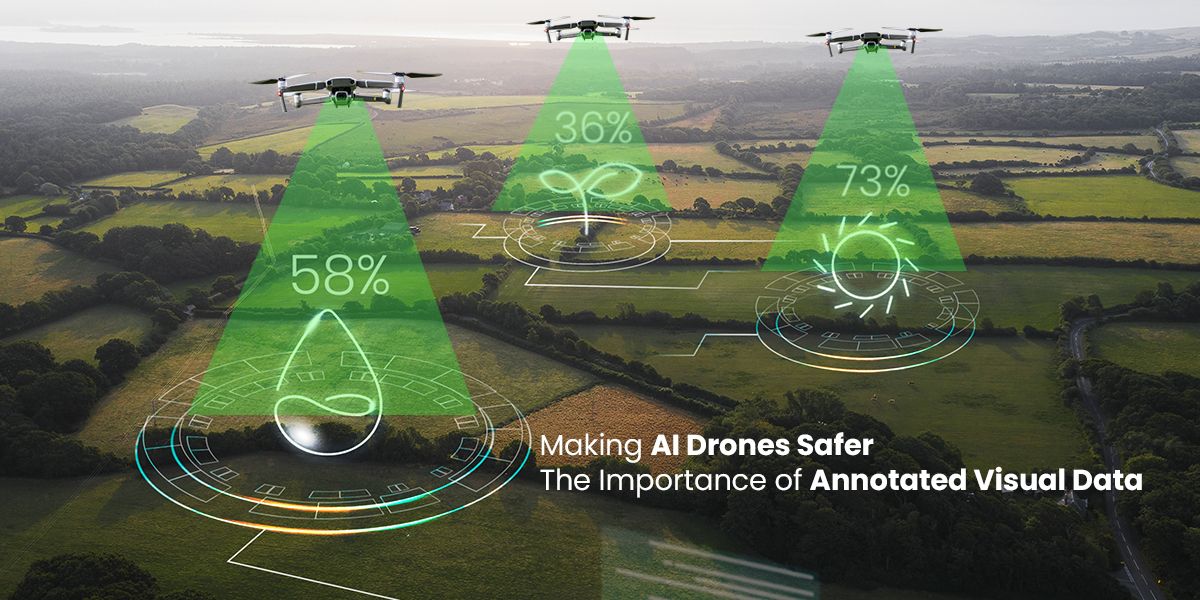
Making AI Drones Safer: The Importance of Annotated Visual Data
Autonomous aerial systems, such as drones skimming above crop fields or planes inspecting infrastructure at scale, are redefining operational efficiency across industries. Yet their ability to perceive, interpret, and act in real time requires interpretation of sensor data to operate in any environment. To make drones truly autonomous, they need to safely perform three essential functions, beyond their predefined route:
Taking off and landing without a runway
Detecting obstacles (like vehicles, buildings)
Altering course to manage unpredictable situations (like a fleet of birds, engine failures, and obstacles)
This level of autonomy requires sensors, advanced software, and artificial intelligence (AI) systems that continually perceive risky situations, plan a safe motion path, and execute those motions. These systems must also be smart enough to decipher the difference between buildings, wind gusts, and other aircraft in any weather condition.
It’s the annotated image data behind the algorithms that shapes this intelligence in identifying structural anomalies and tracking environmental changes. Every decision hinges on training datasets enriched with context. Raw images mean nothing to a machine until they’re labeled precisely.
This implies that the drone data needs detailed annotation for AI algorithms to make swift decisions because machines don’t get that smart on their own; they require annotated image data.
In this blog post, the need for annotated aerial imagery to power autonomous drones and safely navigate complex airspace will be explored. We will also examine how effective image annotation is for drones in identifying power lines, birds, no-fly zones, and dynamic flight paths.
Supporting Drone Technology with Image Annotation
To navigate safely and autonomously, drones must recognize and distinguish between objects like cranes, workers, vehicles, roadblocks, powerlines, trees, and even temporary changes like scaffolding or traffic congestion. Image annotation helps autonomous aircraft perceive these objects for safely observing dense forests, crowded construction sites, or rapidly changing urban landscapes.
Aerial image annotation services offered by data labeling companies support the development of drones. In other words, the reliability of fully autonomous flight depends on how well the AI algorithms perceive its environment, which is achieved by tagging aerial images with detailed object information, defining what the drone is seeing, how far it is, how fast it’s moving, and the conditions under which they appear.
Even the most advanced algorithms risk misinterpreting the environment without quality annotation. Therefore, methods like bounding boxes, segmentation masks, keypoints, object trajectories, control commands, and corner-level annotation enable drones to recognize and respond to obstacles in real time.
Accurate Image Datasets For Computer Vision Models
Earlier, drones were only able to display what their cameras captured. Now, artificial intelligence and machine learning algorithms can perceive their surroundings in order to deliver the products at the customer’s doorstep, perform infrastructure inspection, precision agriculture, wildfire detection, and urban planning.
High-up drone shots do not mean much without proper annotation. Interpreting the aerial image data supports the development of next-gen AI drone systems that are safe. The datasets consist of annotating LiDAR, Radar, and other sensor data, a feat accomplished by subject-matter experts. Therefore, rather than doing it in-house, data scientists outsource training datasets that offer:
High-resolution, high-frequency visual data: These data are captured using RGB cameras mounted on drones. Annotation on these fine-grained image data is necessary for object detection and scene understanding, allowing machine learning models to extract meaningful patterns.
Inertial and motion capture data: Complementing visual inputs with accelerometer and gyroscopic data helps train computer vision systems to predict orientation and movement.
Control commands and flight telemetry: Annotating images of control inputs like throttle, pitch, yaw, and roll allows models to correlate visual input with behavioral response.
Environmental variation: Data collected in multiple light settings, weather conditions, and terrains serve various industries, each with distinct operational demands that require tailored image training datasets.
The emphasis on achieving quality image annotation required by data engineers is due to the complex nature of drone data (radar, LiDAR, cameras, sound, and infrared sensors) used to perceive the flying environment. Information from different sources must be interpreted accurately so that drones can navigate through every obstacle and weather condition. That is why outsourcing image datasets from expert data annotation providers is advisable.
Precision Image Training Datasets for Sector-specific Applications
Autonomous drone machines have benefits in various sectors, each conveying the need for tailored annotation solutions.
AI-Enabled Drone Applications
Artificial intelligence is used in drones to make flying machines smarter. In a way, they have advanced from capturing images to becoming autonomous entities capable of safe flight. For this to happen, they rely on annotated aerial images. For example, object detection and tracking powered by annotated datasets help drones avoid collisions, identify threats, or monitor resources.
Construction Progress Tracking
Drone technology makes it easy to observe end-to-end construction sites. When trained with structured image data, they can automatically detect changes in topography, addition or removal of objects, inventory management, or equipment relocation, giving relief to project managers with real-time tracking.
Construction Site Safety
Safety is paramount on construction sites, which means compliance with the rules regarding unauthorized zone entries and potential hazards. With human-annotated examples, computer vision systems can be trained to ensure safety by identifying whether workers are wearing helmets or vests and whether safety barriers are properly placed.
Asset Tracking
Annotated drone images help companies track expensive assets like excavators, generators, or cranes across large construction zones or remote industrial facilities. Well-structured drone data is a great way to assess the condition of assets. When paired with GPS and temporal metadata, it enables intelligent systems to locate, catalog, and monitor the status of equipment automatically.
Property Monitoring
Real estate developers, insurers, and property managers benefit from annotated aerial surveys. These datasets help AI models that assess roof damage, encroachment issues, infrastructure development, or vegetation overgrowth, enabling fast and accurate property evaluations.
Road Traffic Reporting
Urban planners and traffic controllers use drone footage, provided it is annotated with vehicle types, densities, and movement patterns, to understand congestion zones. Real-time traffic analysis powered by aerial AI training datasets helps reroute vehicles, identify illegal parking, or inform infrastructure upgrades.
Maintaining Data Integrity in Drone Systems Operating in Real Time
To operate effectively in real-time environments, autonomous drone systems must make quick decisions with minimal room for error. These decisions are only as reliable as the data powering them. Annotated image training data powers the algorithms to detect obstacles, assess distances, track movement, and navigate complex terrains. Inconsistent, incorrectly classified, or insufficient data used to train or evaluate these models may compromise performance and result in false positives, detours, or even crashes.
Maintaining integrity is another way annotation companies use as an assurance process, combining automated verification with human supervision. Additionally, scenario-based testing, redundant labeling, and cross-validation across datasets can help find and remove hidden discrepancies. Every annotation needs to be as accurate as possible to the real world, especially when drones are used in hazardous or dynamic areas.
Final Thoughts
In the future, aircraft will not be partially automated but fully autonomous. This ability to perceive and interpret real-world environments is derived from the datasets that train machine learning algorithms to sense, interpret, and react to the objects around them.
As aerial autonomy expands into new sectors, from logistics and environmental conservation to defense and smart cities, drone image annotation will be foundational to its success. Annotated training datasets are more than a training source for drones as they catalyze innovation in how AI systems see, learn, and act.
To unlock the power of AI-enabled drones, we must invest in developing task-specific image annotation datasets that reflect complex flying scenarios. Data annotation companies can provide quality image training datasets to AI developers aiming to build autonomous drone systems by defining clear, quantifiable benchmarks such as label accuracy, consistency rates, and annotation throughput. This collaboration can build robust drone technology where machines can fly autonomously and intelligently.
Appreciate the creator