Mahabharata vs Ramayana: What Makes Them Different
It is said in India that there is nothing in human existence which does not have a place in the Mahabharata.
Lord Rama is infinite, his qualities are also infinite and the extent of his stories is also limitless. Therefore, those whose thoughts are pure, they will not be surprised to hear this story.
Ramayana and Mahabharata in themselves are epics filled with immense knowledge, powerful characters and all sorts of “masalas” ranging from love, lust, hate, conviction, devotion, and duty.
Ramayana took place earlier than Mahabharata with many believing a difference of a “Yuga” between them. The both inspire readers to follow their duty or “Dharma” and be devoted towards the divine and their responsibilities.
However, in a subtle manner, there are some differences between the two that I find absolutely interesting:
1. Idealism vs Pragmatism

During Lord Rama’s era, the world was driven largely by values and ideals. The Ramayana portrays almost each character having a sort of ideals. From Bharata, who refuses to be the King of Ayodha to Ravana, who despite abducting Seeta doesn’t dishonor her, to Lord Rama, who is ready to give up the throne for his father’s words to Lakshmana, who accompanies his brother in the exile to Mata Seeta, the symbolism for an ideal wife, each character in Ramayana is driven by ideals.
On the other hand, Mahabharata depicts the decays of ideals to a certain extend in all characters apart from the Dharma raj Yudhishthira. Aswathama, the son of Guru Dhronacharya attacks the Pandava sons at midnight, Duryodhana and Dushashana humiliate Draupadi in the Kaurava court, Arjuna suspects his wife Chitrangana, and Draupadi too is believed to have insulted Duryodhana.
In the war of Kurukshettra too, Lord Krishna emphasizes more upon pragmatism and fulfilling one’s role, while during Rama’s era even the Ashuras are seen displaying a sense of morality.
The core idea during both Ramayana and Mahabharata was fulfilling one’s Dharma. But how characters define their own “Dharma” differed with many in Ramayana choosing “righteousness” while Pitamaha Bhisma, Karna and Arjun stressed upon “Dharma” as fulfilling one’s duty.
2. Karma Yoga Vs Bhakti Yoga
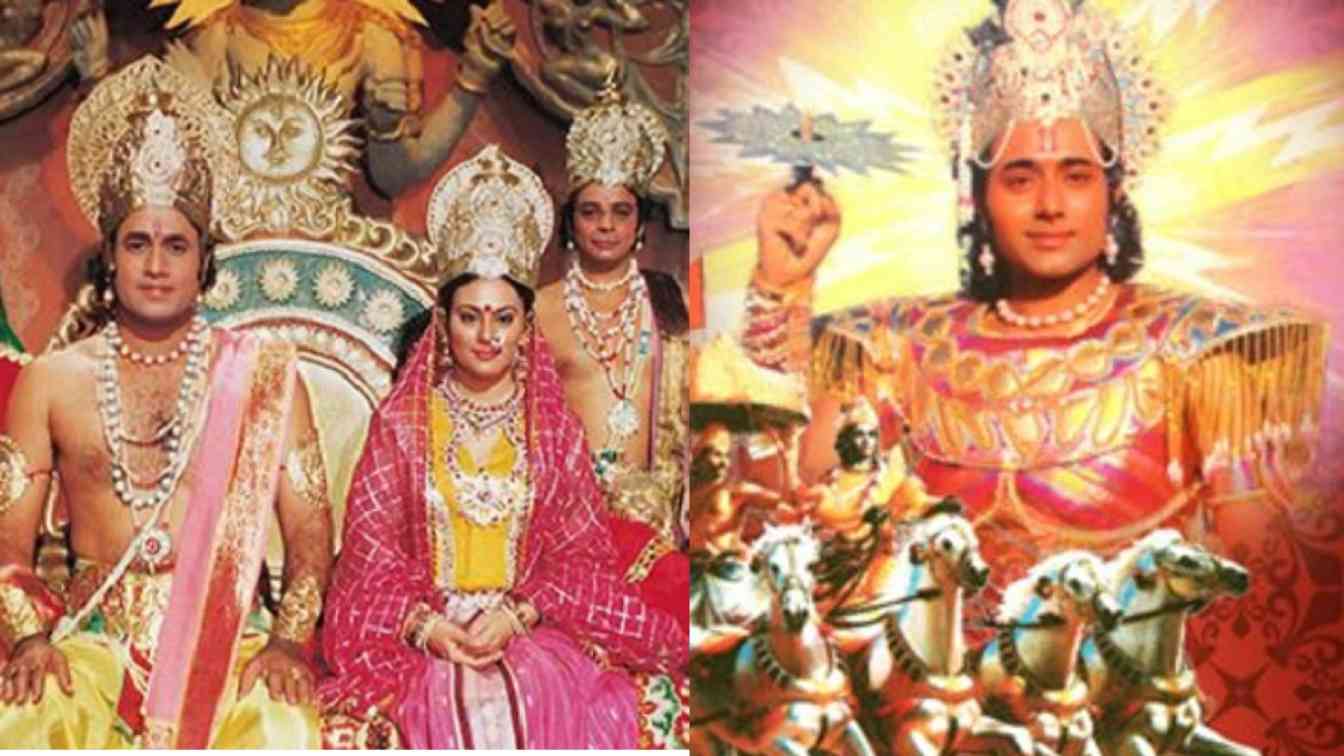
In Ramayana, one of the most important encounters is the one between Lord Rama and Shabari, the Adivasi saint of Ramayana. Similarly, Lord Hanuman is also depicted as the greatest “Bhakta” or devotee.
In fact, Lord Rama reveals his 9-form discourse on devotion to Shabari, which includes the 9 pathways of devotion. In popular culture too, Ramayana is largely associated with “Bhakti” or “Devotion”. Therefore, it would not be wrong to say that Bhakti Yoga has been stressed upon in the Ramayana.
On the other hand, in Mahabharata, Lord Krishna himself emphasizes upon “Karma Yoga” stating that “one should do his duty and one’s karma alone can drive them to Mukti or Moksha.” Lord Krishna strongly states that “One should be devoted towards their duty without worrying too much about the rewards.”
Other iconic characters in the Mahabharata like Pitamaha Bhisma and Karna are also seen stressing upon their “duty” as their “Dharma”.
Perhaps it was the situational difference or the need of time, Ramayana and Mahabharata both provide pathways to Mukti or Liberation with one stressing more on Bhakti, while the other on Karma Yoga.
This however does not mean that Ramayana does not incorporate Karma Yoga or Shree Krishna in Mahabharata does not say “one should be devoted”, it is simply that a large number of characters in Mahabharata are inclined towards “Karma Yoga”, while in Ramayana most characters are seen focusing upon Devotion.
3. Women and their Roles

While different versions of Ramayana portray Seeta Mata in different forms, there is a common consensus that Mata Seeta underwent an “Agni Pariksha” to prove her purity.
In Mahabharata, Chitrangana is depicted challenging this. It is said that she chose not to furnish evidence when Arjun questioned her whom she had gone to meet the night of their marriage.
Chitrangana is depicted stating that “If she does so, women in every age will have to furnish evidence of their purity to their husbands.”
While the standard version of Ramayana mentions little about Mata Seeta as a warrior, Mahabharata clearly mentions that Chitrangana, the Princess of Manipur, was well versed in warfare skills and arts.
Another way to look into this would be from Draupadi and Mata Seeta’s point of view. Through this lens, it can be inferred that while the societal values of morality including respect for women had seen a moral decay by the time of Mahabharata, women had stood up to question and challenge with some like Chitrangana and the Karna’s wife choosing to break down the societal limitations.
Ramayana and Mahabharata both are great epics with wonderful lessons, powerful characters and amazing stories. They are special and different in their own manner and portray the values and societal scenarios during their respective Yugas.
Appreciate the creator