Inventory and Asset Management Challenges in Higher Education
In the high-stakes environment of modern higher education, institutional success is often measured by research breakthroughs and student outcomes. However, beneath the surface of these achievements lies a massive, complex web of physical resources. From specialized mass spectrometers in research labs to the fleet of laptops powering a hybrid business school, universities are responsible for thousands of high-value assets.
As institutions scale, managing these resources becomes more than a clerical task—it becomes a strategic necessity. Yet, many universities are still plagued by decentralized systems that create "blind spots" in their operations.
The decentralized dilemma: Why campus tracking fails
The very nature of a university—diverse departments, autonomous research centers, and a mobile population—creates a perfect storm for logistical chaos. When departments operate as silos, several critical challenges emerge:
The "Shadow" Procurement Cycle: Without a central view, Department A may purchase expensive equipment that Department B already has sitting idle in storage.
Asset Drift: High-value equipment frequently moves between classrooms, labs, and faculty homes, often without a digital paper trail.
Reporting Lag: Manual or spreadsheet-based tracking means that by the time an inventory report reaches leadership, the data is already weeks out of date.
Compliance Risks: For grant-funded research, the inability to prove the location and usage of an asset can jeopardize future funding and lead to grueling audit cycles.
Transforming Operations with Integrated ERP Systems
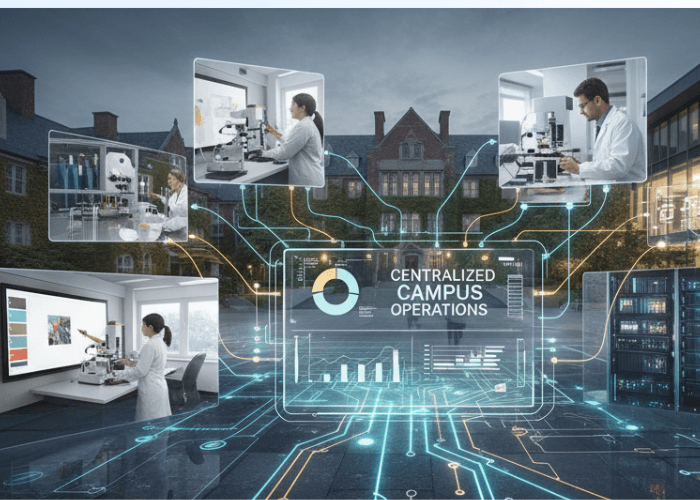
To plug these financial leaks, forward-thinking institutions are moving away from fragmented tools in favor of Enterprise Resource Planning (ERP) systems. By centralizing inventory and asset management, an ERP acts as the "nervous system" for campus operations.
1. Real-Time Transparency
An ERP provides a single source of truth. When procurement is linked directly to inventory, the system can automatically flag if a requested item is already available elsewhere on campus, instantly reducing unnecessary capital expenditure.
2. Serialized Asset Lifecycles
For high-value assets, "tracking" isn't enough; you need a biography. ERP systems maintain a serialized history of every microscope, server, and vehicle—documenting purchase records, warranty status, maintenance history, and department transfers.
3. Automated Accountability
By assigning assets to specific "cost centers" or individuals, institutions create a culture of responsibility. Automated alerts can notify department heads when equipment is due for calibration or when inventory levels of consumables (like lab reagents) hit critical lows.
Strategic Wins for Institutional Leadership
The shift to an integrated system like Kechie ERP isn't just an IT upgrade; it’s a financial strategy. Operations and procurement leaders who leverage ERP data can expect several key outcomes:
Budget Optimization: Data-driven insights into usage patterns allow for leaner, more accurate budget planning.
Audit Readiness: Instead of weeks of manual document gathering, reports for grant providers or tax authorities can be generated in clicks.
Extended Asset ROI: Better maintenance tracking ensures that expensive equipment lasts longer and performs more reliably.
Conclusion: Moving Toward the "Smart" Campus
As universities face increasing pressure to do more with less, the ability to account for every asset—from the smallest lab supply to the largest infrastructure project—is a competitive advantage. By integrating inventory into the broader institutional ERP, universities can stop "managing chaos" and start driving operational excellence.
Appreciate the creator