Importance of Medical Documentation for Legal Protection
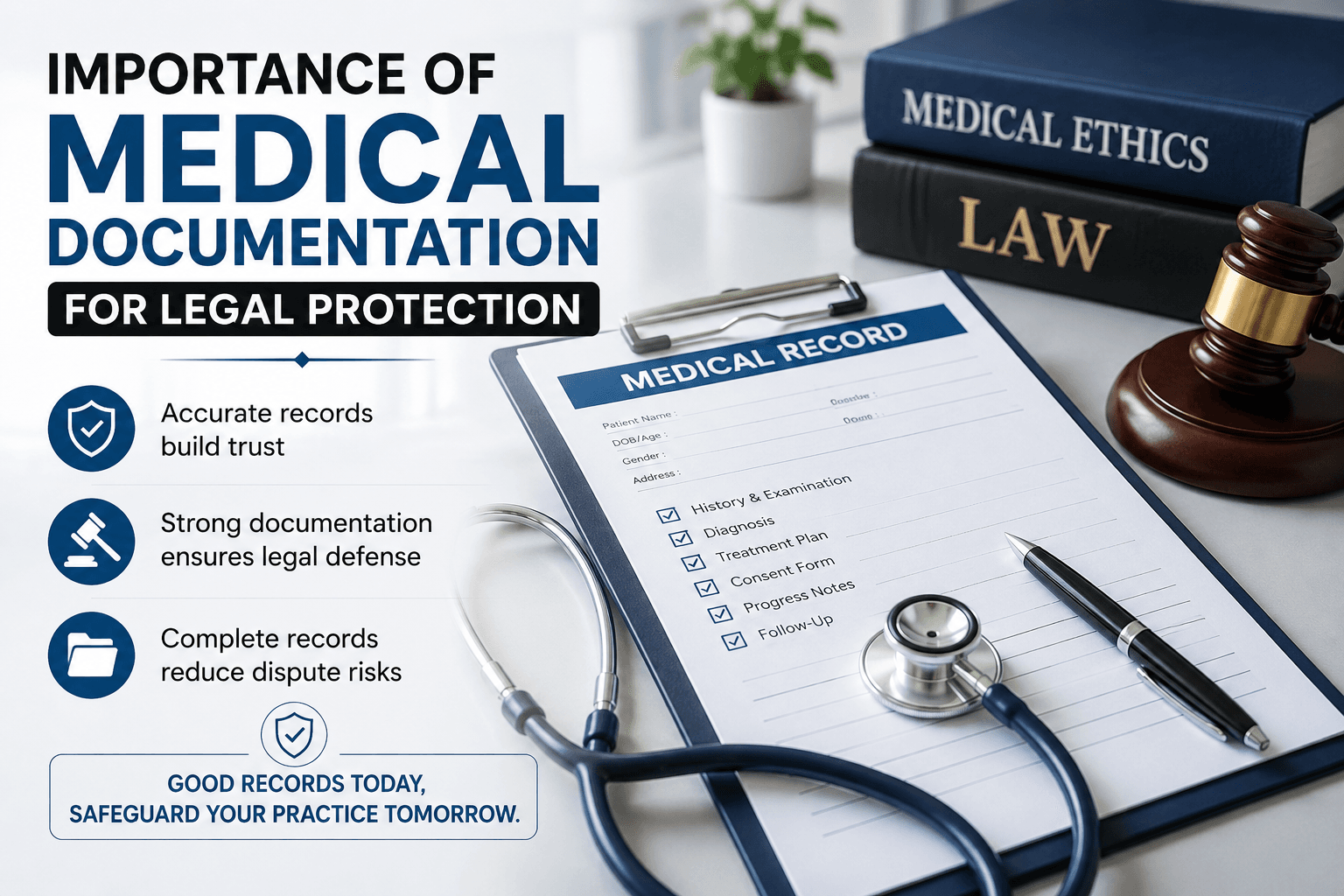
When a treatment outcome is questioned, the first thing anyone reviews is not the doctor's memory of events but the written record left behind. This is the foundation of any serious legal guide for doctors in Delhi: documentation is not a bureaucratic formality, it is the primary evidence that determines whether a doctor's decisions can be defended. Doctors who assume good clinical judgment speaks for itself often discover, too late, that reviewers cannot evaluate reasoning that was never written down. A structured medico legal guide for hospitals in Delhi reinforces the same point at an institutional level, showing that consistent, accurate records protect not just individual practitioners but entire healthcare systems.
Legal Guide for Doctors in Delhi: Why Documentation Is Your First Line of Defence
What Medical Documentation Actually Covers
Medical documentation includes far more than diagnosis notes. It covers consent forms, treatment plans, medication records, discharge instructions, and any communication about risks or alternatives discussed with the patient. Any thorough legal guide for doctors in Delhi treats each of these elements as equally important, since a gap in any single area can weaken an otherwise strong clinical case.
Why Documentation Matters More Than Doctors Realise
Many doctors underestimate how much weight documentation carries until they face an actual dispute. At that point, memory alone is rarely enough; investigators, medical boards, and courts rely almost entirely on written records to reconstruct what happened. Good documentation essentially preserves the doctor's side of the story in a form that can be reviewed months or years later, long after the specific details of a busy day have faded from anyone's memory.
How Poor Documentation Creates Legal Exposure
Consent Forms and Communication Gaps
Consent forms and patient safety are closely linked, and vague or incomplete consent documentation is one of the most common sources of legal exposure. If a patient later claims they were not properly informed about risks, a poorly documented consent conversation offers little protection, even if the discussion actually happened. What was actually said in the room matters far less, legally, than what was captured on paper afterward.
Documentation Errors and Missing Records
Documentation errors, including missing timestamps, inconsistent entries, or lost files, directly undermine a doctor's ability to prove that appropriate care was delivered. Even minor inconsistencies can raise doubts during a legal review, making the overall case appear weaker than the actual clinical care warranted. Reviewers often assume that if something important happened, it would have been written down, so silence in the record is rarely read as a neutral gap.
How Strong Documentation Protects Doctors Legally
Establishing Standard of Care
Clear, detailed documentation helps demonstrate that a doctor's decisions matched the accepted standard of care for a given situation. Recording the reasoning behind each clinical choice, not just the choice itself, gives reviewers a complete picture of why a particular treatment path was selected, rather than leaving them to guess at intent from the outcome alone.
Supporting a Doctor's Defence During Disputes
When a complaint does arise, well-maintained medical records allow a doctor to respond with specifics rather than generalities. This significantly strengthens legal defence strategy, since precise, contemporaneous notes are far more persuasive than reconstructed explanations offered after the fact, a point emphasised consistently in any current legal guide for doctors in Delhi.
Medico Legal Guide in East Delhi: Regional Lessons in Documentation Practice
Patient Load and Documentation Pressures
A focused medico legal guide in east Delhi highlights how high patient volumes in certain hospitals can create pressure to rush documentation, particularly during peak hours. These pressures are not unique to one part of the city, but the region's specific patient demographics make the pattern especially visible.
Practices That Reduce Regional Risk
Institutions following a practical medico legal guide in east Delhi often introduce brief, structured templates that allow accurate documentation even during high-pressure periods. This approach shows that reducing documentation time does not have to mean reducing documentation quality, provided the format itself is well designed.
Building Better Documentation Habits
Real-Time Recording and Accuracy
Recording clinical notes as close to the actual event as possible reduces the risk of missing or inaccurate details. Real-time documentation, even when brief, tends to carry far more credibility than detailed notes written well after the fact from memory.
Training Staff on Consistent Standards
Training programs that establish clear expectations for what must be documented, and how, help reduce variation across an entire team. When documentation quality does not depend solely on individual habits, hospitals see more consistent protection across every department and shift, even as staff rotate or new team members join over time.
Medico Legal Guide for Hospitals in Delhi: Systemic Approaches to Protection
Standardising Hospital Documentation Systems
A comprehensive medico legal guide for hospitals in Delhi typically recommends standardised templates for consent forms, treatment notes, and discharge summaries across all departments. Consistency at this level makes documentation easier to review internally and far more defensible during any external legal scrutiny.
When to Seek Expert Legal Review
Hospitals and doctors benefit from periodic expert legal review of their documentation systems, rather than waiting until a dispute exposes existing weaknesses. Regular reviews, guided by a sound medico legal guide for hospitals in Delhi, help identify gaps early and correct them before they affect a real case.
Medical documentation is often treated as a routine administrative task, but its role in legal protection is anything but minor. Following a dependable legal guide for doctors in Delhi, and building documentation habits that hold up under scrutiny, gives practitioners their strongest defence when disputes arise. Dr. Vimal Kant Goyal reminds every healthcare professional that thorough, accurate records are not just good practice; they are the clearest form of legal protection a doctor can build for themselves.
Appreciate the creator