Implementing Version Control for Big Data Projects
The importance of a version control system in the big data projects
0. Introduction
A version is a particular form of something that differs in certain respects from an earlier form or other forms of the same kind. In the dev world, on the other hand, it refers to versions related to resources such as software or data. If there is a change in a resource’s structure, content, or state, one may consider creating a new version.
Manipulating datasets, correcting errors, and bugs, or inserting extra data may require creating a new version. It is also a practical method of tracking interrelated changes in dynamic data.
1. What Are Version Control and Data Versioning?
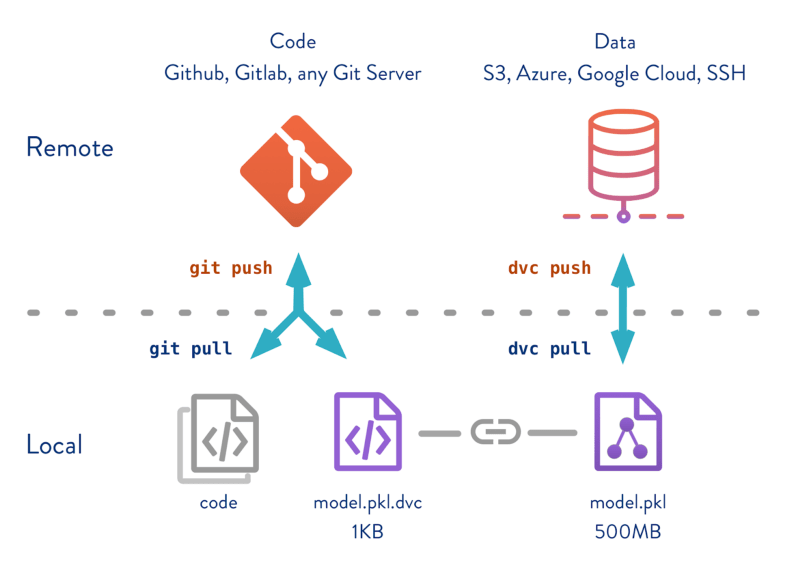
Version control is a mechanism that allows you to follow and monitor every stage of a project. It enables teams to check modifications on the source code and ensure that changes are not overlooked in the code.
Data versioning is the process of storing corresponding versions of data that were created or modified at different time intervals.
There are many valid reasons for making changes to a dataset. Data specialists can test the machine learning (ML) models to increase the project's success rate. For this, they need to make essential manipulations on the data. Datasets may also update over time due to the continuous inflow of data from different resources. In the end, keeping older versions of data can help organizations replicate a previous environment.
2. Why Is Data Versioning Important?
Usually, in the software development lifecycle, the development process is spread over a large period, and tracking changes in the project can be difficult. Therefore, versioning software projects makes this process easy and saves teams from having to regularly name every version of the script.
Additionally, with the help of data versioning, historical datasets are saved and kept in the databases. This aspect provides some advantages as follows.
3. Benefits of Data Versioning
Keeping the Best Model while Training
The main objective of data science projects is to contribute to the business demands of the company. Therefore, data scientists need to develop many ML models as per customer or product requests. This situation requires inserting new datasets into the ML pipeline for every attempted modeling. However, data specialists need to be careful not to lose the dataset that gives them the best score in modeling. This is achieved with the help of a data versioning system.
Providing A New Business Metric in Growth
In today’s digital world, it is a fact that companies that make decisions and develop strategies using data will survive. Therefore, it is important not to lose historical data.
Consider an e-commerce company that serves daily necessities. Every transaction in the application changes the sales data. People’s needs and demands may change over time. Therefore, keeping all the sales data can be beneficial for gaining insights into new trends in customer demands and determining the right strategies and campaigns.
In the end, it gives companies a new business metric to measure their success or performance.
Protection Regarding Data Privacy Issues
As digital transformation is accelerating in today’s world, the amount of data produced is increasing rapidly. However, this situation has brought with it concerns about protecting personal data. Consequent data protection regulations set by governments force companies to store a certain amount of data.
Data versioning can help in such situations by ensuring that data is stored at specific times. It can also assist organizations in meeting the requirements of such regulations.
4. Conclusion
Today’s world generates more and more data. Therefore, data-driven companies must store data correctly and safely. Enterprises need to make sure that they utilize the right data versioning platforms/tools to aid their business growth.
Appreciate the creator